Sheet Music Symbols Explained: Dynamics, Articulation, Repeats and More
Wondering what all the little marks on a page of music mean? In this guide, we explain the sheet music symbols you are most likely to meet, from dynamics and articulation to repeats, codas, ornaments and tempo words, with a clear picture for each group.

Have you ever been able to read every note on a page, and still felt unsure about all the other marks around them? Letters under the staff, dots and lines above the notes, curved lines, strange Italian words, and signs that seem to send you back to the start of the piece. It can feel like a second language on top of the first one.
The good news is that these sheet music symbols fall into a handful of families, and each family answers one simple question. Dynamics tell you how loud. Articulation tells you how each note starts and ends. Repeat signs and road map words tell you where to go next. Ornaments tell you how to decorate a note, and tempo words tell you how fast. None of them change which notes you play. They change how the music sounds.
In this guide, we explain each family in turn, with a picture for every group and a description of what each mark sounds like. If you are new to the staff, clefs and note names themselves, start with our guide on how to read sheet music, then come back here. If you can name the notes but it is slow going, our guide to using a note reader app shows you how to find out what notes are on your sheet music, and how to name them faster yourself.
Dynamics: how loud to play
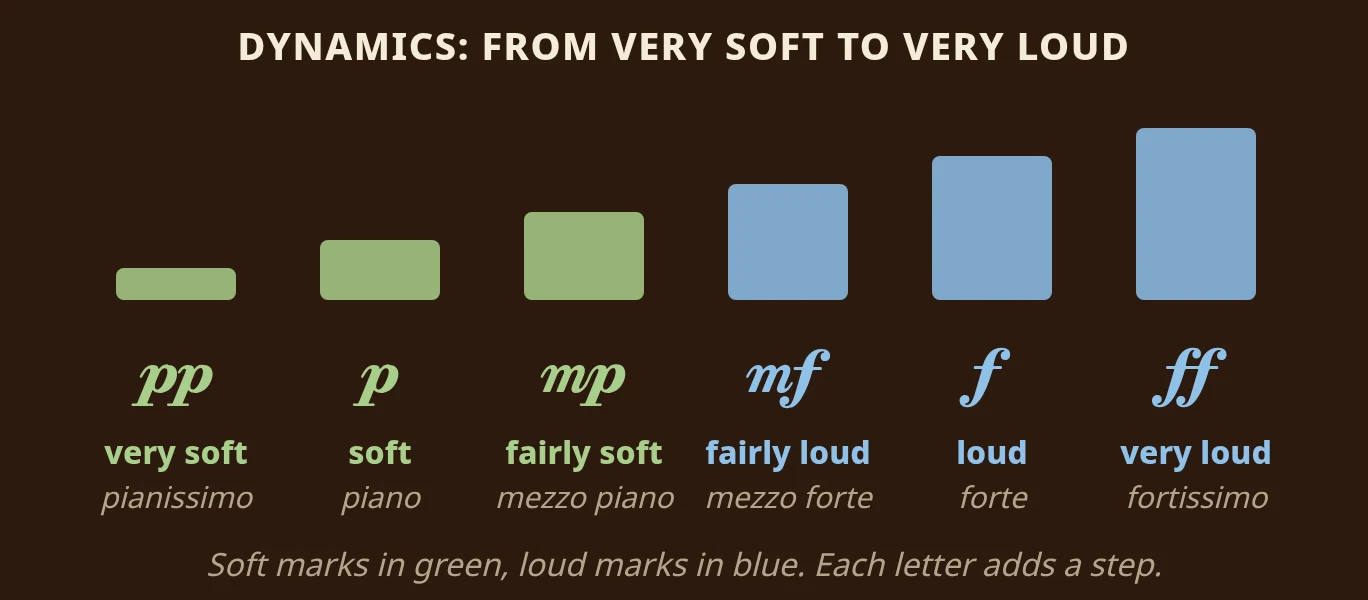
Dynamics are the italic letters written under the staff. They are short for Italian words, and they set the volume until the next dynamic mark appears.
What do p and f mean?
The two basic letters are p for piano, which means soft, and f for forte, which means loud. Doubling the letter goes further: pp (pianissimo) is very soft and ff (fortissimo) is very loud. You may even see ppp or fff, each extra letter one more step.
In between sit mp (mezzo piano, fairly soft) and mf (mezzo forte, fairly loud). From soft to loud, the order is pp, p, mp, mf, f, ff. When nothing is marked, most players use something close to mf.
Dynamics are relative, not exact. A forte in a lullaby is quieter than a forte in a march. Soft does not mean weak or thin, either: play with the same good tone, just gentler and with less attack. Loud means full and firm, never forced.
What do the long wedges mean?
The long wedge shapes under the staff are called hairpins. A wedge that opens to the right is a crescendo: get gradually louder. A wedge that closes to the right is a diminuendo (also called a decrescendo): get gradually softer. You will also see the words cresc. and dim., sometimes followed by a dotted line showing how far the change lasts.
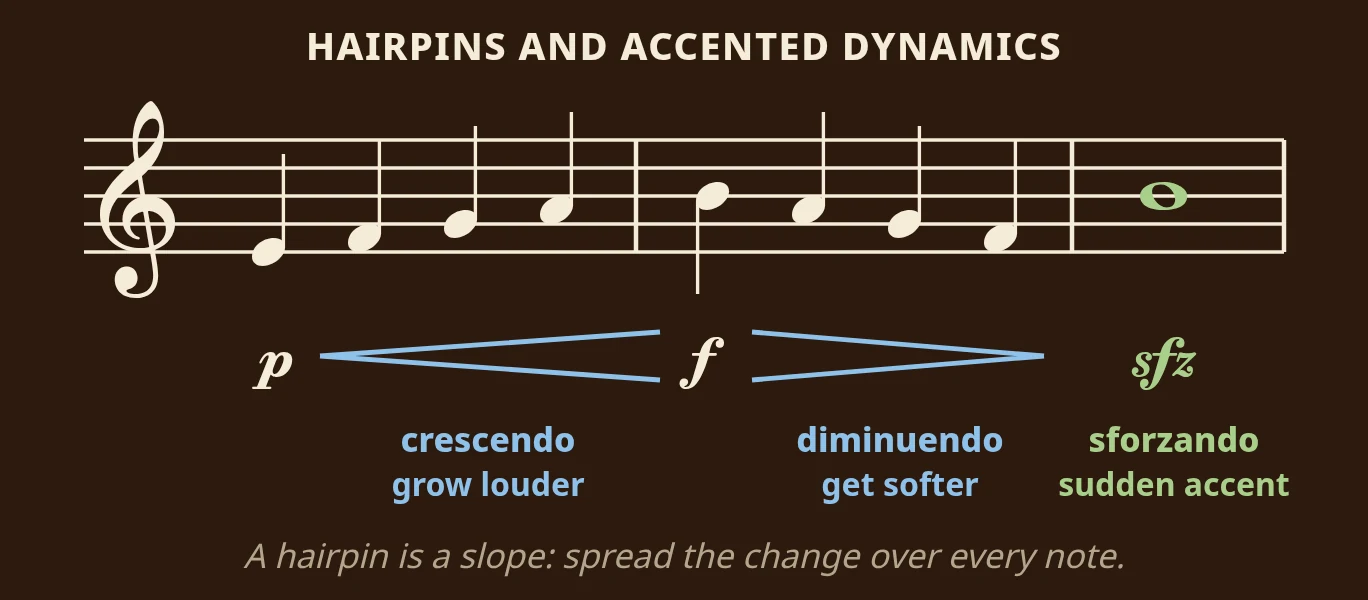
The most common mistake is treating a hairpin like a step. Players jump straight to loud on the first note of a crescendo. The end of the hairpin is the destination: the first note under it should be only a tiny bit louder than the one before, with the change spread across every note.
What do sfz and fp mean?
sfz (sforzando) is a sudden, strong accent on one note, after which the music goes straight back to the volume it had before. fp (forte-piano) means start the note loud and immediately drop to soft while it is still sounding.
Articulation: how each note is played
Articulation marks sit just above or below a note head. They change how the note starts, how long it lasts and how much weight it has, but never its pitch.
What does a dot above a note mean?
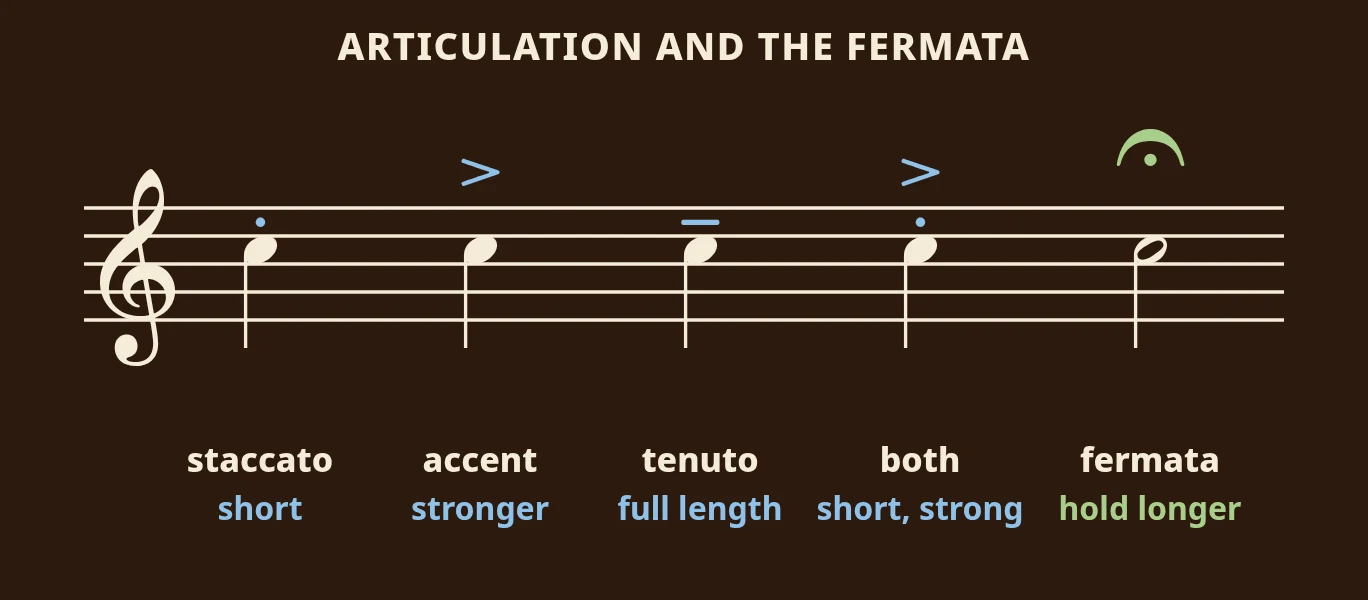
A small dot above or below the note head is a staccato. Play the note short and detached, roughly half its written length. The little gap before the next note matters more than the exact length. It sounds crisp, separated and bouncy.
Be careful not to confuse it with a dot after the note head, which does the opposite: it makes the note longer by half. Our guide to dotted notes and ties explains that one.
What does the sideways V mean?
A sideways wedge (>) is an accent. Play that note with more weight or a stronger attack than the notes around it, but for its full written length. A note can carry an accent and a staccato at the same time: short and strong.
What does a short line over a note mean?
A short horizontal line is a tenuto. Hold the note for its full written value, with a slight pressing weight, instead of letting it shorten the way unmarked notes naturally do.
What does the bird's eye mean?
An arc with a dot under it is a fermata, also called a pause or a bird's eye. Hold that note, chord or rest longer than written, for as long as the player or conductor judges. Often that is about half as long again, or twice as long. On the last note of a piece, let it ring.
What does a curved line over notes mean?
A curved line over two or more notes of different pitches is a slur: play them smoothly joined, in one breath, one bow or one movement of the hand, with no gap between them. A curved line joining two notes of the same pitch is a tie, and the second note is not played again.
Repeat signs and endings: play it again
Repeat signs save space on the page. Instead of printing the same music twice, the composer prints it once and tells you to go back.
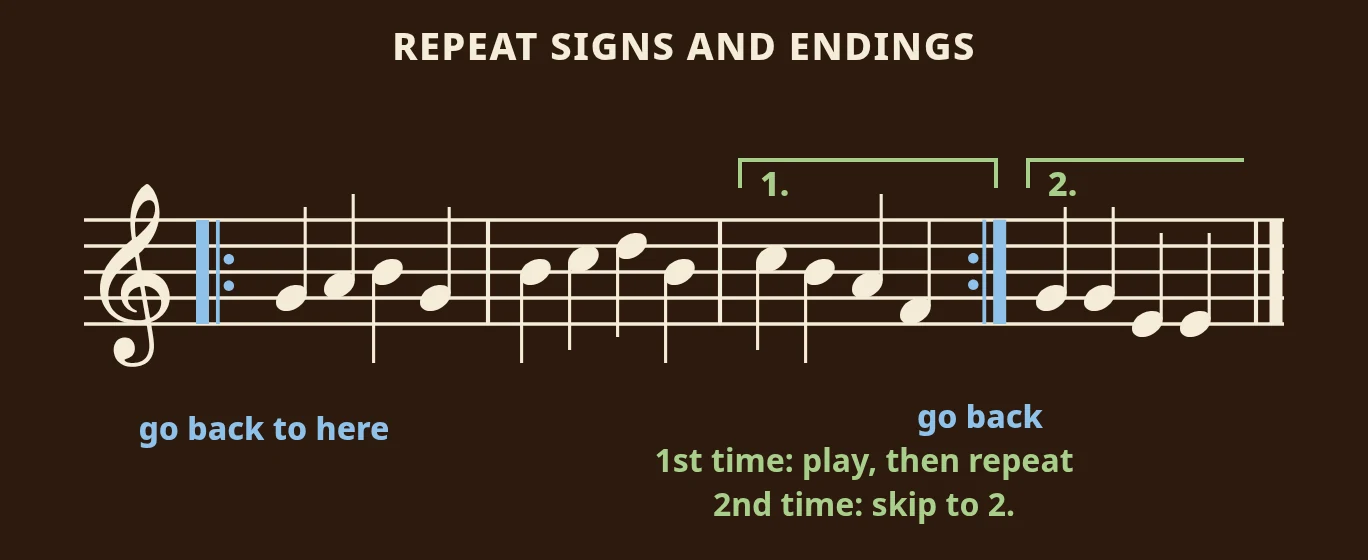
What do the double bar lines with dots mean?
A repeat sign is a thick and a thin bar line with two dots. Dots on the left of the double bar mean "go back". Dots on the right mark the place you go back to. Play the section between them twice, then carry on. If there is no matching start sign, go back to the very beginning of the piece. A repeat is played once more, not over and over, unless the music says otherwise.
What do the brackets marked 1. and 2. mean?
These are first and second endings. The first time through, play the bars under bracket 1 and take the repeat. The second time, skip bracket 1 completely and jump to bracket 2, then carry on. It sounds like the same phrase twice, with a different ending.
What do the percent sign and simile mean?
A slash with two dots inside a bar, a bit like a percent sign, is a bar repeat: play the previous bar again. The word simile (or sim.) after a marked pattern means keep playing in the same way, even though the marks are no longer printed.
D.C., D.S. and Coda: the road map of a piece
Some pieces send you back to an earlier point and then tell you where to stop or where to jump. These instructions are Italian words and two special signs.
- D.C. (da capo) means "from the head": go back to the very beginning.
- D.S. (dal segno) means "from the sign": go back to the segno, a stylized S with a slash and two dots.
- Fine means "the end": stop here when you come back around.
- Coda means "tail": a closing section, marked with a circle and a cross.
Put together, they make four common instructions:
- D.C. al Fine: go back to the beginning and play until the word Fine, then stop.
- D.C. al Coda: go back to the beginning, play until the "To Coda" mark, then jump to the Coda and play it to the end.
- D.S. al Fine: go back to the segno and play until Fine.
- D.S. al Coda: go back to the segno, play until "To Coda", then jump to the Coda. This is the most common one in songs and band music.
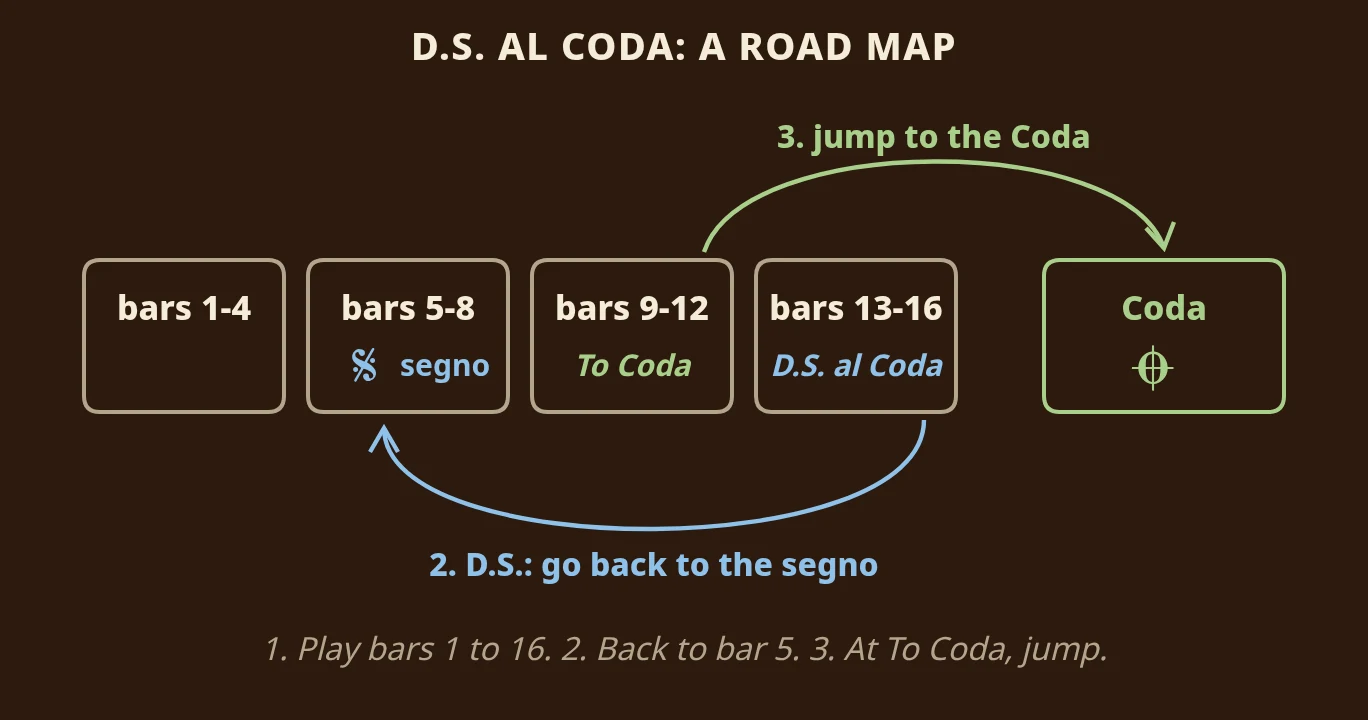
Here is how one page can play out. Picture a 16-bar song with a segno over bar 5, "To Coda" over bar 12 and "D.S. al Coda" at the end of bar 16, followed by a four-bar Coda. You play bars 1 to 16. The D.S. sends you back to the segno at bar 5. You play bars 5 to 12, see "To Coda", and jump to the Coda. That is 16 + 8 + 4 = 28 bars of music from a 20-bar page.
When you come back with a D.C. or D.S., repeat signs inside that section are normally not taken again. And you only ever arrive at a Coda by jumping to it from "To Coda". If you find yourself playing into the Coda in order, you have missed a D.S. or D.C. somewhere.
8va and 8vb: play an octave higher or lower
When a passage goes very high or very low, writing it with lots of ledger lines makes it hard to read. Instead, composers use an octave sign.
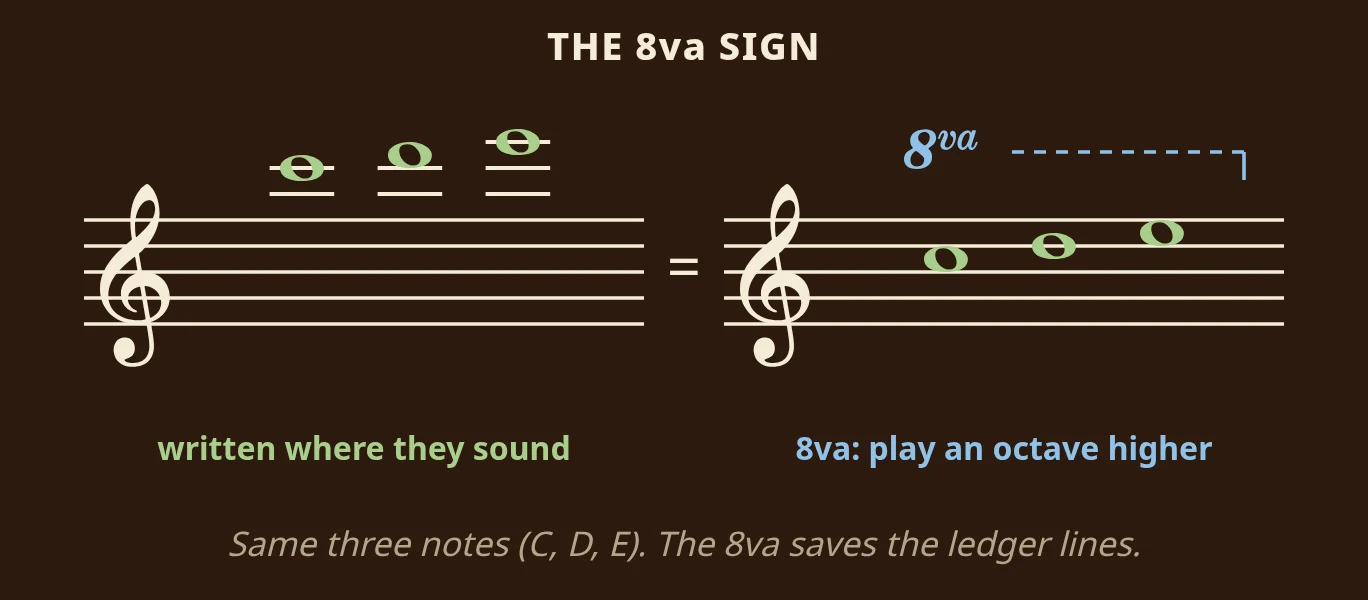
8va (ottava) above the staff, with a dotted line, means play everything under the line an octave higher than written. 8vb (ottava bassa) below the staff means play an octave lower. When the dotted line ends, or you see the word loco, go back to normal. A small 15ma means two octaves higher.
You may also see a small 8 attached to the bottom of a treble clef, common in guitar and tenor voice parts. It means the whole part sounds an octave lower than written. If you play guitar, our guide on how to read guitar sheet music shows where each of your strings sits on that staff. For more on reading notes outside the staff, see our guide to reading ledger lines.
Ornaments: decorating a note
Ornaments are shorthand for decorating one note with quick neighboring notes. The exact speed and number of notes is left to the player and the style of the music.
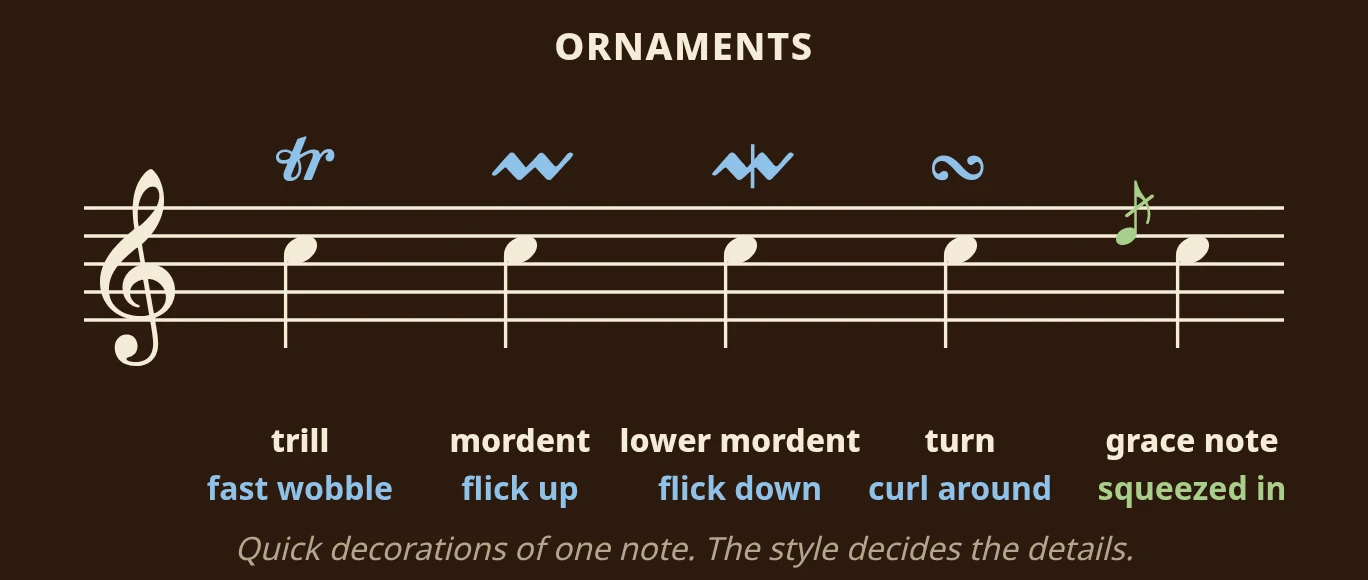
- Trill (tr, often with a wavy line): alternate quickly between the written note and the note above it, for the full length of the note. It sounds like a shimmer.
- Mordent (a short zigzag): play the written note, the note above, and the written note again, quickly, then hold. It sounds like a quick flick.
- Lower mordent (the zigzag with a line through it): the written note, the note below, and the written note again.
- Turn (a sideways S): play the note above, the written note, the note below, and the written note, as a quick little curl.
- Grace note (a tiny note with a slash through its stem): play it as quickly as possible, squeezed in just before the main note. A tiny note without the slash is an appoggiatura, which is played on the beat and takes part of the main note's length.
Tempo words: how fast to play
Tempo words sit above the first bar and tell you how fast the beat goes. A metronome mark next to them, such as a quarter note = 90, gives the exact number of beats per minute. Each word describes a character as much as a speed.
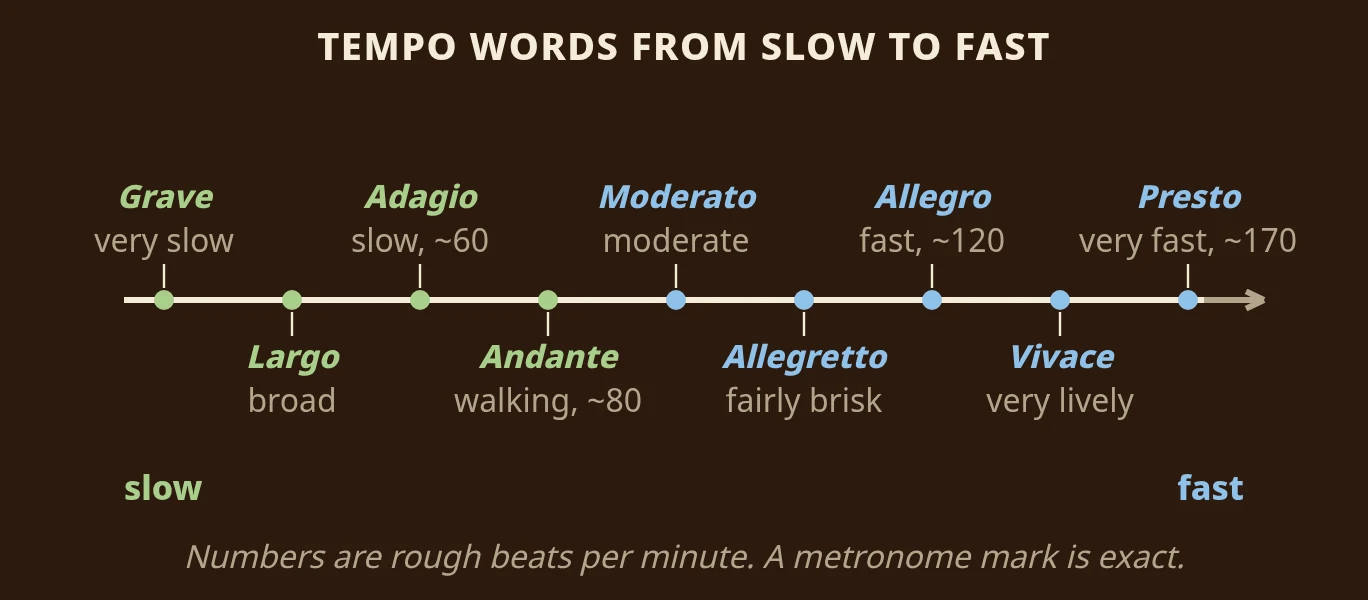
From slow to fast: Grave (very slow and solemn), Largo (broad and slow), Adagio (slow and at ease), Andante (a walking pace), Moderato (moderate), Allegretto (fairly brisk), Allegro (fast and lively), Vivace (very lively) and Presto (very fast). As a rough map, Adagio is near 60 beats per minute, Andante near 80, Allegro near 120 and Presto near 170.
What do rit. and a tempo mean?
rit. (ritardando) and rall. (rallentando) both mean gradually slower. accel. (accelerando) means gradually faster. a tempo means go back to the original speed. Più mosso means with more movement (faster), and meno mosso means with less (slower). Rubato means you may stretch and push the beat a little for expression.
Common mistakes with music symbols
- Reading the notes and skipping the markings. This is the most common one. Every note is right, but with no dynamics it sounds like a typing exercise. Read the markings on their own, out loud, before you play.
- Playing into the Coda. The Coda is only reached by a jump. If you arrive there without jumping, you missed a D.S. or D.C.
- Mixing up the two dots. A dot after the note head makes it longer. A dot above or below makes it shorter.
- Treating a hairpin as a step. Spread the change across the whole hairpin.
A two-minute daily drill
- Read the markings only. Without playing, read out loud every symbol on one page that is not a note, in order: "mp, slur, staccato, crescendo, f, repeat" (1 minute). Look up any you cannot name.
- Trace the route. Follow the piece with your finger through every repeat, D.S., D.C. and jump to the Coda, saying the bar numbers out loud (40 seconds).
- Play the dynamics on one note. Play the page's dynamics on a single note: mp, swell to f, drop to p, whatever is written (20 seconds).
Practice with a way to check yourself
Knowing what a symbol means is the first step. Hearing what it does to the music is what makes it stick. A crescendo, a fermata or a jump to the Coda is much easier to understand once you have heard it.
Sheetly can help with that. Take a photo of a printed page with your iPhone or iPad, and Sheetly plays it back with a playhead that follows the notes. Play the bar with the marking at half speed, loop it, and try the staccato, the crescendo or the ornament against what you hear. If a symbol puzzles you, ask the built-in coach what the sign in bar 12 means, or where the D.S. sends you. Our guide to the music symbols Sheetly reads lists exactly which marks it understands. If you are wondering how a phone can read these symbols in the first place, our guide to how sheet music recognition works explains it step by step.
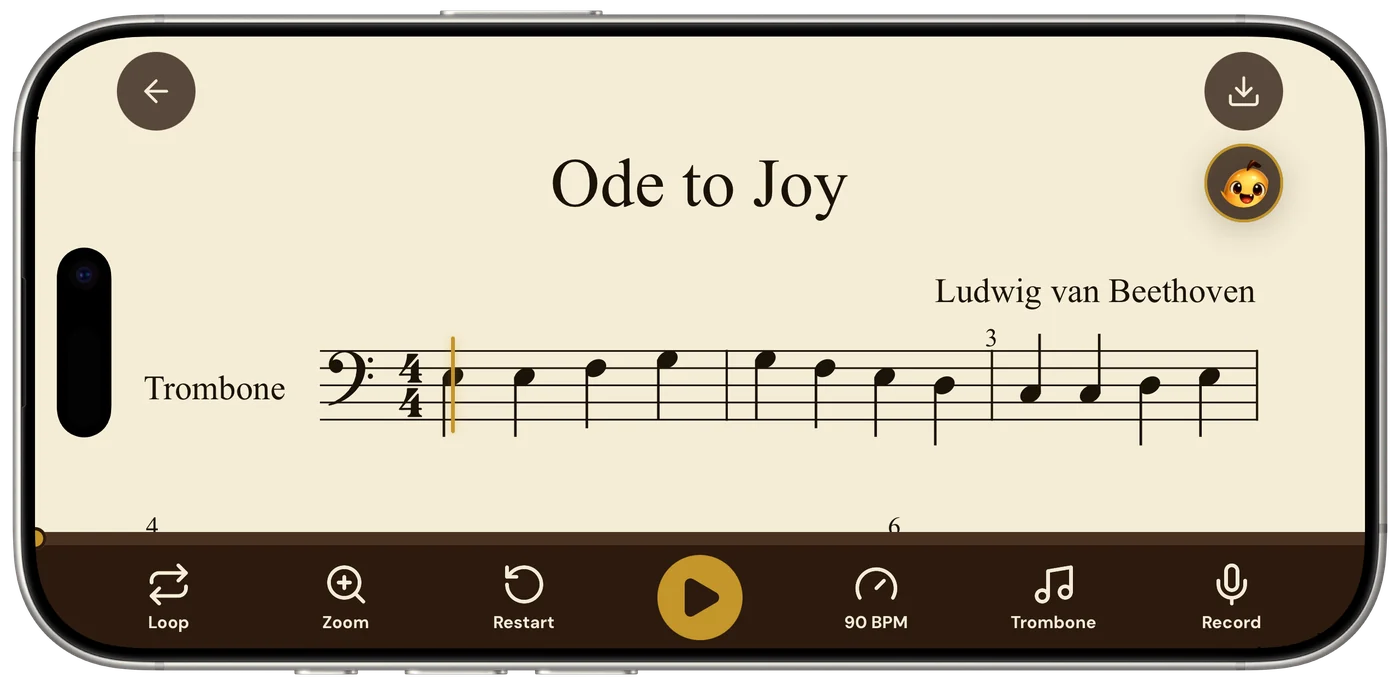
Read the markings first, play the passage, then listen and compare. Over time, the symbols stop being things you decode and become part of how you hear the page.
Questions
What is the difference between D.C. and D.S.?
D.C. (da capo) sends you back to the very beginning of the piece. D.S. (dal segno) sends you back to the segno sign, which is somewhere later than the beginning. Both are usually followed by "al Fine" or "al Coda", which tells you where to stop or jump.
How long do you hold a fermata?
There is no fixed length. Hold it longer than written, often about half as long again or twice as long, and follow the conductor if there is one. On the last note of a piece, let it ring.
Do you take repeats after a D.C. or D.S.?
Usually not. When you go back with a D.C. or D.S., the convention is to play through repeat signs without taking them again, unless the music says otherwise.
What does a double bar line mean?
Two thin lines mark the end of a section, often where the key, the time signature or the character changes. A thin line followed by a thick one marks the end of the piece, and with two dots in front of it, a repeat.