How to Read Dotted Notes and Ties in Sheet Music
Wondering how to read dotted notes and ties? In this guide, we explain exactly how long a dotted note lasts, how to count it, how a tie joins two notes, and how to tell a tie from a slur, with a clear picture for every step.

Have you ever reached a bar that just would not add up? You count the quarter notes and half notes, and somehow there is half a beat left over, or a note seems to need playing twice when it sounds better played once. Very often the answer is a tiny dot after a note head, or a little curved line between two notes.
Dots and ties do the same job in different ways: they make notes last longer than their shape alone would say. A dot adds a fixed amount to a single note. A tie glues two notes together into one longer sound. Once you know the exact rule for each, and how to count them, those awkward bars start to feel natural.
In this guide, we show you how to read dotted notes and ties step by step: what a dot adds, how double dots work, how to count dotted rhythms, how ties cross bar lines, and how to tell a tie from a slur. Each step comes with a picture, and at the end we share a short drill and a way to check that you are holding every note for the right length.
How to read dotted notes and ties
Step 1: Learn what a dot adds
A dotted note is a note with a small dot just to the right of its head. The dot adds half of the note's own length. So a dotted note always lasts one and a half times as long as the plain note.
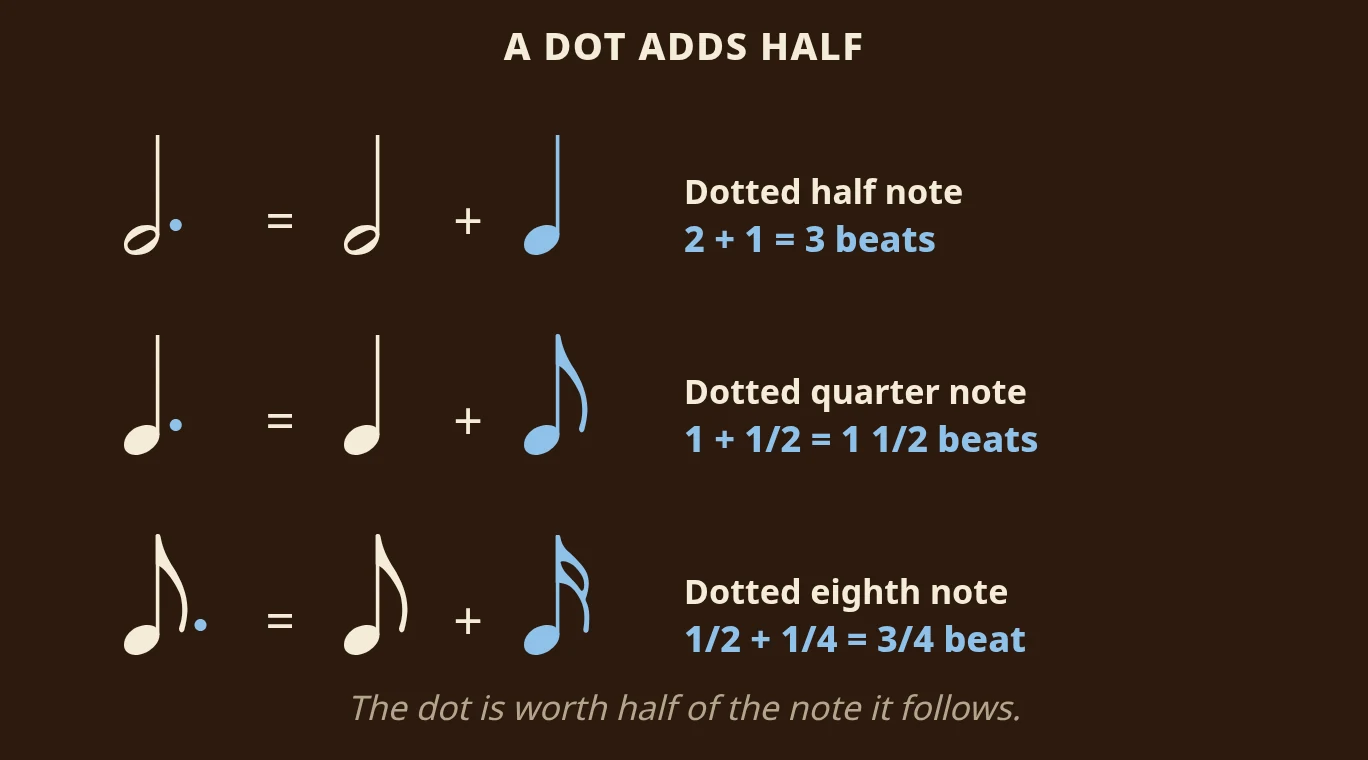
Here is how it works with the most common notes:
- A half note lasts 2 beats, so a dotted half note lasts 2 + 1 = 3 beats.
- A quarter note lasts 1 beat, so a dotted quarter note lasts 1 + 1/2 = 1 1/2 beats.
- An eighth note lasts half a beat, so a dotted eighth note lasts 1/2 + 1/4 = 3/4 of a beat.
(In British English these are the dotted minim, dotted crotchet and dotted quaver.) The rule is exact, not "a bit longer". A dotted quarter note is exactly as long as three eighth notes. Dots work on rests too: a dotted quarter rest is one and a half beats of silence.
A dot beside the note or a dot above it?
Where the dot sits changes everything. A dot to the right of the note head makes the note longer. A dot above or below the note head is a different mark called staccato, and it means play the note short and detached.
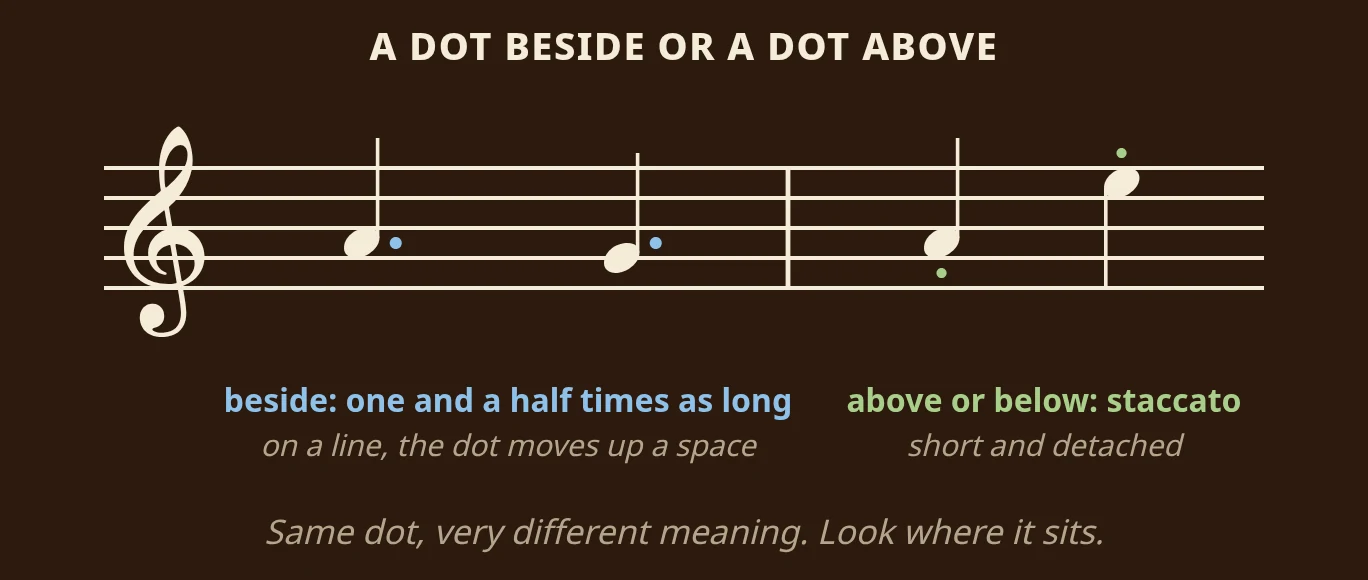
There is one small detail to know. When a note sits on a line, its length dot moves up into the space just above, so it does not get lost in the line. It still counts as a dot after the note, and it still adds half.
Step 2: Understand double dots
Sometimes you will see two dots after a note. A double dot adds half, and then half of that again. The second dot is worth half of what the first dot added.
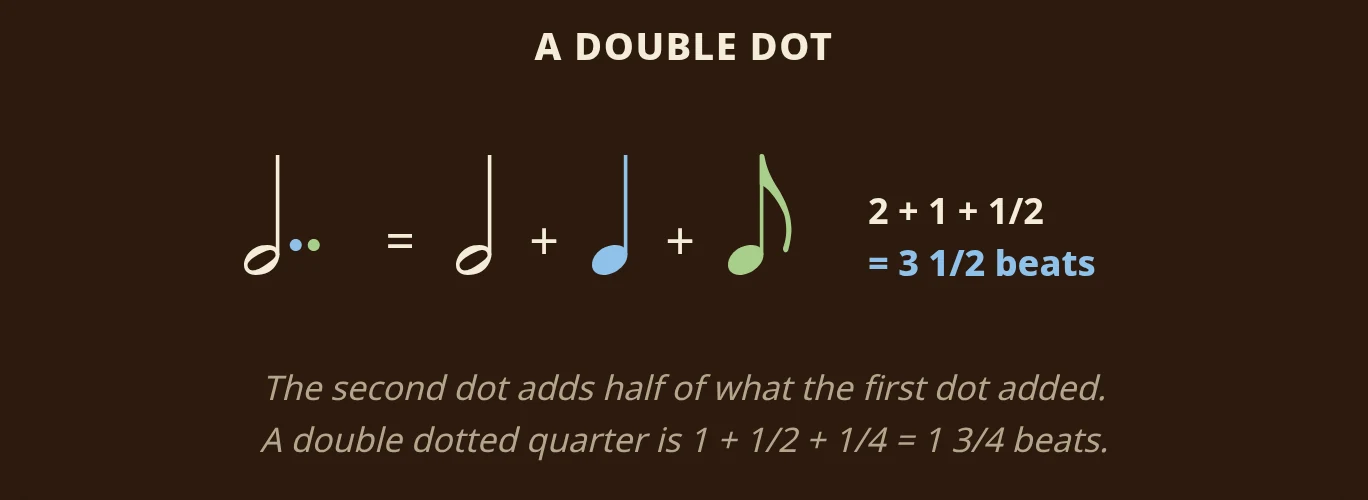
A double dotted half note lasts 2 + 1 + 1/2 = 3 1/2 beats. A double dotted quarter note lasts 1 + 1/2 + 1/4 = 1 3/4 beats, and it is almost always followed by a single sixteenth note that completes the second beat.
Double dots appear in Baroque overtures and in march-like music, where the composer wants a sharper, snappier rhythm than one dot can give. Triple dots exist too, but they are rare enough that you can ignore them until you meet one.
Step 3: Count dotted rhythms out loud
Knowing that a dotted quarter is one and a half beats is one thing. Feeling where the next note lands is another. The secret is to count in smaller pieces than the beat.
The dotted quarter and eighth
The most famous example might be the end of the first phrase of Beethoven's Ode to Joy. After four even quarter notes, the melody stretches the next note with a dot, then hurries to catch up with a quick eighth note.
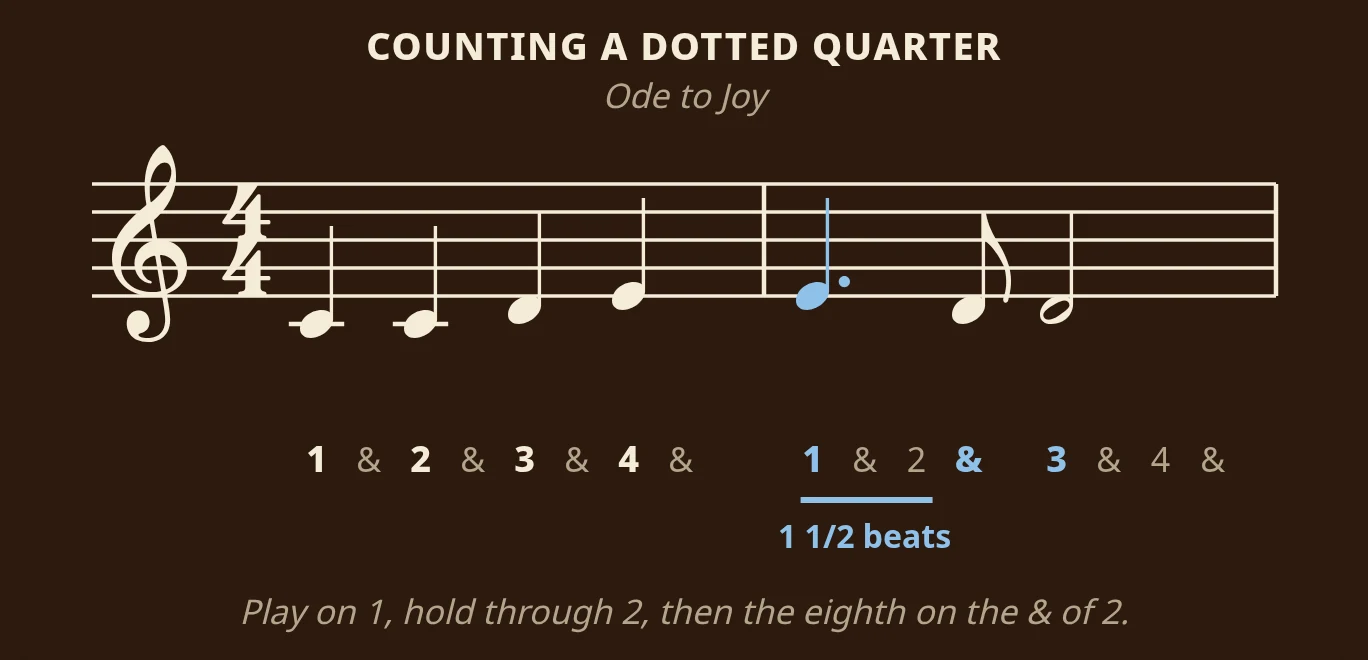
Count the bar in eighth notes: "1 and 2 and 3 and 4 and". The dotted quarter starts on 1 and keeps sounding through "and" and "2". The eighth note lands on the "and" of 2. The half note then starts on 3 and holds through 4. Add it up: 1 1/2 + 1/2 + 2 = 4 beats, so the bar is complete.
Try it now. Count "1 and 2 and 3 and 4 and" out loud at a walking pace, and clap only on 1, the "and" of 2, and 3. That long, short, long feeling is the dotted quarter rhythm.
The dotted eighth and sixteenth
Another very common dotted rhythm fits inside a single beat: a dotted eighth followed by a sixteenth. Count the beat in four, "1 e and a". The dotted eighth sounds on "1" and holds through "e" and "and". The sixteenth falls on "a" and leads straight into the next beat.
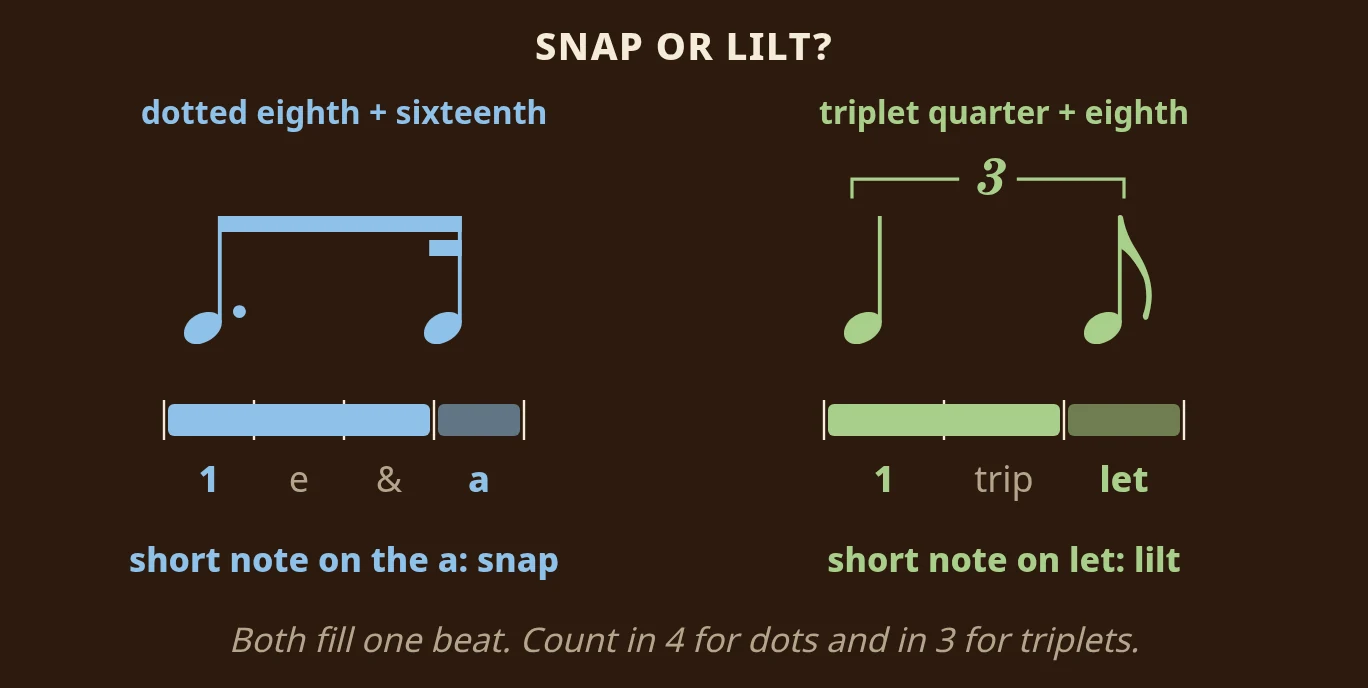
This rhythm should snap. A common mistake is to soften it into a triplet, which puts the short note two thirds of the way through the beat instead of three quarters, so it lilts instead of snapping. If yours lilts, count in four out loud and land the short note firmly on "a". Our guide to reading triplets covers the other side of that line.
Step 4: Learn what a tie does
A tie is a small curved line that joins the heads of two notes of the same pitch, side by side. You play the first note and keep holding it through the length of the second. The second note is not played again.
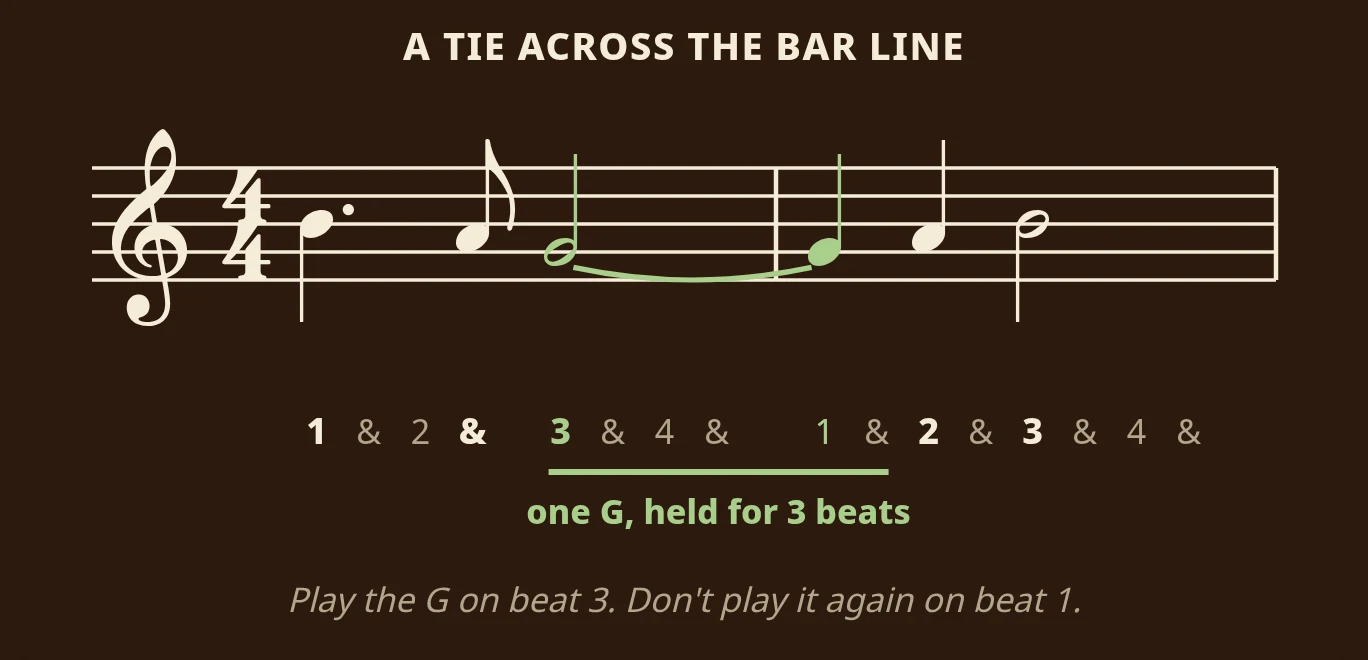
The lengths simply add up. A quarter note tied to an eighth note lasts one and a half beats. A half note tied to a quarter note lasts three beats. A whole note tied to a whole note lasts eight.
Why ties exist
There are two main reasons. First, a single note cannot cross a bar line. If a note starts on beat 3 and keeps sounding into the next bar, it has to be written as two notes joined by a tie, like the G in the picture above. You play it on beat 3, hold it through beat 4 and beat 1 of the next bar, and play nothing new until beat 2.
Second, some lengths have no single note shape. Five eighth notes, for example, is a half note tied to an eighth note.
A tie can do the same job as a dot
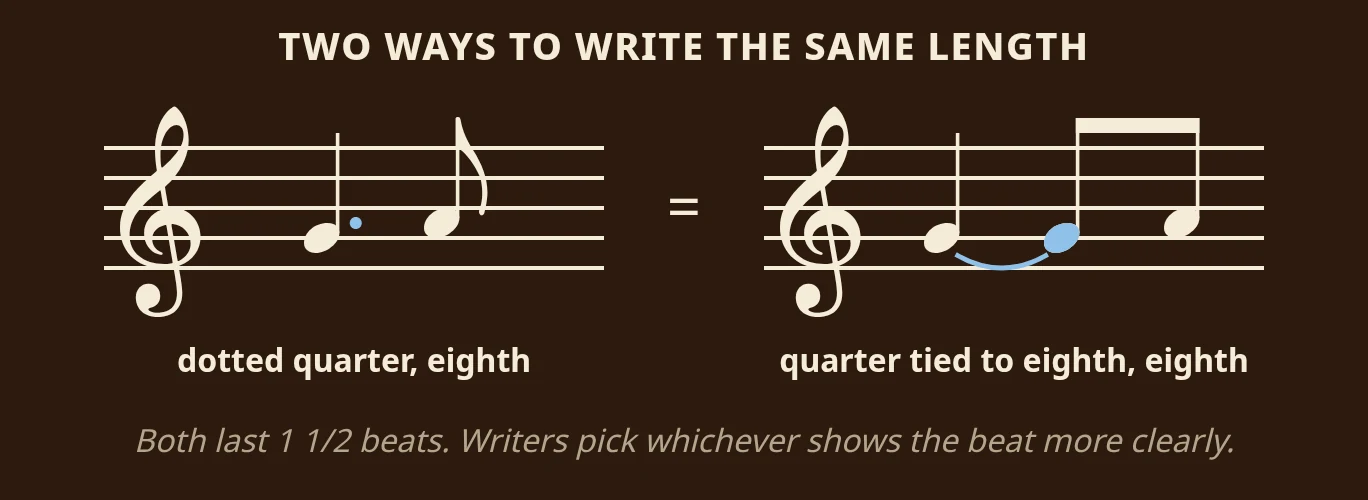
A quarter note tied to an eighth note lasts exactly as long as a dotted quarter note. Writers choose whichever version shows the beats more clearly, so in some bars you will see the tie even though a dot would fit.
Common mistake: playing the second note of a tie again. It is a continuation, not a new note. On the piano, keep the key down. On a wind instrument, do not tongue it. On a string instrument, do not change bow unless the bowing says so.
Step 5: Tell a tie from a slur
A slur is the same kind of curve, but drawn over notes of different pitches. It means play them smoothly joined, in one breath, one bow or one movement of the hand, and every note under it is played.
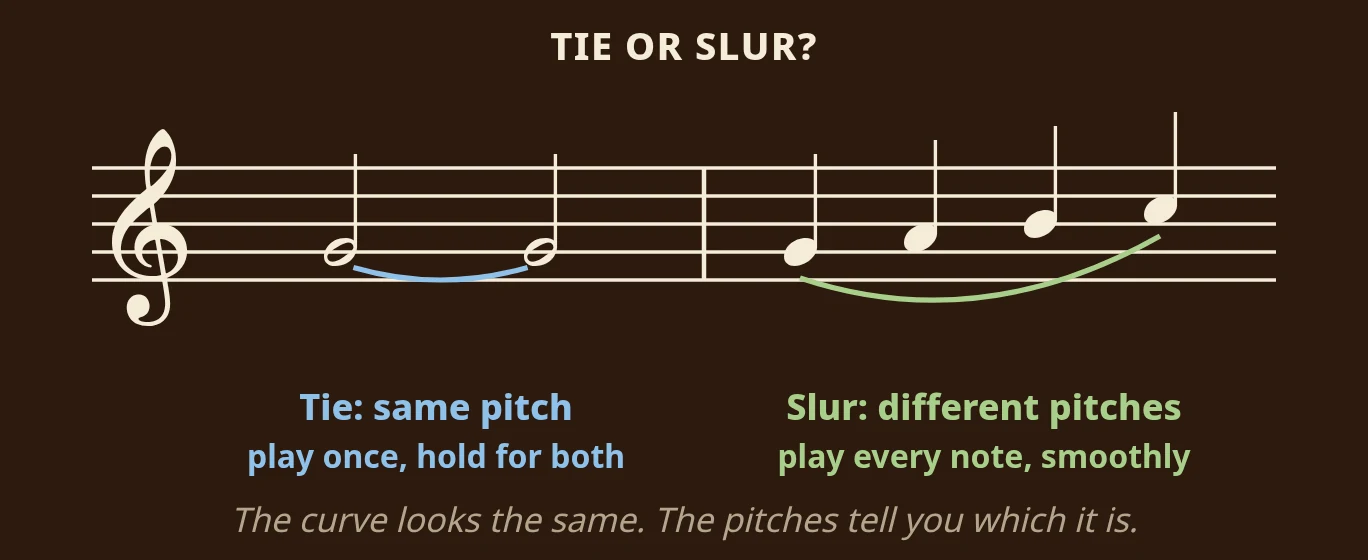
The curve alone cannot tell you which is which. The pitches can:
- Tie: two notes of the same pitch, side by side, with the curve going from one note head to the next.
- Slur: notes of different pitches, or a curve arching over a whole group of notes.
Watch out for one trap: a slur over a group that happens to contain two repeated notes. If the curve touches only the two same-pitch heads, it is a tie. If it arches over other notes too, it is a slur, and the repeated note is played again. When both happen at once, engravers draw a short tie inside the longer slur.
Step 6: Put it together in one bar
Look back at the bar with the tied G. It has three notes in the first bar: a dotted quarter (1 1/2 beats), an eighth (1/2 a beat) and a half note (2 beats). Counted in eighths:
- The dotted quarter sounds on "1" and holds through "and" and "2".
- The eighth note plays on the "and" of 2.
- The half note G starts on "3" and holds through "4 and".
The G is tied to a quarter note G on the first beat of the next bar, so it keeps sounding for three beats in total. Nothing new is played on that beat 1, and the next new note comes on beat 2.
If you miss the tie, you play the G twice, and the second bar feels as if it has an extra note. If you read the tie as a slur, you still play it twice, just more smoothly: the same wrong note with better manners.
A two-minute daily drill
- Count "1 e and a, 2 e and a" out loud at a walking pace and clap only on "1" and "a": that is the dotted eighth and sixteenth (45 seconds).
- Keep counting and clap on "1" and "and" instead: even eighth notes. Switch between the two every bar until the difference is obvious.
- Count "1 and 2 and 3 and 4 and" and clap on 1, the "and" of 2, and 3: the dotted quarter bar from Step 3 (45 seconds).
- Open any piece, point at six curved lines, and say "tie" or "slur" for each one, judging by the pitches (30 seconds).
Step 7: Practice with a way to check yourself
Rhythm mistakes with dots and ties are hard to spot on your own, because a note held slightly too long or too short still feels fine while you play it. The way to catch them is to hear the exact length and compare.
That is what Sheetly is for. Take a photo of a printed page with your iPhone or iPad, and Sheetly plays it back with a playhead that follows the notes, holding every dotted and tied note for exactly its length. Slow it down and loop the bar, then clap along: you will hear at once whether your dotted rhythm snaps or lilts, and a tied note should sound as one long note, not two. If you are unsure, ask the built-in coach whether a curve in bar 7 is a tie or a slur.
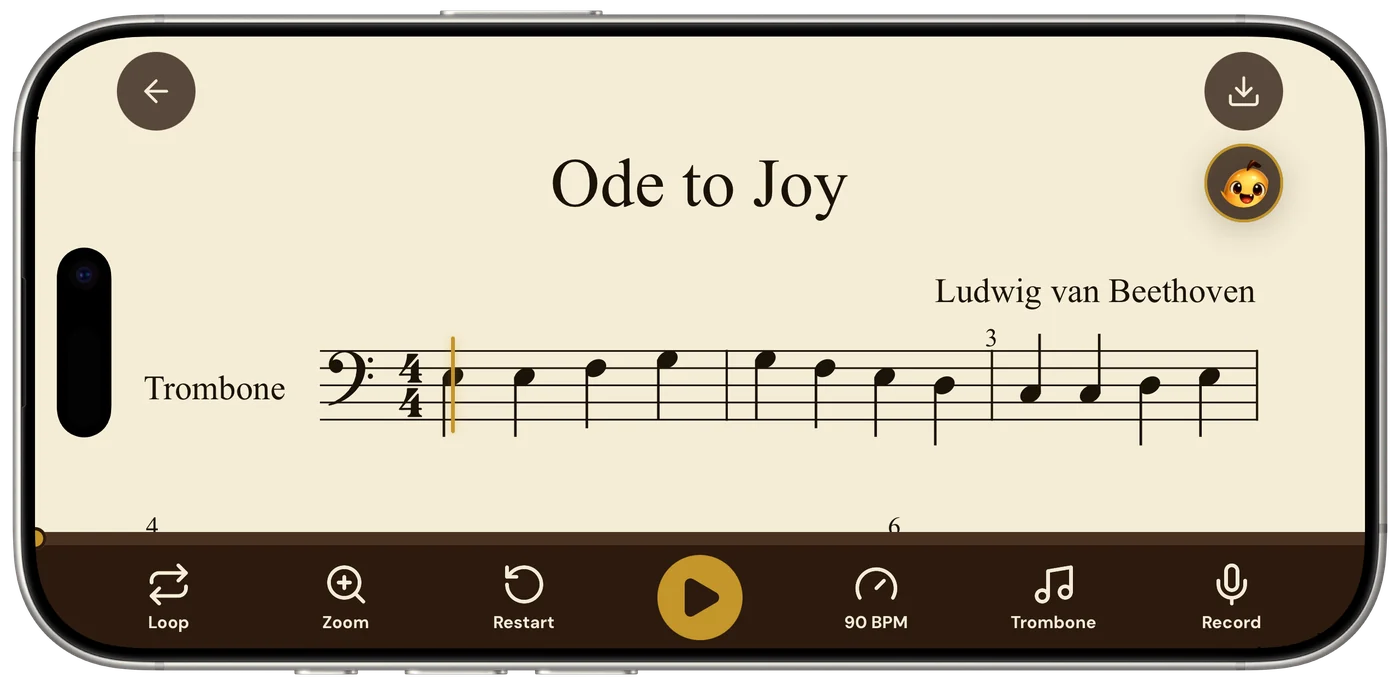
Count the bar first, clap it, then press play and compare. The places where you and the playback disagree are your practice list for tomorrow.
Questions
How long is a dotted half note?
Three beats in 4/4 or 3/4 time. A half note lasts two beats, and the dot adds half of that, one more beat. In 3/4 time a dotted half note fills a whole bar.
Can a dotted note cross a bar line?
No. A single note, dotted or not, cannot cross a bar line. A dotted quarter that starts on beat 4 of a 4/4 bar is written as a quarter note on beat 4 tied to an eighth note on beat 1 of the next bar.
Does an accidental carry through a tie?
Yes. A sharp, flat or natural on the first note of a tie holds for the tied note across the bar line, but not for any later notes of the same pitch in the new bar.
What is the difference between a tie and a slur?
A tie joins two notes of the same pitch into one longer sound, so the second note is not played. A slur joins notes of different pitches and means play them smoothly, and every note under it is played.