How to Read Ledger Lines: Notes Above and Below the Staff
Wondering how to read ledger lines? In this guide, we show you how the notes above and below the staff are named, the C landmarks that make them quick to read, and the mistakes to watch for, with a picture for every step.


Have you ever been happily reading a melody when it suddenly climbs off the top of the staff, onto a stack of little extra lines, and you have to stop and count? Ledger lines slow down almost every reader at first, whether you play the flute, the piano, the trombone or the violin.
Here is the good news: learning how to read ledger lines does not mean learning anything new. A ledger line is just a short piece of an extra staff line. The note names keep going in the same order they always do, one letter per step. What makes ledger lines feel hard is only that the eye cannot take in a stack of short lines at a glance, so you need a smarter way of counting.
In this guide, we explain what ledger lines are, walk through every ledger note above and below the treble and bass staves, and show you a landmark method that turns long counts into one or two steps. Each part comes with a picture, and at the end we share a short daily drill and a way to check yourself as you practice.
How to read ledger lines
Step 1: Understand what a ledger line is
A ledger line is a short line drawn above or below the staff to make room for a note that is too high or too low to fit on the five lines. (You will also see it spelled "leger line".) Each ledger line counts as one more line of the staff, and each gap between them counts as one more space.
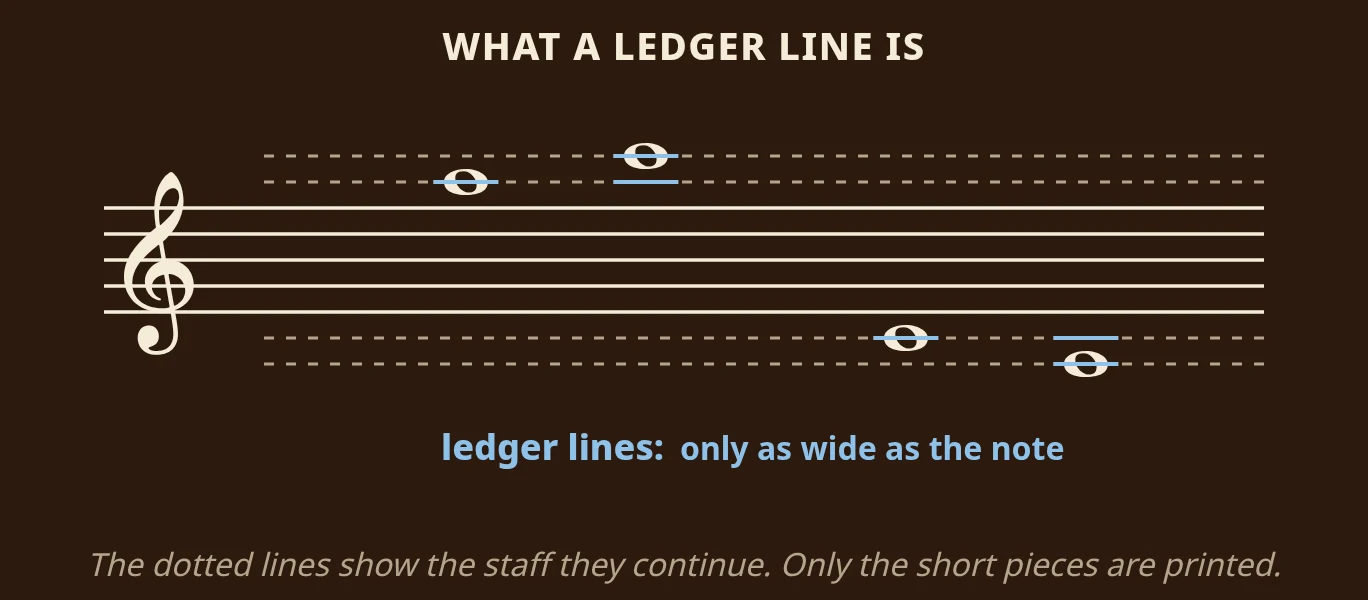
Why not just draw more full lines? Because the eye can count five lines at a glance, but not eleven. So instead of printing a huge staff, engravers draw only the bits of extra line that a note actually needs, and only as wide as the note head. In the picture, the dotted lines show the imaginary staff lines that the short ledger lines belong to.
Ledger lines are always counted outward from the staff. The first ledger line above the staff is the one closest to the top line. The first ledger line below the staff is the one closest to the bottom line.
Step 2: Check whether the note is on the line or beside it
Just like the notes on the staff, a ledger note can sit on a line or in a space. This is the first thing to check, and the most common place to slip.
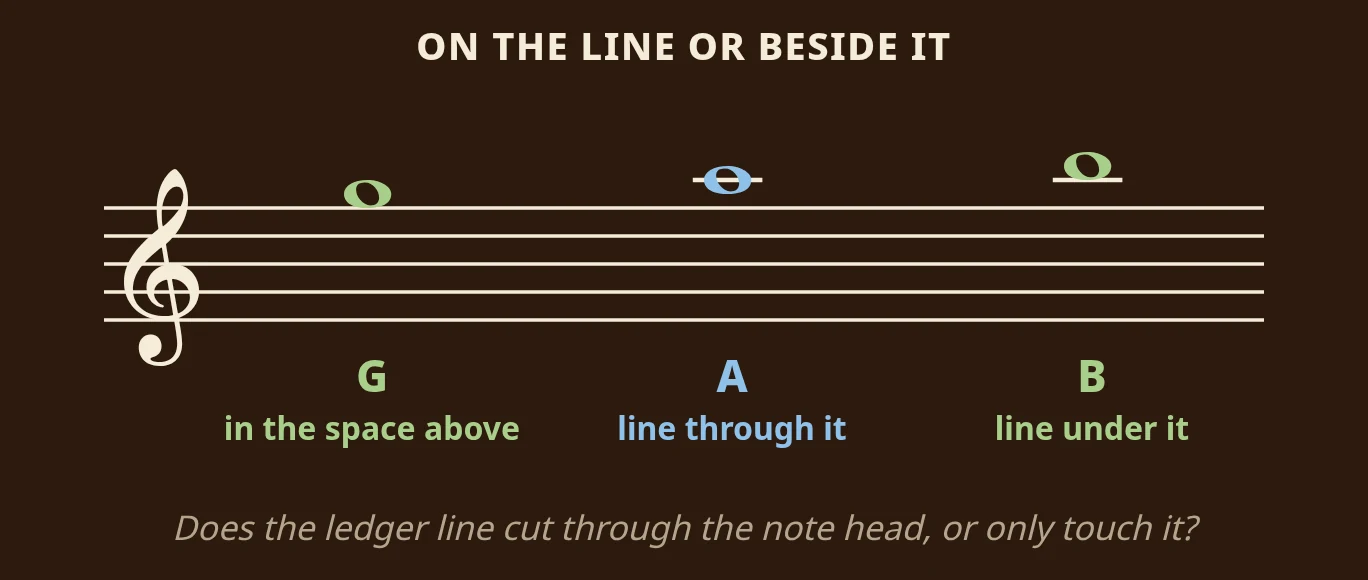
If the ledger line runs through the middle of the note head, the note is on that line. If the ledger line sits under the note head and only touches it, the note is in the space above that line. In the treble clef example above, that is the difference between A and B, one step apart.
A note in the space just above the staff, like the G on the left, does not need a ledger line at all. It simply sits on top of the top line.
Common mistake: reading a note that sits on top of a ledger line as if it were on the line. Before you count, look closely: does the line cut the note in half, or is it just underneath?
Step 3: Learn the ledger notes on the treble staff
Now let's name the notes. On the treble staff, the lines from bottom to top are E, G, B, D and F. To go beyond the staff, you simply keep stepping through the alphabet.
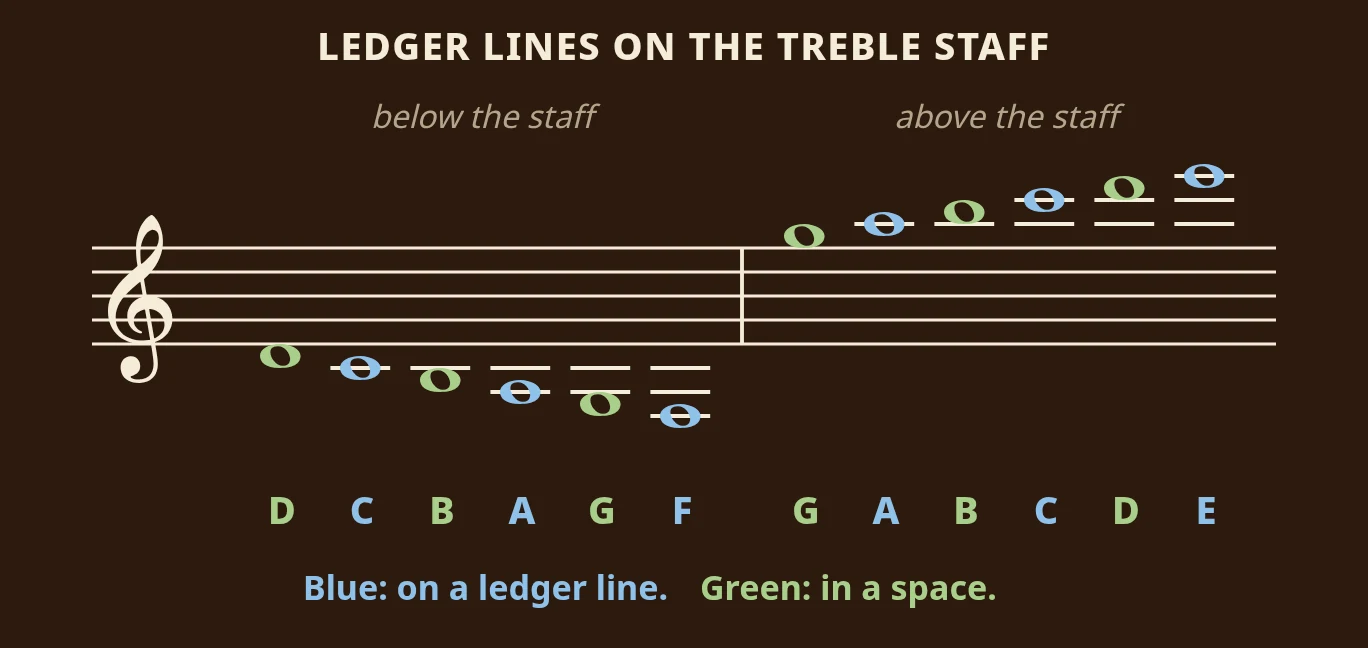
Above the treble staff
Start from the top line, F. The space above the staff is G. The first ledger line above is A. The space above it is B. The second ledger line above is C, often called top C or high C. Keep going and you reach D in the next space and E on the third ledger line.
Below the treble staff
Start from the bottom line, E. The space just below the staff is D. The first ledger line below is C, which is middle C, the C nearest the middle of the piano keyboard. Below it come B, then A on the second ledger line, G, and F on the third ledger line.
If you play guitar, these are the notes of your lowest strings: the open A string is written on the second ledger line below the staff, and the low E hangs just below the third. Our guide on how to read guitar sheet music maps out every string.
Try this now: sing or play from middle C up to top C. That is two octaves, and it covers most of the treble clef music you will read.
Step 4: Learn the ledger notes on the bass staff
The bass staff works exactly the same way, starting from different letters. Its lines from bottom to top are G, B, D, F and A.
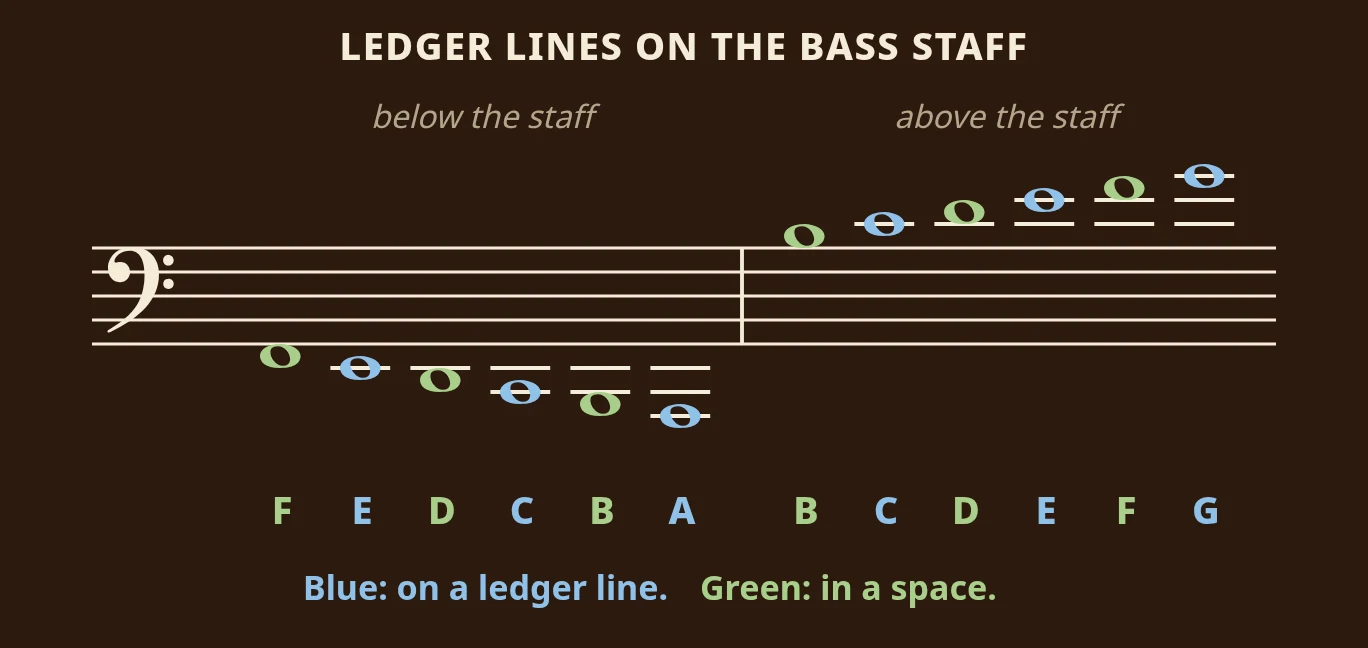
Above the bass staff
Start from the top line, A. The space above the staff is B. The first ledger line above is middle C, the very same note that sits on the first ledger line below the treble staff. After that come D, E on the second ledger line, F, and G on the third.
Below the bass staff
Start from the bottom line, G. The space below the staff is F. The first ledger line below is E, which is the lowest open string on a standard bass guitar or double bass. Next comes D, then C on the second ledger line, two octaves below middle C. Below that are B and A on the third ledger line.
Why middle C appears in both clefs
The treble and bass staves are really one tall staff with the middle line left out, and middle C is that missing line. That is why it shows up as the first ledger line in both clefs. The two staves even overlap for a few notes: the D just above middle C in the bass clef is the same D that sits just under the treble staff. Engravers simply pick whichever clef needs fewer ledger lines.
Step 5: Count from a C landmark
Counting from the edge of the staff works, but it is slow when a note is three or four lines out. Fluent readers use a shortcut: they memorize where a few C's are, and read every other ledger note as a step or two from the nearest one.
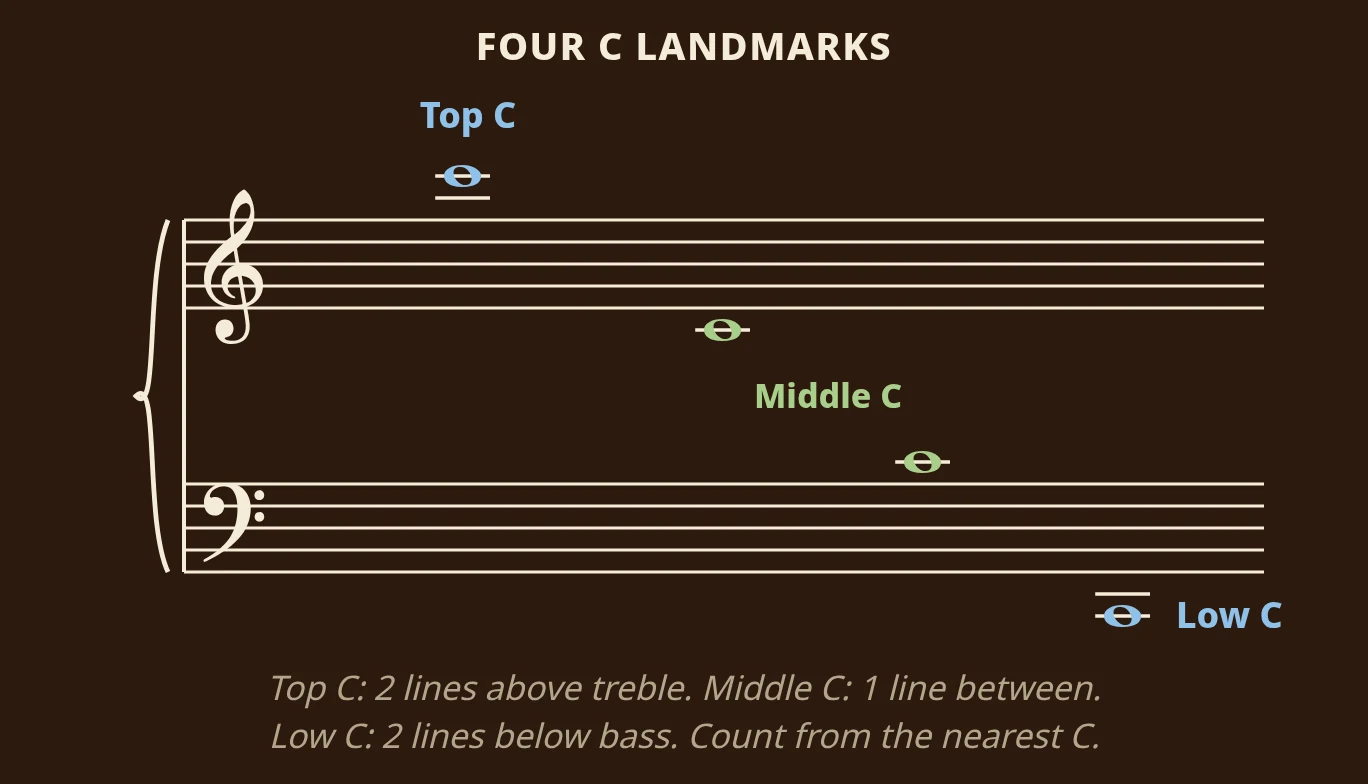
There are four C positions to know. Top C sits on the second ledger line above the treble staff. Middle C sits on the first ledger line below the treble staff, and on the first ledger line above the bass staff. Low C sits on the second ledger line below the bass staff.
A worked example
Imagine a treble melody that climbs to a quarter note on the third ledger line above the staff. Counting up from the top line, you would go F, G, A, B, C, D, E: seven steps. With the landmark method, you know the second ledger line is top C, so the next line up is two steps higher: E.
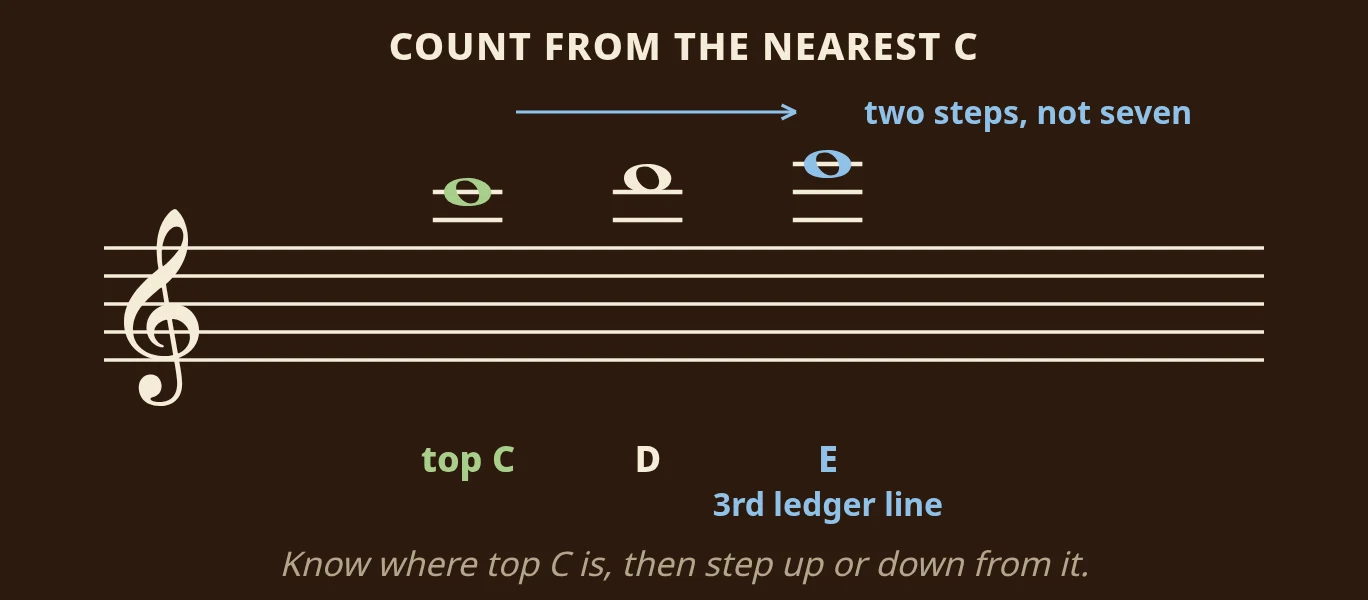
The same trick works everywhere. The ledger line just below low C is A. The space just above middle C in the bass clef is D. The line just under top C is A. You never need to move more than two or three letters from a landmark. And if one note still will not give up its name, our guide to using a note reader app shows you how an app that has read your page can tell you what it is, plus landmarks for the notes inside the staff.
Step 6: Watch out for 8va signs
When music goes very high, even ledger lines get hard to read. Instead of drawing five or six of them, composers often write the notes an octave lower and add an 8va sign: a small "8va" followed by a dotted line above the notes.
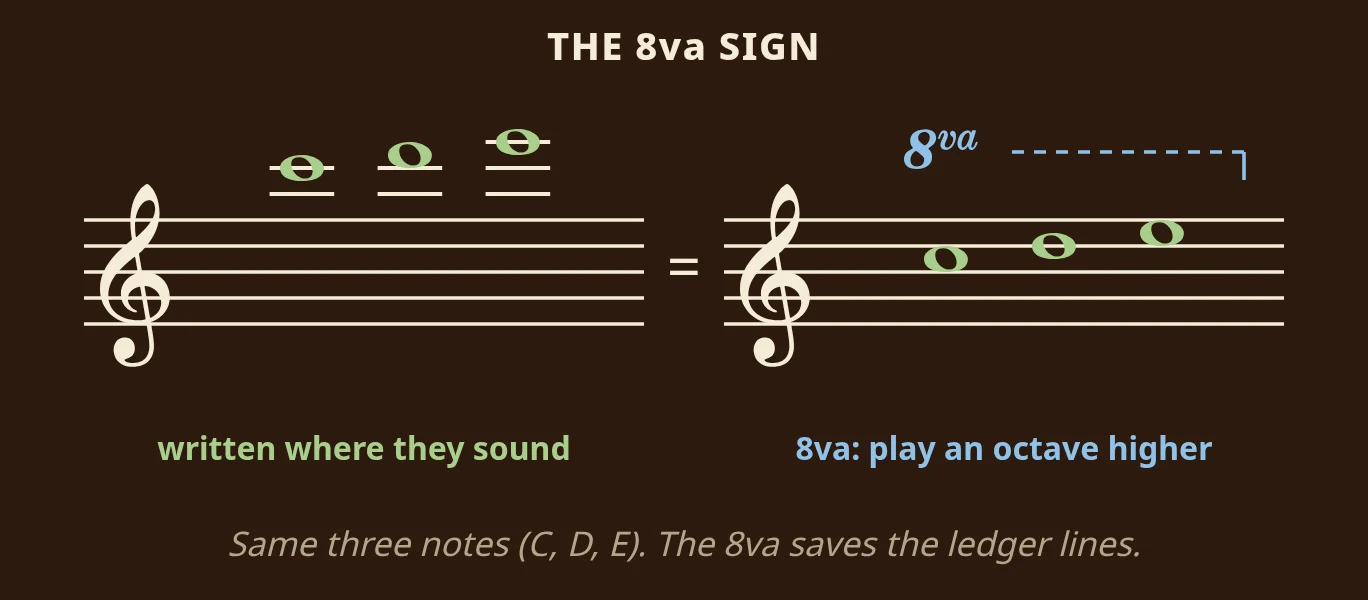
The 8va sign means "play these notes an octave higher than written", until the dotted line ends. Both versions in the picture sound exactly the same. You will also see 8vb (sometimes written 8va bassa) below the staff, which means "play an octave lower".
Common mistake: counting all the ledger lines correctly and then playing in the wrong octave because you missed the 8va. Before you start counting, glance above and below the staff for a bracket.
Step 7: Avoid the three common misreads
Most ledger line mistakes come from the same three habits. Knowing them makes them much easier to catch.
- On the line or beside it. A line through the note head means the note is on the line. A line just under or over it puts the note in the space next to it, one step further out.
- Losing count in a stack. With three or four ledger lines, the eye tends to merge two of them, and the note gets read too low. Count with a pencil tip the first time, or count from the nearest C so four lines become "two above top C".
- Missing an 8va. Look for the bracket before you count, as we saw above.
A two-minute daily drill
- Say the four landmarks out loud: top C, middle C (twice) and low C, and picture each on the staff (30 seconds).
- Open any piano piece with ledger lines. Point at ten notes outside the staff and name each one aloud by its distance from a C: "one above middle C, D" or "one line below top C, A" (1 minute).
- Play the ones you hesitated on (30 seconds). Those are tomorrow's ten.
Naming the notes out loud matters. Silent guessing does not stick nearly as well.
Step 8: Practice with a way to check yourself
Ledger notes are exactly where a quick check pays off, because a note counted one line out sounds clearly wrong once you hear it. The trick is hearing the right version while you practice.
That is what Sheetly is for. Take a photo of a printed page with your iPhone or iPad, and Sheetly plays it back with a playhead that follows the notes. Count the note on the third ledger line, commit to a name, then press play and hear whether it really is an E. At a slower tempo, a run of high ledger notes separates into pitches you can check one by one, and looping the bar lets you sing the note before the playback does. If you are stuck, ask the built-in coach about that note in your bar.
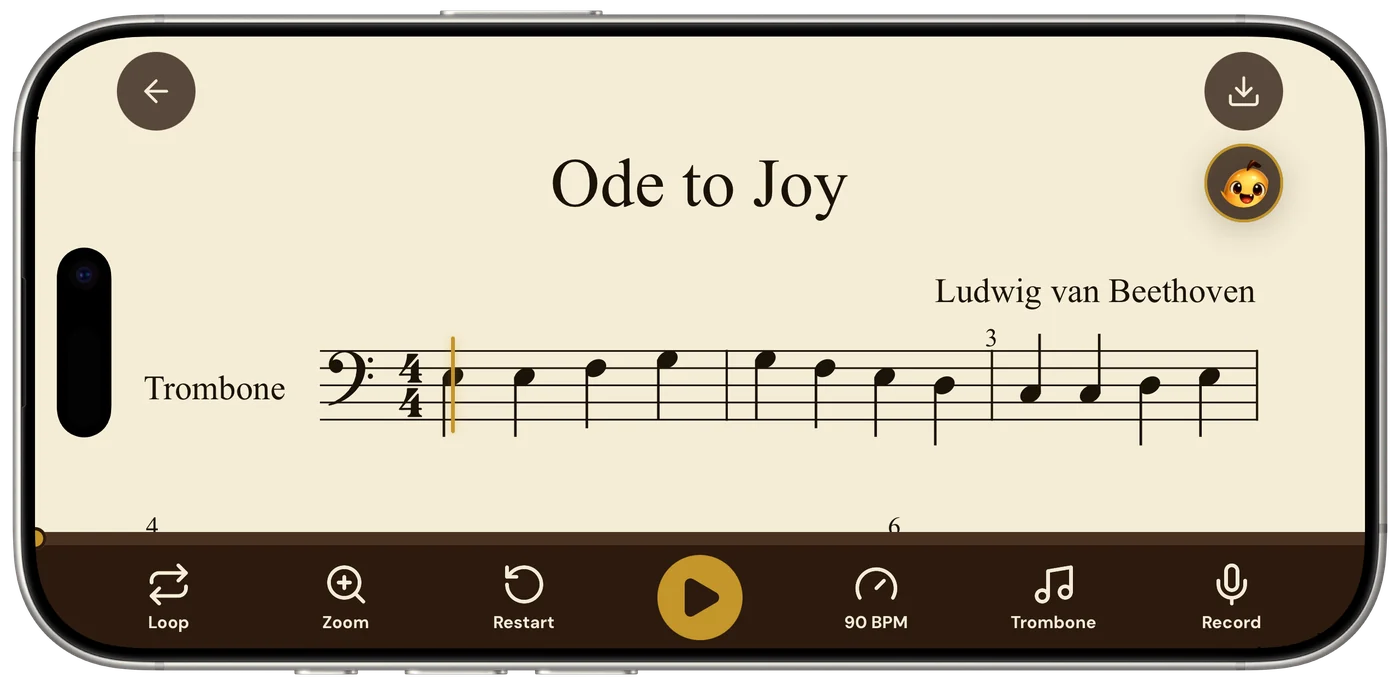
Use playback as the answer sheet, not the textbook: count first, then listen. Each note you get right on your own makes the next one faster.
Questions
How many ledger lines can there be?
There is no fixed limit, but engravers usually stop at four or five because more become hard to count. Piano and flute music often reach four, and most other parts use one to three. Beyond that, the music is written an octave lower with an 8va sign, or an octave higher with an 8vb sign.
Do ledger lines work the same way in every clef?
Yes. In any clef, each ledger line is one more staff line and each gap is one more space, and the letters carry on in order. Only the starting letters change, because each clef names the staff lines differently.
Is middle C a ledger line note?
Yes. Middle C sits on the first ledger line below the treble staff and on the first ledger line above the bass staff. Both are the same key on the piano.
What is the fastest way to read ledger lines?
Memorize where the C's are (top C, middle C and low C) and read every other ledger note as a step or two from the nearest one. A few minutes of naming notes out loud each day makes it automatic within a few weeks.