How to Read Guitar Sheet Music: Notes, Tab and Numbers
Wondering how to read guitar sheet music? In this guide, we walk you through what a guitar page looks like, the notes on each string, rhythm, tab and what all the numbers mean, with a clear picture for every step and a way to hear the page played back.


Maybe your teacher just handed you a classical guitar study, maybe you bought a fingerstyle book and found notes on a staff where you expected tab, or maybe you have played by ear for years and want to finally learn how to read guitar sheet music. Whatever brought you here, the good news is that guitar music is far less mysterious than it looks, and you already know more of it than you think.
So how does guitar sheet music work? It is really three systems that often share one page. Standard notation is the five-line staff with notes on it, which tells you the pitch and the rhythm. Tablature (tab) is a six-line picture of your strings with fret numbers on it. And chord boxes are small grids that show a chord shape. Once you know what each one tells you, and which numbers belong to which, the page turns into a clear set of instructions.
Follow the steps below in order. Each one comes with a picture, so you can see exactly what we mean, and each one ends with something you can try today, whether you take lessons or teach yourself. At the end, we show you how to scan a printed guitar page and hear it played back while you learn it.
What does guitar sheet music look like?
Here is one line of a typical guitar arrangement, the kind you find in a songbook or a method book. From top to bottom, it has chord boxes, a staff of notation and a tab staff, all describing the same two bars.
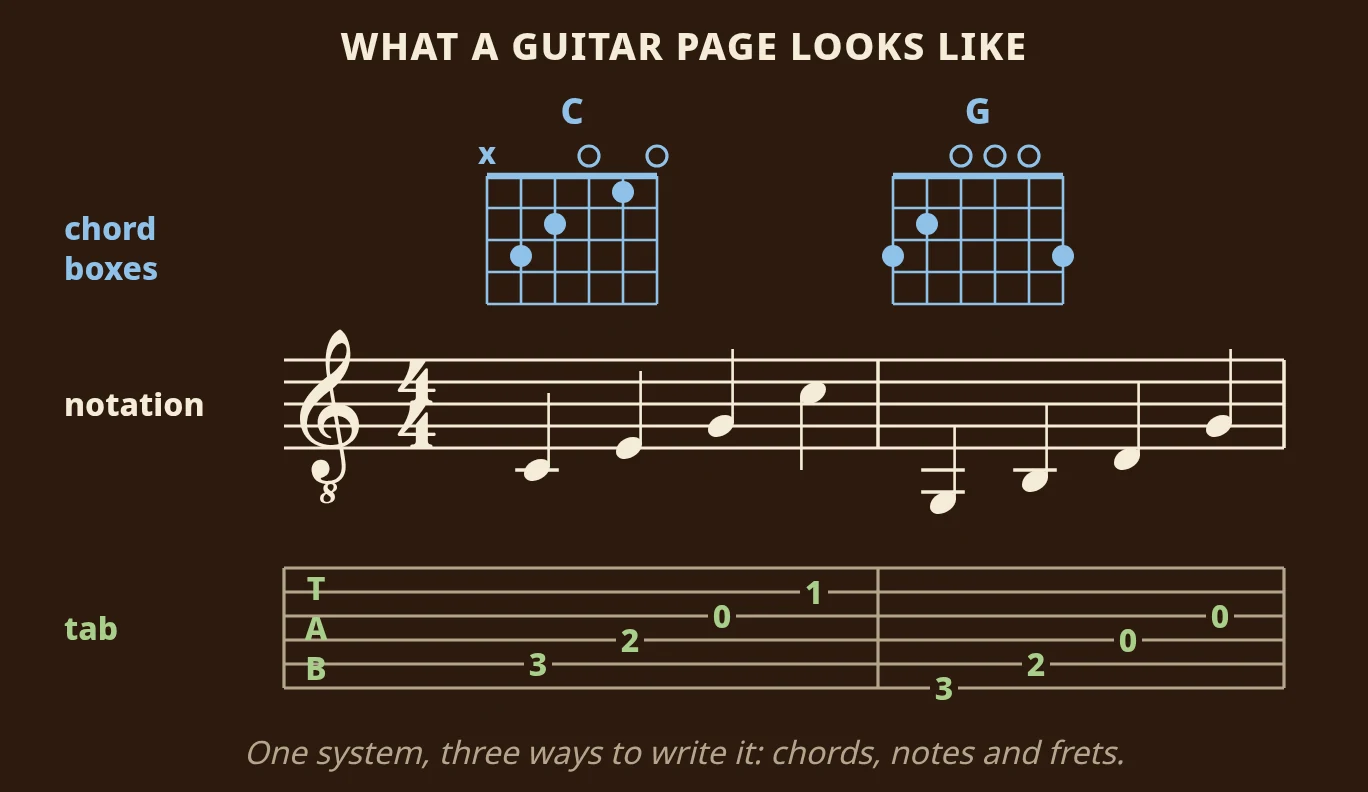
- Chord boxes sit above the music. Each one is a tiny picture of the neck: the vertical lines are the six strings (the low E on the left), the horizontal lines are frets, and the dots show where your fingers go. An x above a string means do not play it, and an o means play it open.
- Notation is the staff in the middle. It uses the treble clef, often with a small 8 underneath, and it shows exactly which notes to play and how long each one lasts.
- Tab is the six-line staff at the bottom, marked TAB. Each line is a string and each number is a fret.
Not every page has all three. Classical guitar music is usually notation only. Pop and rock songbooks often print notation and tab together. A lead sheet has a melody on the staff with chord names such as C or Am7 above it, and leaves the accompaniment to you. In this guide we focus on reading guitar sheet music notation, because it is the only part that shows both the pitch and the rhythm, and then show how tab and the other numbers fit around it.
How to read guitar sheet music, step by step
Step 1: Know that guitar music is written an octave high
Guitar music uses the treble clef, often with a small 8 under it. That little 8 is a reminder that the guitar sounds one octave lower than the music is written.
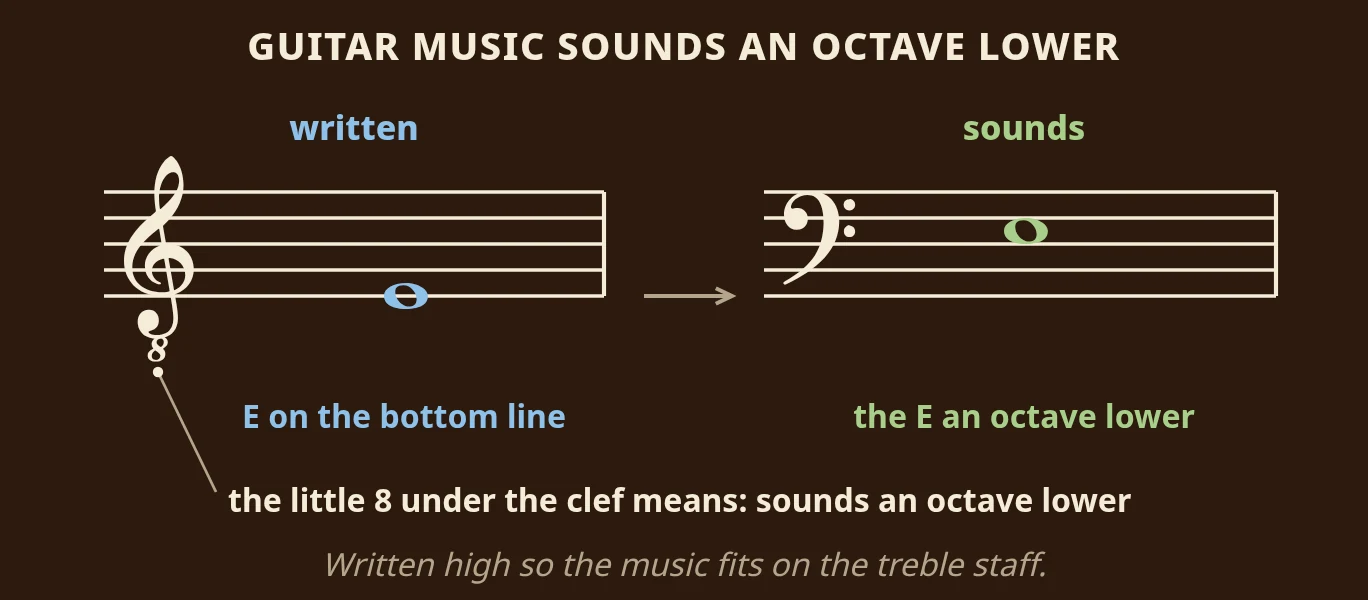
Why write it that way? The guitar's real range sits mostly below the treble staff. Written at its true pitch, most notes would need a ladder of ledger lines or a constant jump between clefs. Writing everything an octave higher puts most of the guitar's notes right on the treble staff, where they are easy to read.
In practice, you do not need to do anything with this. You read the written note and play the fret that matches it. The only time it matters is when you compare your part with a piano or another instrument: the guitar's "middle C" on the page sounds the C below middle C. Some editions leave the 8 off the clef, but guitar music is read the same way either way.
Step 2: Find the open strings on the staff
Your six open strings are E, A, D, G, B and E, from the thickest to the thinnest. On the staff they sit like this:
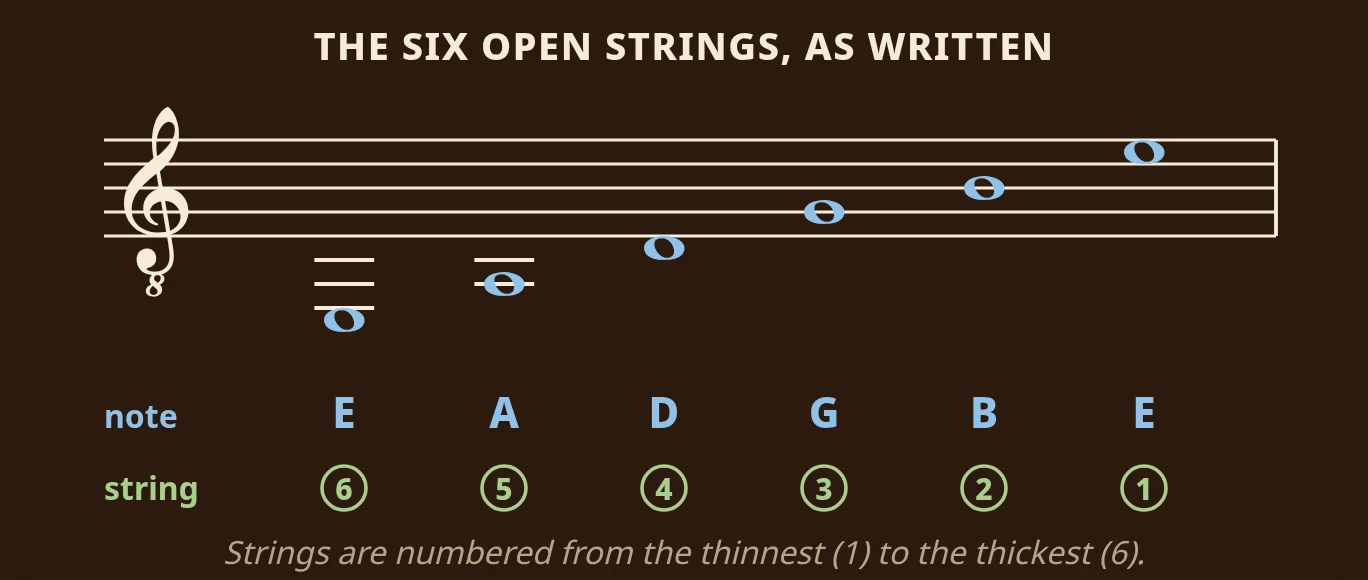
The low E string hangs just below the third ledger line under the staff. The A string sits on the second ledger line below. The D string sits just under the staff, the G string on the second line, the B string on the middle line, and the high E string in the top space.
Strings are numbered from the thinnest to the thickest: the high E is string 1 and the low E is string 6. Those numbers matter, because guitar music often uses them (see the section on numbers below).
Try it today: play each open string slowly and point to its note on the staff while you say its name.
Step 3: Learn the notes in first position
Once the open strings are your landmarks, learn the notes on the first three frets of each string. With your first finger at fret 1 and one finger per fret up to fret 4, your hand is in first position, and a huge amount of beginner and intermediate guitar music lives there. Here are the natural notes (no sharps or flats) on the three low strings:
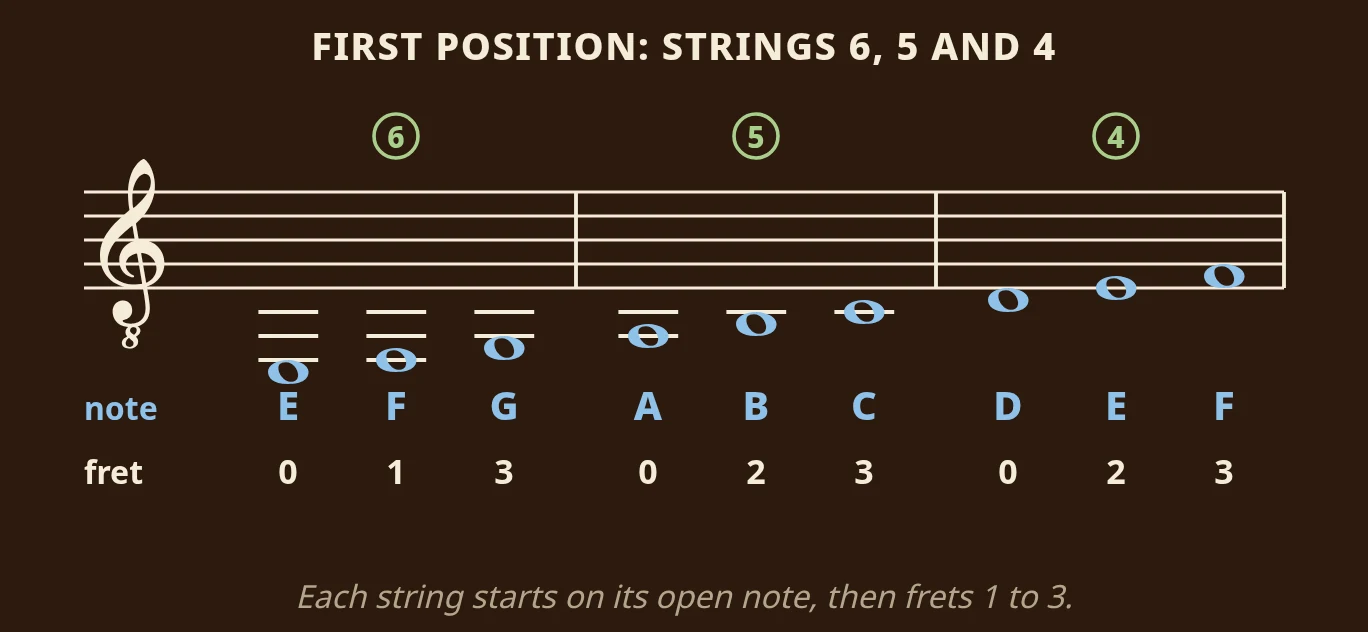
On the low E string you play E open, F on fret 1 and G on fret 3. On the A string you play A open, B on fret 2 and C on fret 3. On the D string you play D open, E on fret 2 and F on fret 3. Notice how the notes walk up the staff one line or space at a time, and how each string picks up where the last one stopped.
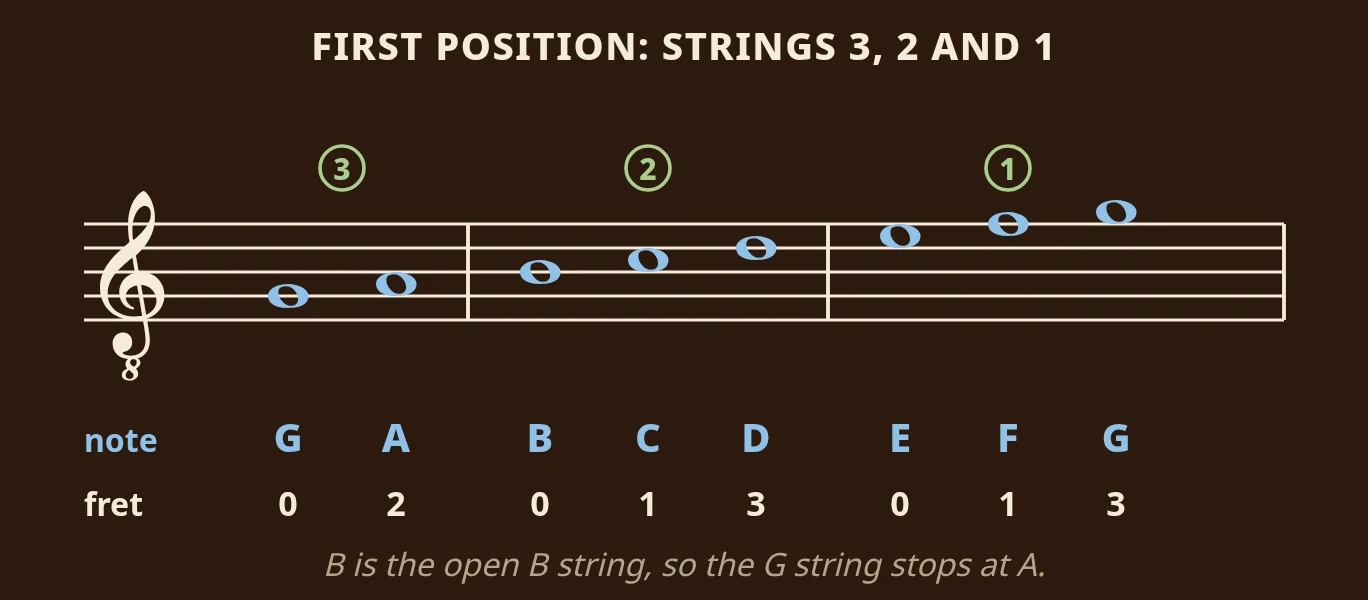
The three high strings work the same way. On the G string you play G open and A on fret 2. On the B string you play B open, C on fret 1 and D on fret 3. On the high E string you play E open, F on fret 1 and G on fret 3. The G string only needs two notes, because the next note up, B, is simply the open B string.
Sharps and flats
A sharp (♯) in front of a note means play it one fret higher. A flat (♭) means play it one fret lower. So F♯ on the high E string is fret 2, and B♭ on the A string is fret 1. If the natural note is an open string, as E is on the high E string, there is no lower fret to go to, so play the flat on the next string down in pitch instead: E♭ is fret 4 on the B string. When there are sharps or flats in the key signature at the start of the line, they apply to every note with that letter, so a key signature with one sharp turns every F into F♯.
The common mistake for players coming from tab is to translate every note into a fret number in your head. That works at first, but it is slow. Instead, read the note name, then play it where it lives in first position, the way you would read a word without spelling it out.
Try it today: pick one string and play its first-position notes up and down while saying their names out loud. Then point to random notes in the diagrams above and find them on the guitar without looking at the fret numbers.
Step 4: Read the rhythm, not just the notes
Here is the biggest reason to learn notation: it shows the rhythm exactly. Plain tab often does not. In the picture below, both bars have exactly the same tab, 0 2 0 1, but they sound completely different.
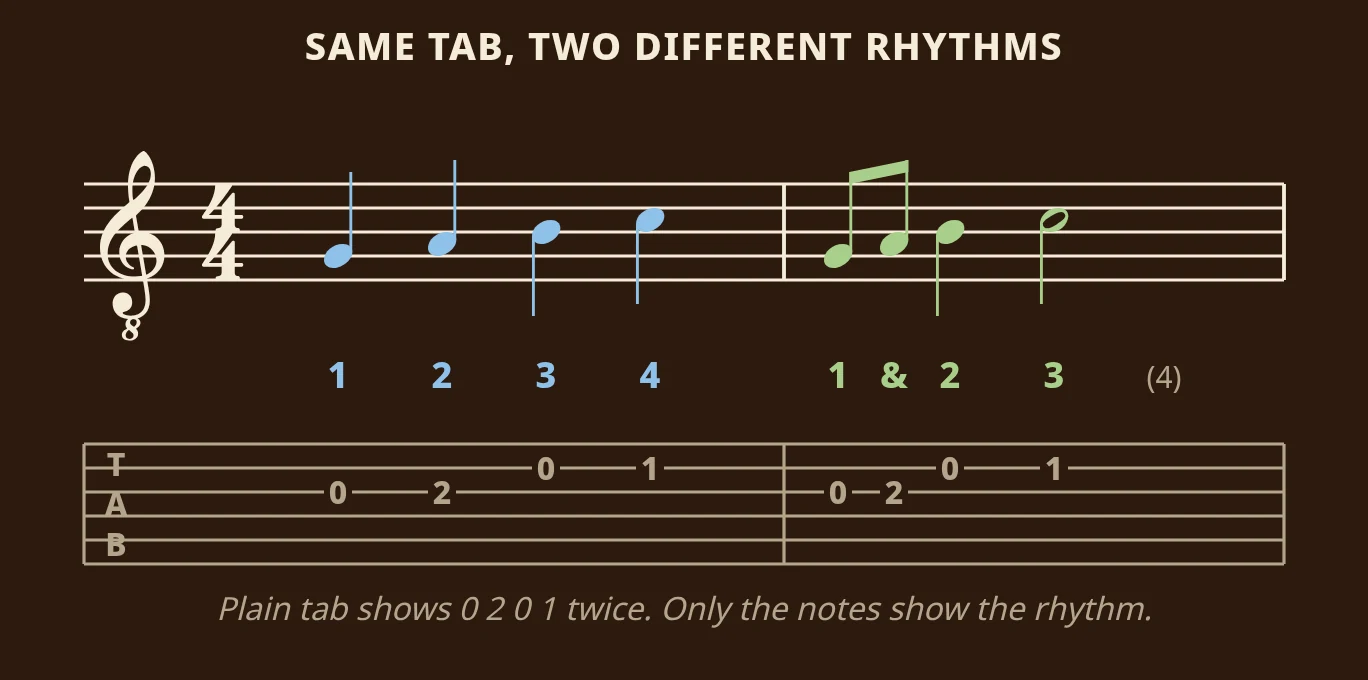
The first bar has four quarter notes (crotchets), one on each beat: G, A, B, C, counted "1, 2, 3, 4". The second bar starts with two eighth notes (quavers) joined by a beam, which share one beat and are counted "1 and". Then comes a quarter note on beat 2, and a half note (minim) on beat 3 that you hold through beat 4. Same frets, a different rhythm.
Count every bar out loud. In 4/4, count "1, 2, 3, 4", and when there are eighth notes, add "and" between the beats. A quarter note gets one count, a half note two, a dotted half note three and a whole note four. If tied notes or dots slow you down, our guide to dotted notes and ties walks through them.
The common mistake is to play notation like tab, getting the frets right and guessing the timing. Clap the rhythm of a bar before you play it. If you can clap it while counting, your hands will follow.
Step 5: Read two voices on one staff
Classical and fingerstyle guitar music usually has a bass line and a melody sharing one staff. They are written as two voices: the melody with stems pointing up, the bass with stems pointing down.
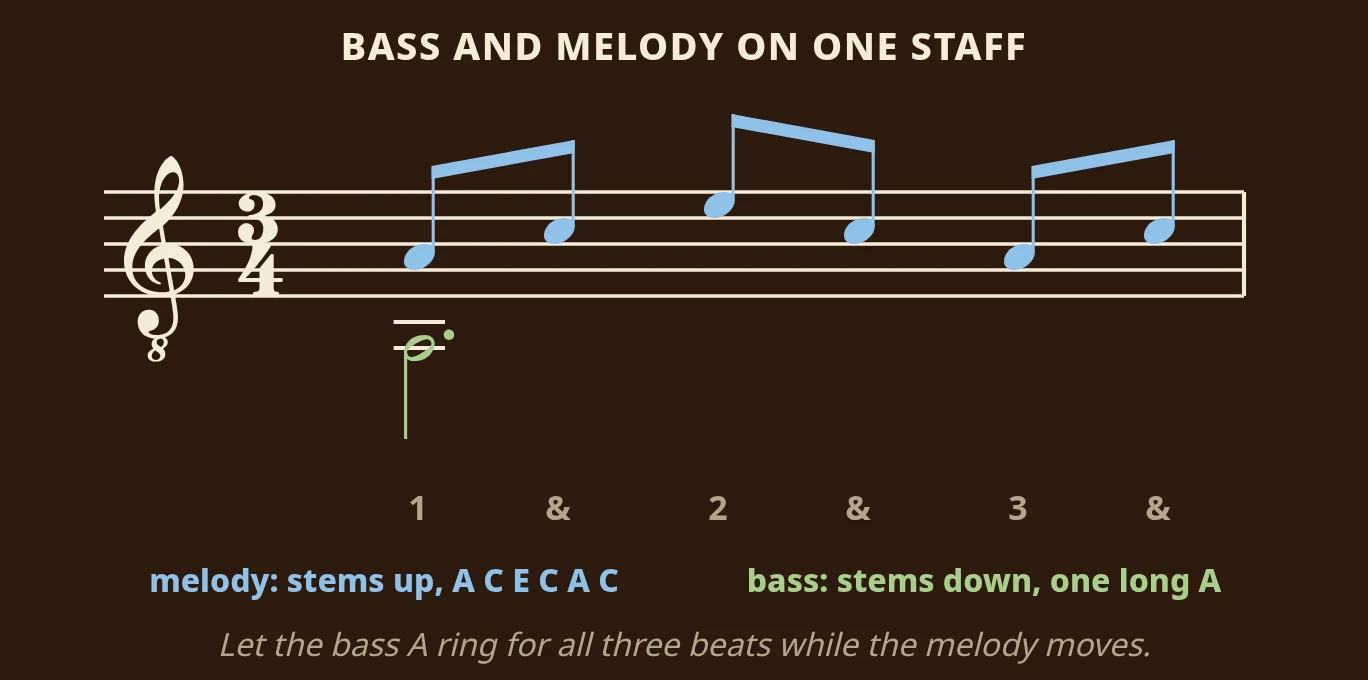
In the example, in 3/4 time, the bass plays one long A, a dotted half note that lasts the whole bar. Above it, the melody moves in eighth notes: A, C, E, C, A, C. Your thumb plays the bass on beat 1 and lets it ring, and your fingers play the melody on top.
The two voices are counted separately, and each should add up to a full bar. Here the bass is three beats (one dotted half note) and the melody is also three beats (six eighth notes). If the bass note stops early, the bar sounds thin. Keep your thumb's string ringing until the next bass note.
Try it today: play only the stems-down notes of a piece, then only the stems-up notes, then both together, slowly.
Step 6: Read tab and notation together
Many guitar books print notation with tab underneath, the same music written two ways. The tab tells you which string and fret to use; the notation tells you the pitch and the rhythm.
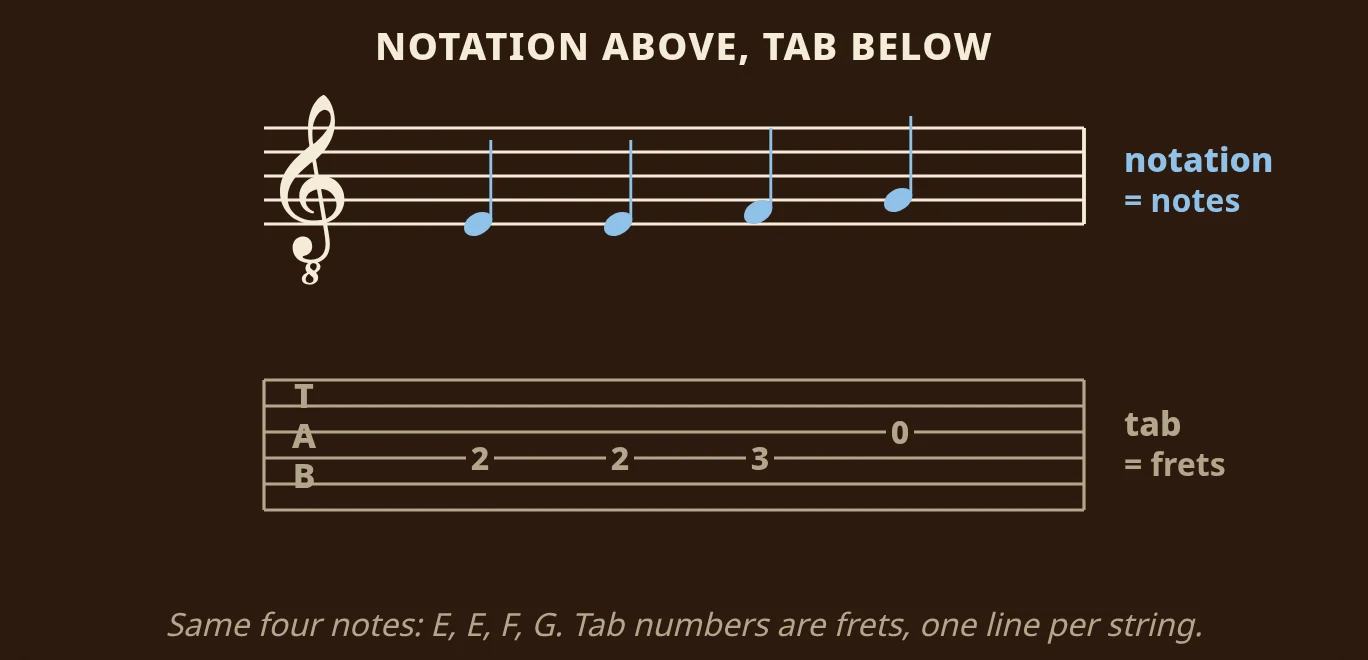
Reading tab is simple once you know one rule: the top line is your thinnest string, the high E, and the bottom line is the low E. A number on a line is the fret to press on that string, and 0 means play the string open. Numbers stacked on top of each other are played together, as a chord.
Reading both together is a great way to learn notation. Look at the note on the staff first, name it, then check your answer against the fret number underneath. After a few weeks you will find you only glance at the tab when a note sits somewhere unusual on the neck.
What do the numbers on guitar sheet music mean?
Guitar music is full of numbers, and they do not all mean the same thing. This is one of the most common sources of confusion for guitarists who are new to the staff, so here they are side by side:
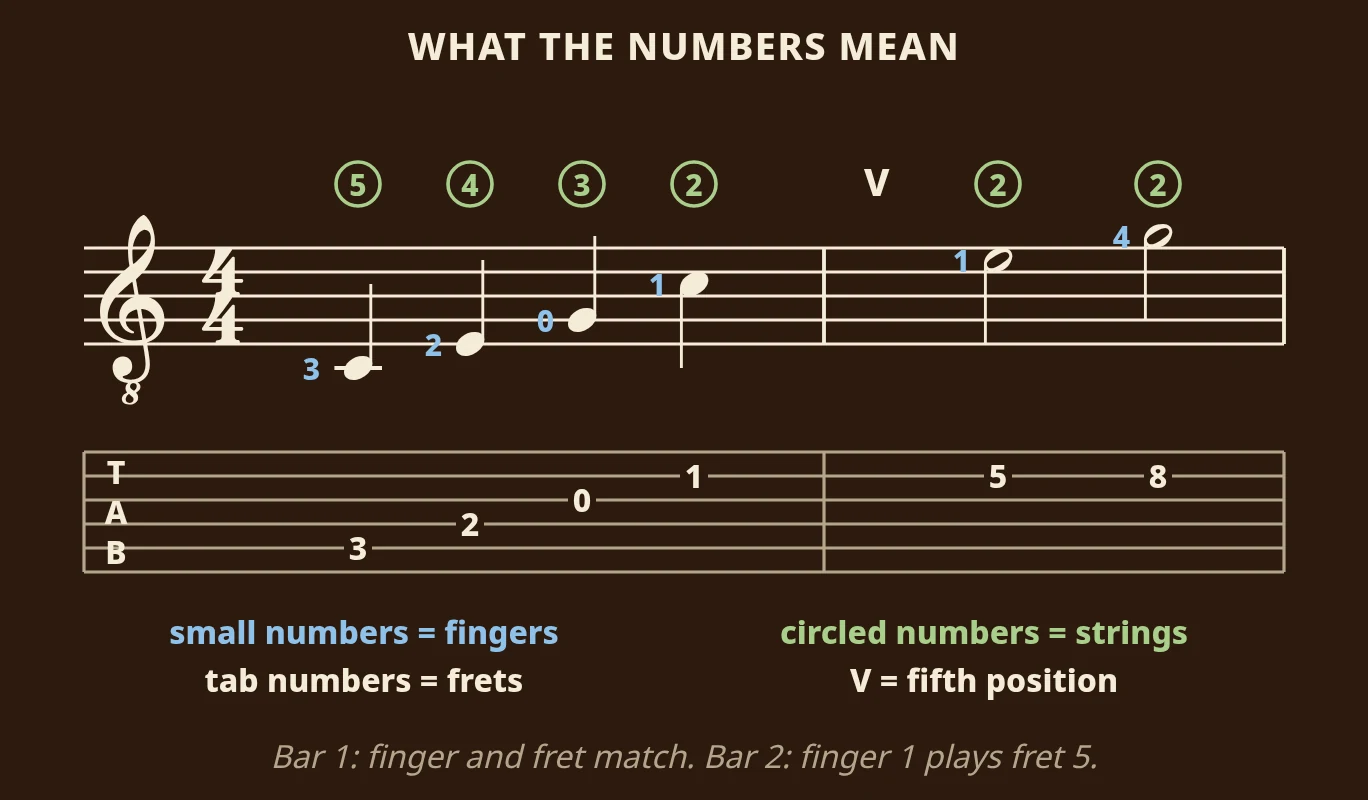
- Numbers on the tab lines are frets. A 3 on the fifth line from the top means press the A string (string 5) at the third fret.
- Small numbers next to a note head are left-hand fingers. 1 is your index finger, 2 your middle finger, 3 your ring finger and 4 your little finger. A 0 means an open string.
- Numbers in circles are strings. A circled 2 means play the note on the second string, the B string, even if the same note could be played somewhere else.
- Roman numerals are positions. V means fifth position: your first finger sits at the fifth fret. A barre sign such as CII or BII means lay your first finger across the strings at the second fret.
- The two stacked numbers at the start are the time signature. 4/4 means four beats in each bar, with the quarter note as the beat.
The mix-up to watch for is finger numbers and fret numbers. In first position they often match, as in the first bar of the picture: finger 3 plays fret 3, finger 2 plays fret 2. Higher up the neck they do not. In the second bar, in fifth position, finger 1 plays fret 5 and finger 4 plays fret 8. If a fingering seems impossible, check whether you are reading a finger number as a fret.
Right-hand fingers use letters instead of numbers: p, i, m and a, from the Spanish names for the thumb, index, middle and ring finger. Here they are on the staff, together with a barre sign:
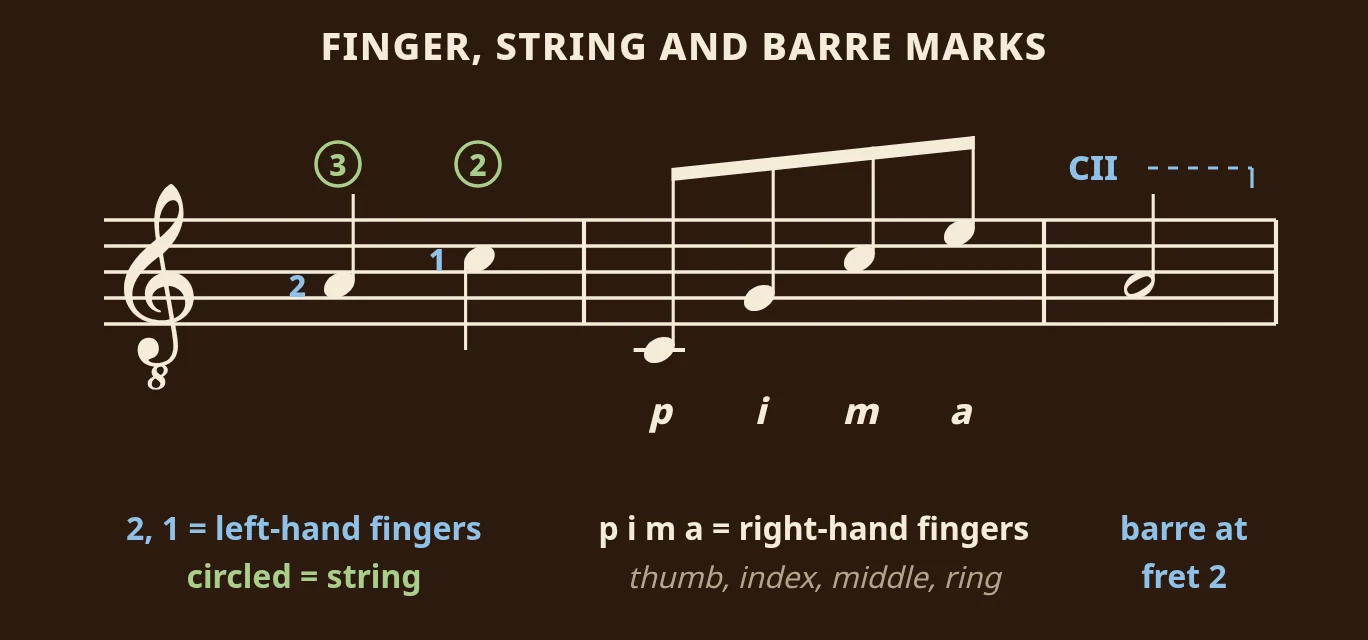
The common mistake is to treat fingerings as optional. Editors usually choose them to make the next bar easier, so following them early saves you from relearning a passage later.
Guitar sheet music scanner: hear the page played back
The hardest part of a new page is often not working out which notes to play. It is knowing how the bar is supposed to sound, especially how the bass and melody fit together in time. That is where a sheet music scanner helps: it reads the notation from a photo and plays it back to you.
Sheetly is built around the five-line staff, so it helps to know what it can read. A classical study, a fingerstyle arrangement, a grade book or a transcription with the staff printed above the tab all work. A book of tab, a chord chart or a songbook with lyrics and chord boxes is the wrong material for Sheetly, because it does not read tablature, chord diagrams or chord symbols. On a page with notation and tab stacked together, Sheetly reads the notation and ignores the tab, and two voices on one staff come back as separate lines that play together.
- Reads well: printed studies and repertoire, grade exam books, arrangements in standard notation.
- Needs a careful photo: dense chords with six notes stacked, many ledger lines above the staff, very small print in anthologies.
- Not read: fingering numbers, circled string numbers, barre marks and position marks. They are not part of the playback, but you can ask the coach about them.
- Flatten it. Thin guitar books lie flat on a table. For a thick anthology, press the spine down so the staff runs straight.
- One page, square-on. Hold the phone parallel to the paper and centered, with the staff filling the width of the frame, not the open spread.
- Notation-plus-tab pages are fine. Photograph the page as it is. The notation is read and the tab is ignored.
- Listen straight through once. At the written tempo, anything that sounds out of key is usually a misread accidental.
- Slow it down and loop. Take the tempo to something you can actually play, and loop the passage that needs work.
PDFs, such as a piece from your teacher or a public-domain edition, can be imported directly.
Practice with the voices playing back
Hearing how the bass and melody fit together in time is the part Sheetly is built to help with. Photograph a printed page with your iPhone or iPad, and Sheetly plays it back with a playhead that follows the notes, on a guitar sound or another instrument.
- Hear the voices together. Slow playback lets you hear where the bass should ring through and where the melody sits on top.
- Slow down without the pitch moving. Slowing a recording can change the sound, but Sheetly plays the notes it read, so a slow tempo is still clean.
- Loop the bar with the stretch in it. Loop the handful of hard bars instead of starting from the top and practicing the easy opening again.
- Record a take. Play against the score and record it. Listening back finds the rushed bar and the bass note cut short.
You can also ask the built-in coach about the notes on that page. It has the notes of the piece you scanned and knows you play guitar, so you can ask about your bar 6 rather than guitar in general: where a phrase actually begins, why the bass line keeps dying, or which bars are worth tonight's practice.
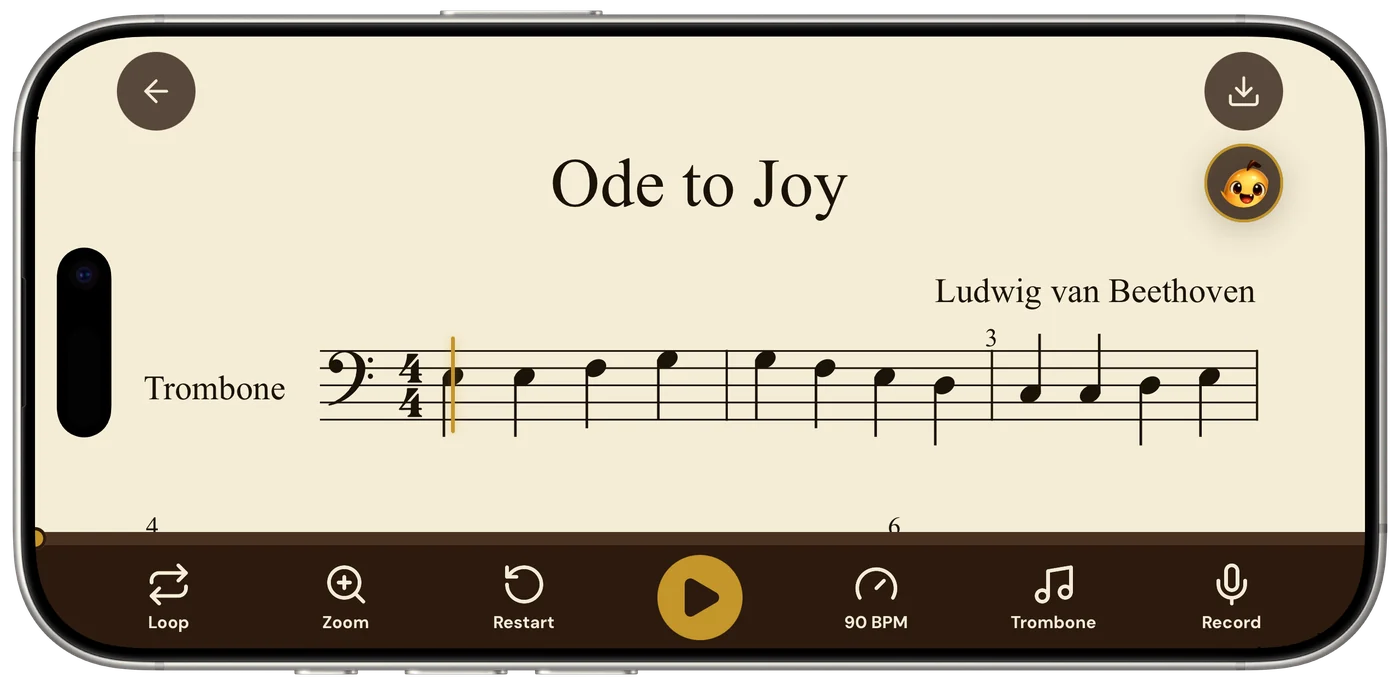
If you want tab afterwards, export the scanned piece as MusicXML. Free notation software such as MuseScore can open it and add a tab staff linked to the notation, filling in fret numbers from a default position. Correcting a few positions is much quicker than entering the whole piece by hand.
Questions
How do I start reading guitar sheet music?
Start with the six open strings on the staff, then learn the natural notes in first position, which sit on the open strings and frets 1 to 3. Count the rhythm out loud as you play, and use the tab underneath, if there is one, only to check your answers.
What do the numbers on guitar sheet music mean?
Numbers on tab lines are frets. Small numbers next to a note are left-hand fingers, from 1 (index) to 4 (little finger), with 0 for an open string. Circled numbers are strings, from 1 (high E) to 6 (low E). Roman numerals such as V are positions on the neck.
Why is guitar music written an octave higher than it sounds?
Guitar music is written an octave up so that most of the instrument's range fits on the treble staff, instead of sitting below it on ledger lines.
Can Sheetly read guitar tab?
No. Sheetly reads standard notation on the five-line staff. On a page with both notation and tab, the notation is read and the tab is ignored.