How to Read Sheet Music: A Step-by-Step Guide for Beginners
Wondering how to read sheet music? In this guide, we walk you through the staff, the notes, rhythm and key signatures, with a clear picture for every step and an easy way to check yourself as you practice.

Have you ever looked at a page of sheet music and wondered how anyone turns those dots and lines into a song? Maybe your child just started band, maybe you want to finally play the piano that has been sitting in your living room, or maybe you found an old songbook in a drawer. Whatever brought you here, the good news is the same: reading music is a skill anyone can learn.
Sheet music is a language. Like any language, it has an alphabet (the notes), grammar (rhythm and time signatures) and a few extra marks that tell you how to say things (dynamics and articulation). Once you know what each symbol means, a page of music stops looking like a puzzle and starts looking like a set of instructions.
Follow the steps below in order. Each one builds on the last, and each one comes with a picture so you can see exactly what we mean. At the end, we show you a simple way to check that you read each bar correctly while you practice.
How to read sheet music
Step 1: Learn the staff and the clefs
Every piece of music is written on the same foundation: a staff, a clef and the notes on top of them. Learn these first and everything else will make sense.
The staff
The staff is the set of five horizontal lines that runs across the page. It has five lines and four spaces, and every line and every space stands for a different note. The higher a note sits on the staff, the higher it sounds. The lower it sits, the lower it sounds.
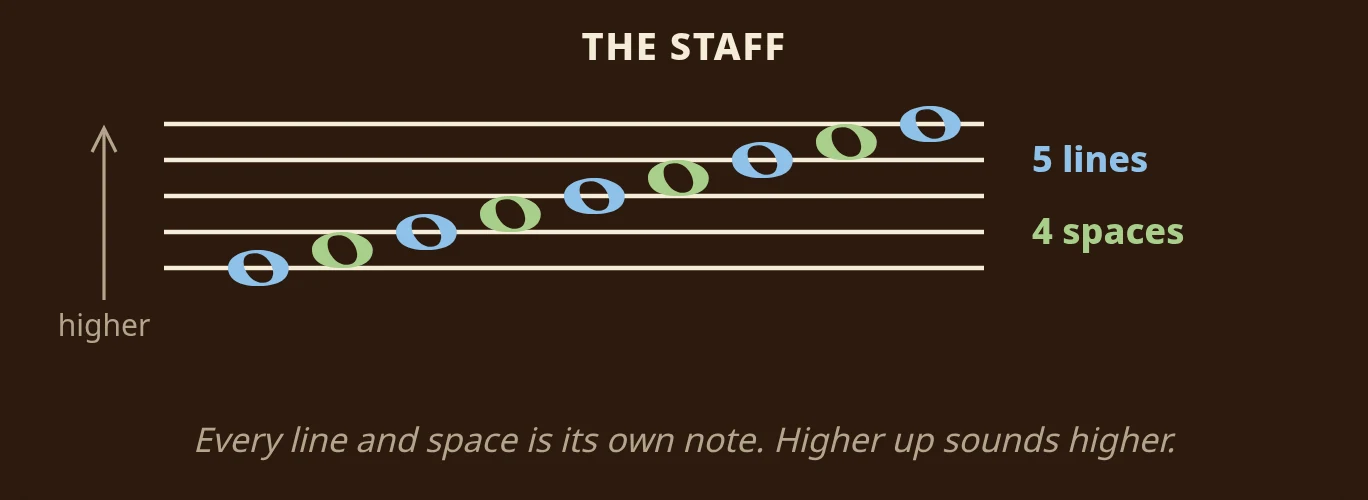
Notes are named after the first seven letters of the alphabet: A, B, C, D, E, F and G. After G, the letters start over at A. Each time you move up from a line to the space just above it, or from a space to the line above it, you move up one letter.
The treble clef
The symbol at the very start of the staff is called a clef, and it tells you which note each line and space stands for. The most common one is the treble clef, also called the G clef. Its curl wraps around the second line from the bottom, and that line is G.
The treble clef is used for higher sounding music: the right hand on the piano, most singing parts, and instruments like the violin, flute, clarinet, trumpet and saxophone.
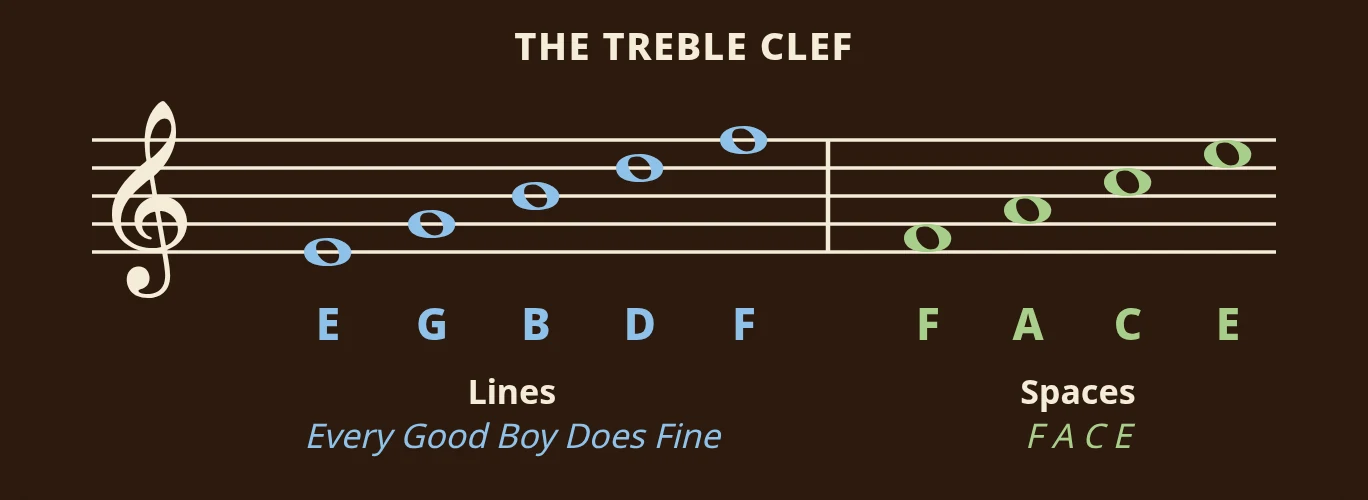
To remember the notes on the lines from bottom to top, most people use the phrase Every Good Boy Does Fine (E, G, B, D, F). The notes in the spaces spell the word FACE.
The bass clef
The bass clef, also called the F clef, is used for lower sounding music: the left hand on the piano, and instruments like the cello, trombone, tuba, bassoon and bass guitar. Its two dots sit on either side of the second line from the top, and that line is F.
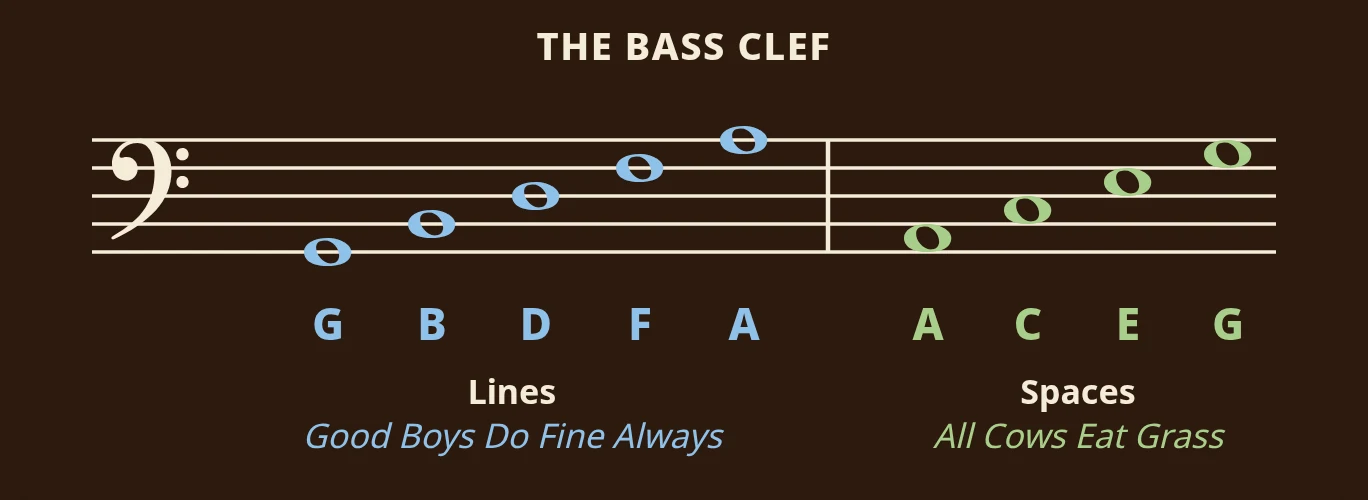
For the lines of the bass clef, from bottom to top, remember Good Boys Do Fine Always (G, B, D, F, A). For the spaces, remember All Cows Eat Grass (A, C, E, G).
Middle C and the grand staff
Piano music uses both clefs at once, joined on the left by a brace. This is called the grand staff. The treble staff sits on top for your right hand, and the bass staff sits below it for your left.
Between the two staves is middle C, written on a short extra line called a ledger line. It is the same note whether it is written just below the treble staff or just above the bass staff. On a piano, it is the C closest to the middle of the keyboard.
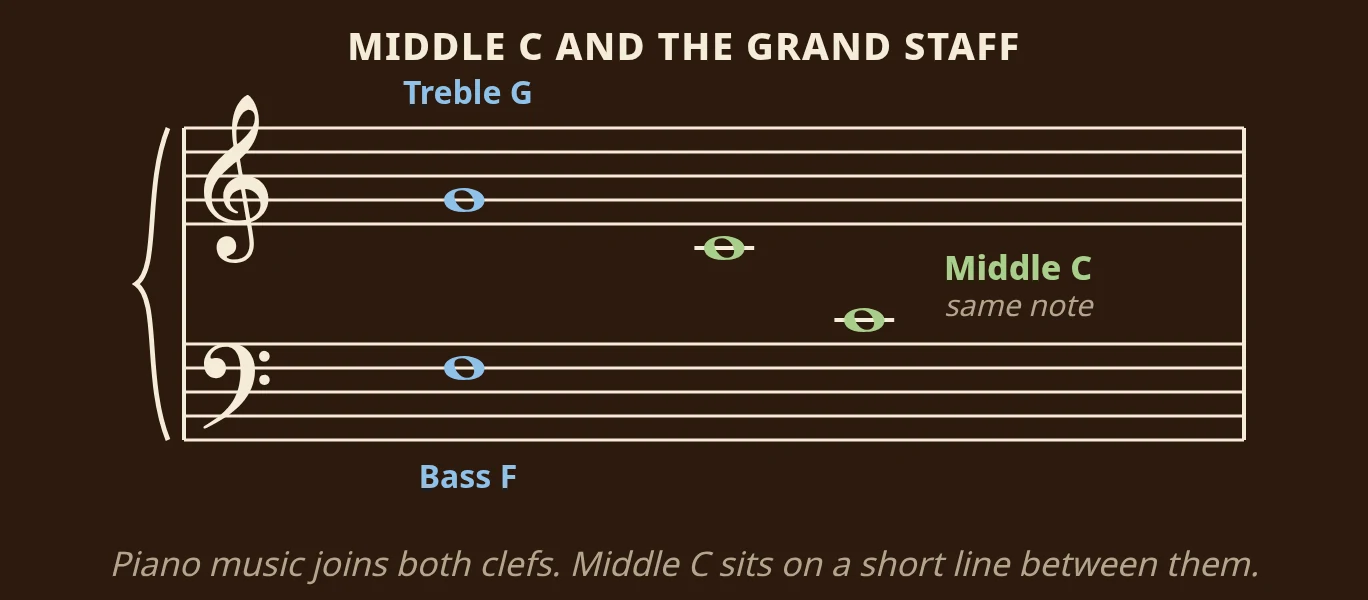
Once you know the phrases above, try learning a few landmark notes by heart: middle C, treble G and bass F. You can then find any other note by counting up or down from the nearest landmark, which is much faster than reciting a whole phrase every time.
Step 2: Learn the notes and how long they last
Where a note sits on the staff tells you which note to play. Its shape tells you how long to hold it.
The parts of a note
Every note is built from up to three parts: the note head, the stem and the flag.
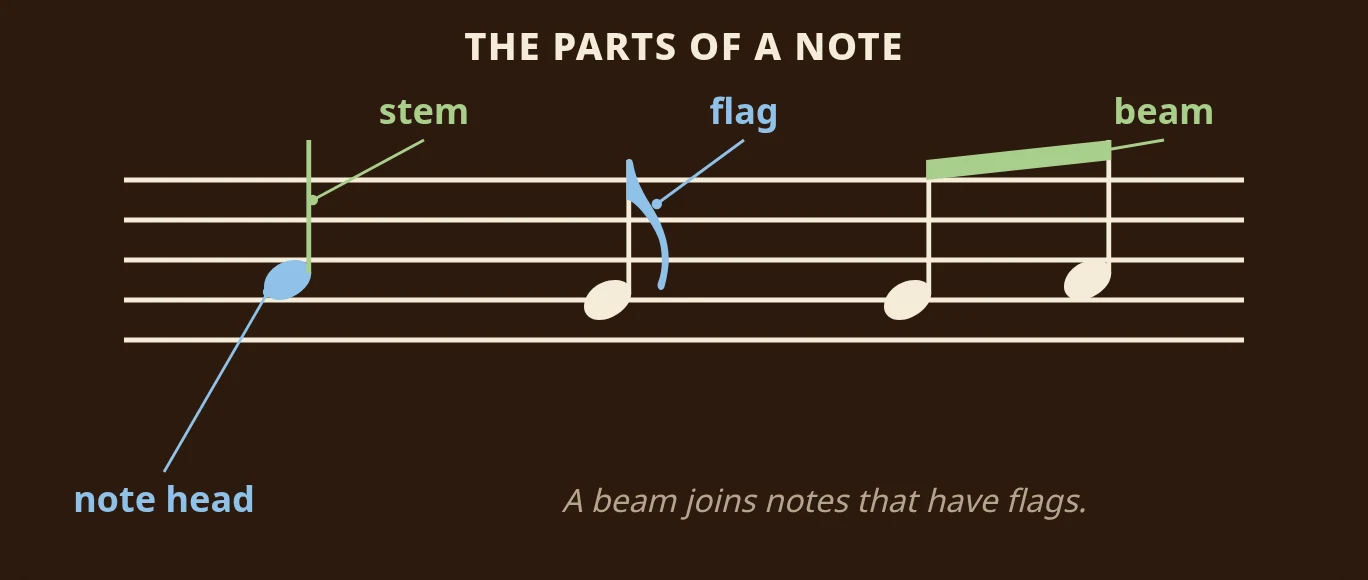
The note head is the oval. It can be filled in or left open, and where it sits on the staff tells you the pitch.
The stem is the thin line attached to the note head. It can point up or down, and the direction makes no difference to how you play the note: it just keeps the page tidy. Notes below the middle line usually have stems pointing up, and notes on or above it usually have stems pointing down.
The flag is the curl at the end of the stem, and it makes a note shorter. When several flagged notes sit next to each other, their flags are often joined into a thick line called a beam, which makes the rhythm easier to read at a glance.
Note lengths
Music is played to a steady beat, like the tick of a clock. Each type of note lasts for a set number of those beats.
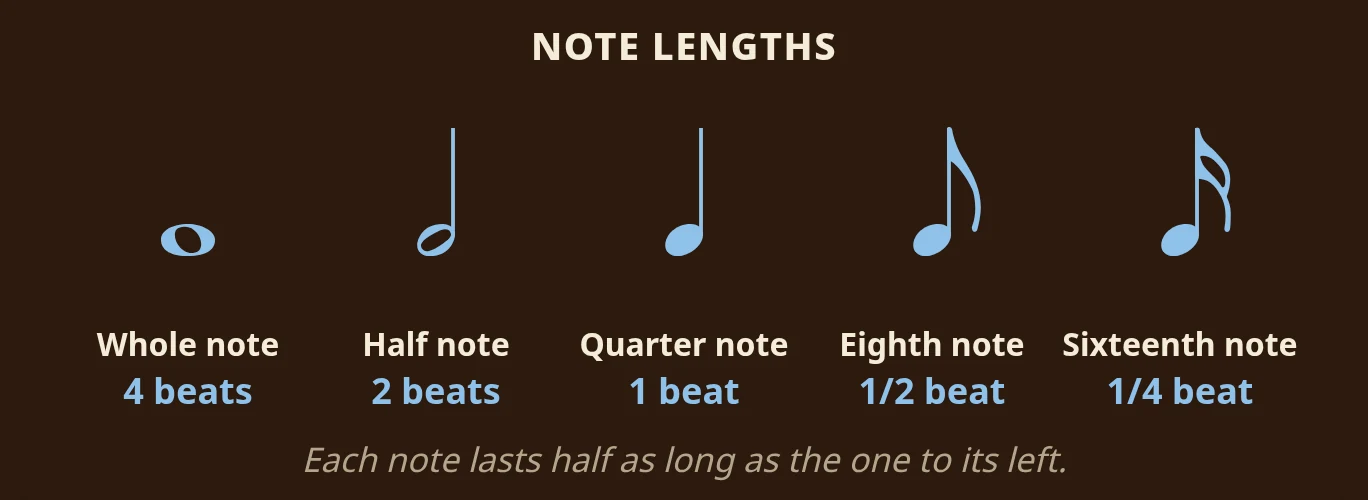
A whole note is an open note head with no stem, and it lasts four beats. A half note has an open head and a stem, and lasts two beats. A quarter note has a filled head and a stem, and lasts one beat. An eighth note adds a flag and lasts half a beat, and a sixteenth note has two flags and lasts a quarter of a beat.
Each note is exactly half as long as the one before it. Two half notes take the same time as one whole note, two quarter notes take the same time as one half note, and so on. (In British English, these are called the semibreve, minim, crotchet, quaver and semiquaver.)
Dots and ties
Sometimes a note needs a length that none of the shapes above can give. There are two ways to make that happen.
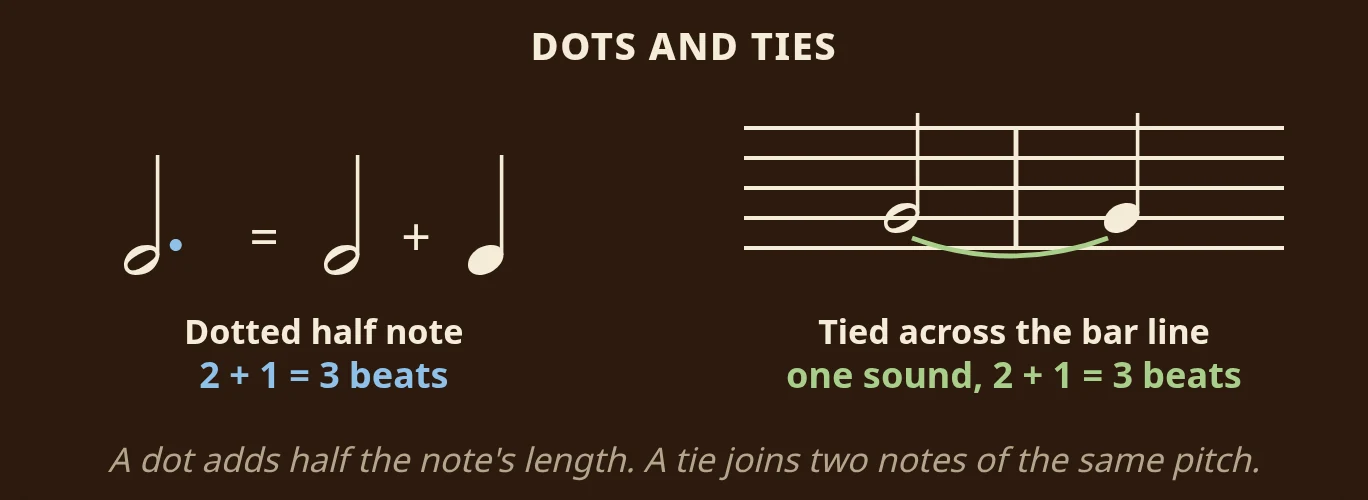
A dot after a note head adds half of that note's length. A half note lasts two beats, so a dotted half note lasts three. A dotted quarter note lasts one and a half beats.
A tie is a curved line that joins two notes of the same pitch. You play the first note and keep holding it through the second, without playing it again. Ties are often used to hold a note across a bar line.
Rests
Music is not only sound. Silence matters just as much, and it is written with rests. Every note length has a matching rest that lasts exactly as long.
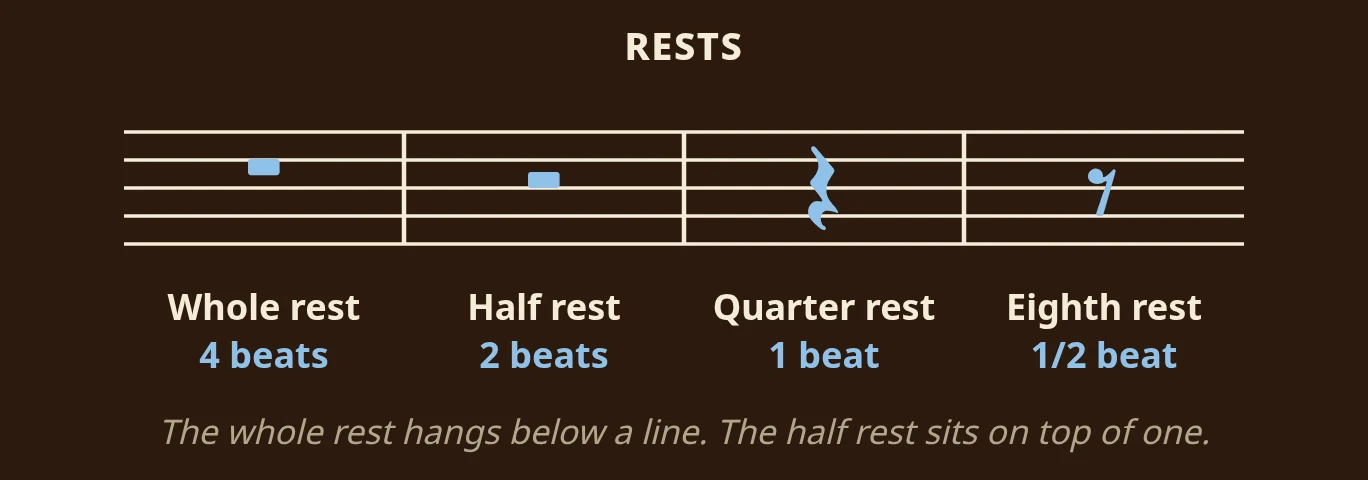
The whole rest and the half rest look almost the same, so here is a trick: the whole rest is heavier, so it hangs down from a line, while the half rest sits on top of a line like a hat. Many beginners rush past rests, so count them just as carefully as you count notes.
Step 3: Feel the beat
Now that you know how long each note lasts, you need to know how the beats are grouped. That is the job of the time signature.
The time signature
The time signature is the pair of numbers right after the clef, stacked like a fraction. The top number tells you how many beats are in each bar. The bottom number tells you which note gets one beat: a 4 means a quarter note, and an 8 means an eighth note.
Music is split into bars, also called measures, by thin vertical lines called bar lines. Every bar holds exactly the number of beats the time signature asks for.
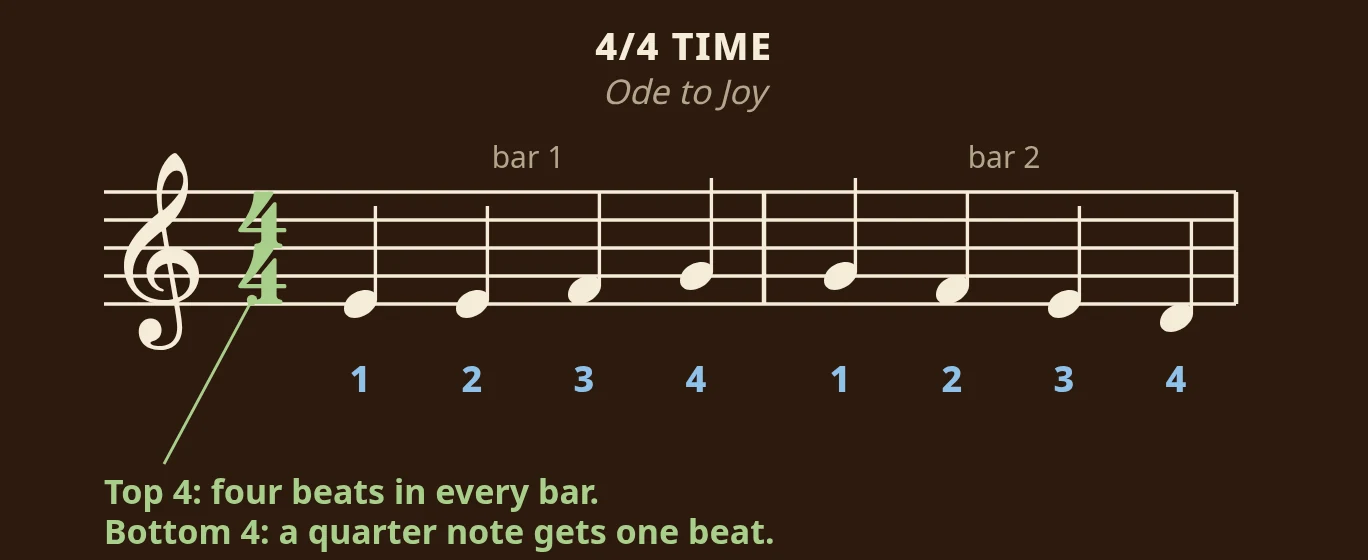
The most common time signature is 4/4, with four quarter note beats in every bar. It is so common that it is also called common time, and it is sometimes written as a large C instead of two numbers. Try counting the example above out loud, one count for each note: 1, 2, 3, 4, then 1, 2, 3, 4 again for the second bar.
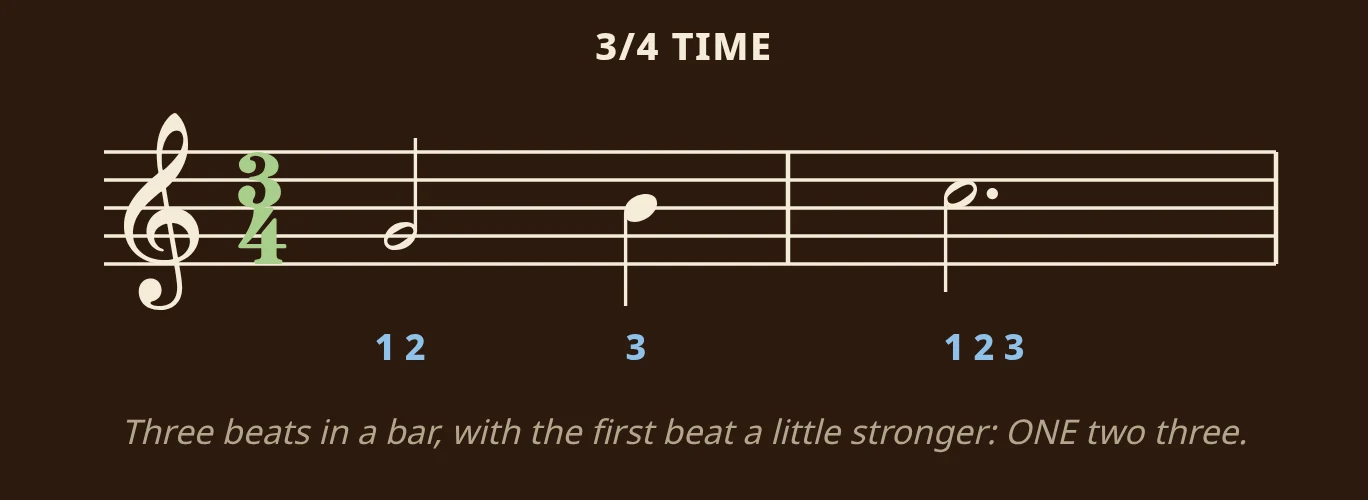
In 3/4 time, there are three beats in every bar. This is the time signature of the waltz. Count it as 1, 2, 3, 1, 2, 3, and lean a little on the first beat of each bar. In the example above, the half note takes the first two counts and the quarter note takes the third. In the second bar, the dotted half note lasts all three.
If a bar ever seems not to add up, look again. You have probably missed a dot, a tie or a rest. Apart from a short pickup bar at the very start of some pieces, every bar adds up.
Tempo
The time signature tells you how the beats are grouped, but not how fast they go. That is the tempo. It is written above the first bar, either as a number of beats per minute (a marking of 90 means 90 beats every minute) or as an Italian word. Adagio means slow, Andante means a walking pace, Moderato means moderate and Allegro means fast.
Step 4: Learn sharps, flats and key signatures
So far, every note we have looked at is a white key on the piano. To read the rest, you need to know about the black keys.
Whole steps and half steps
The distance from one key on the piano to the very next key, black or white, is called a half step (or semitone). Two half steps make a whole step (or whole tone).
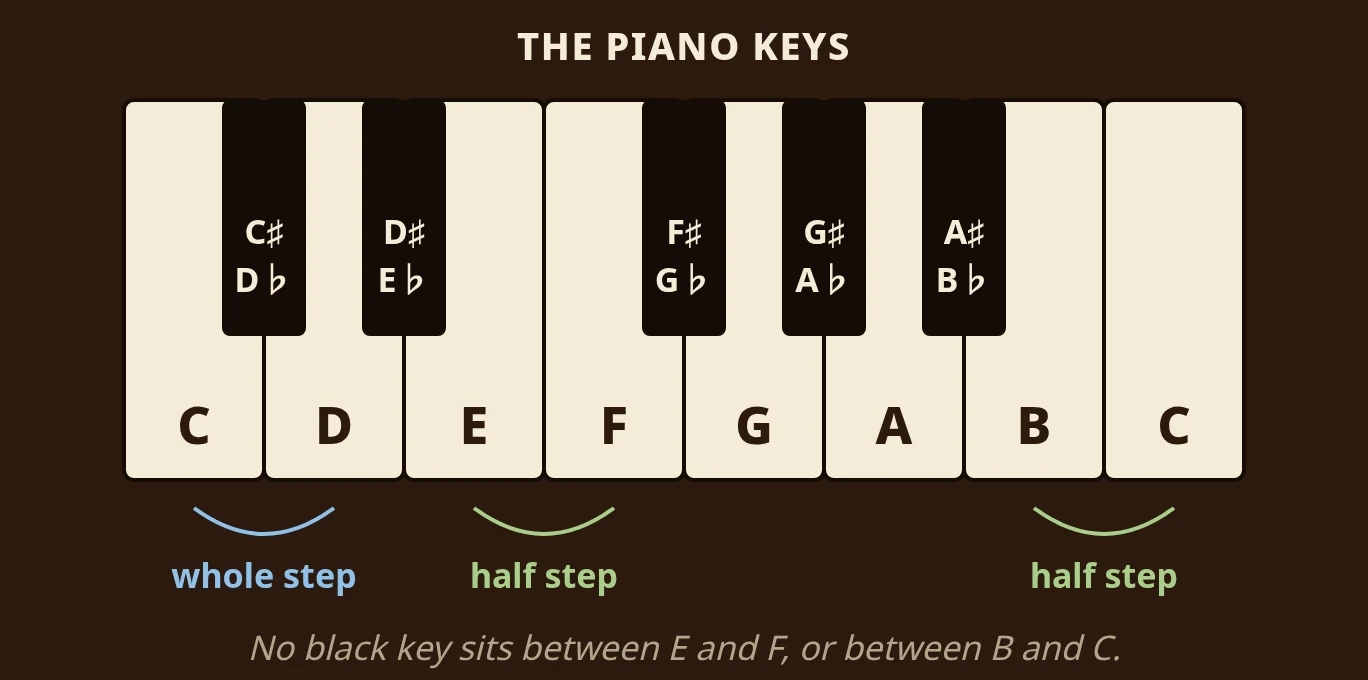
Most white keys have a black key between them, so C to D is a whole step. But there is no black key between E and F, or between B and C. Those two pairs are only a half step apart.
Sharps, flats and naturals
A sharp raises a note by a half step, and a flat lowers it by a half step. Both are written just before the note head, on the same line or space. So the black key just above F is F sharp, and the black key just below B is B flat. That also means every black key has two names: the key between C and D is both C sharp and D flat.
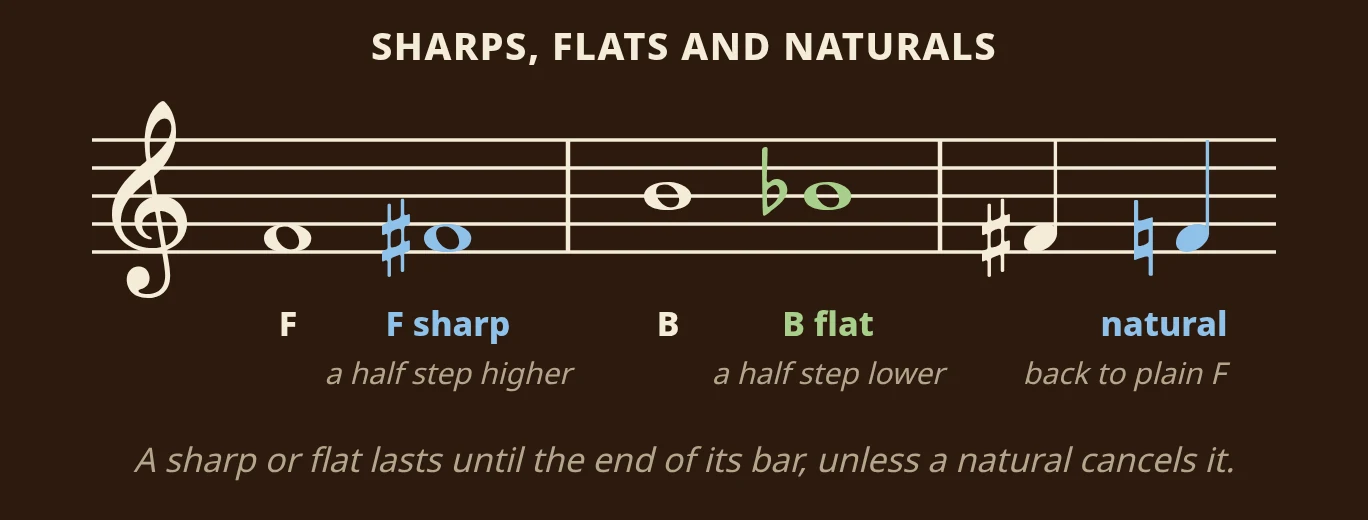
A natural cancels a sharp or a flat. Once a sharp or flat appears in a bar, it applies to every note on that line or space until the end of the bar. The next bar starts fresh.
Key signatures
Writing the same sharp or flat in front of every note would get crowded fast. Instead, music uses a key signature: a group of sharps or flats right after the clef, repeated at the start of every line.
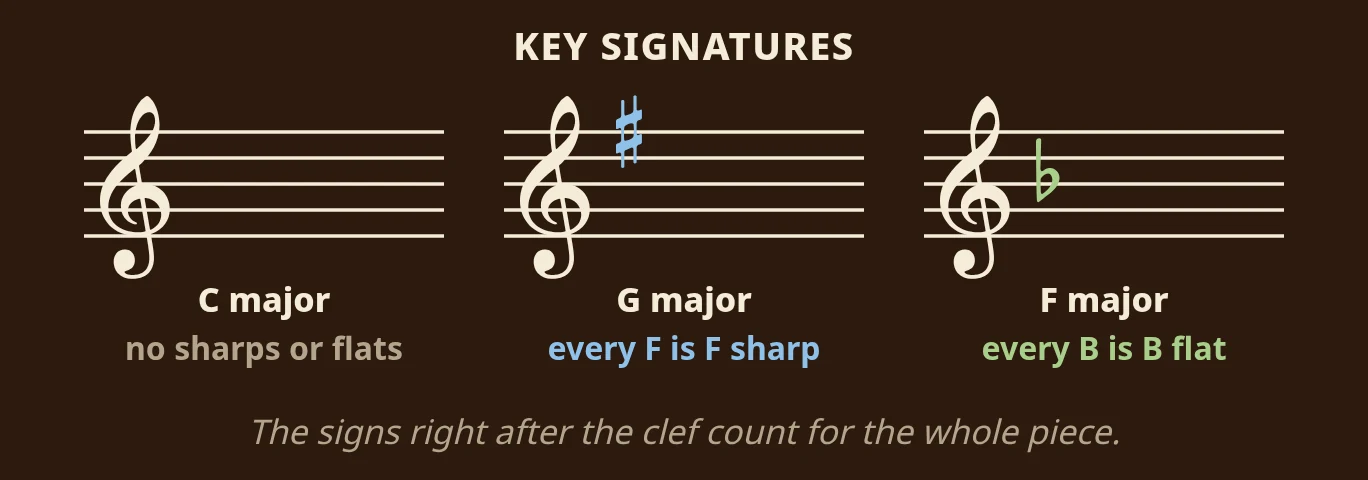
The key signature tells you which notes are sharp or flat for the whole piece. One sharp on the F line means every F you see is played as F sharp, in every octave, unless a natural says otherwise. That is the key of G major. One flat on the B line means every B is B flat, which is the key of F major. No sharps or flats at all usually means C major, which uses only the white keys.
Here is a shortcut for naming the key. With sharps, the key is a half step above the last sharp. With flats, the second to last flat is the name of the key, and a single flat always means F major.
Step 5: Play it with feeling
The notes tell you what to play. A few extra marks tell you how to play it, and this is what turns correct notes into music.
Dynamics
Dynamics tell you how loud or soft to play. They are written as letters under the staff, short for Italian words: p stands for piano, which means soft, and f stands for forte, which means loud. Add an m for mezzo, which means medium, or double the letter to go even further.
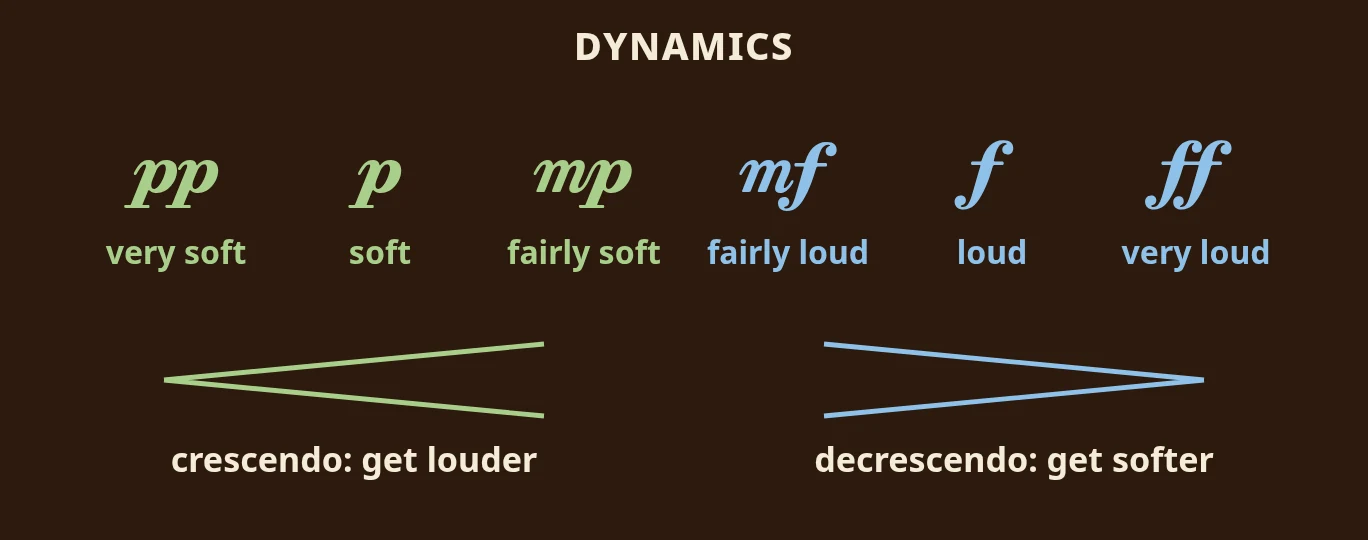
Long wedge shapes, called hairpins, show a gradual change. When the wedge opens up, get louder: that is a crescendo. When it closes, get softer: that is a decrescendo, also called a diminuendo.
Articulation
Articulation marks tell you how to start and shape each note.
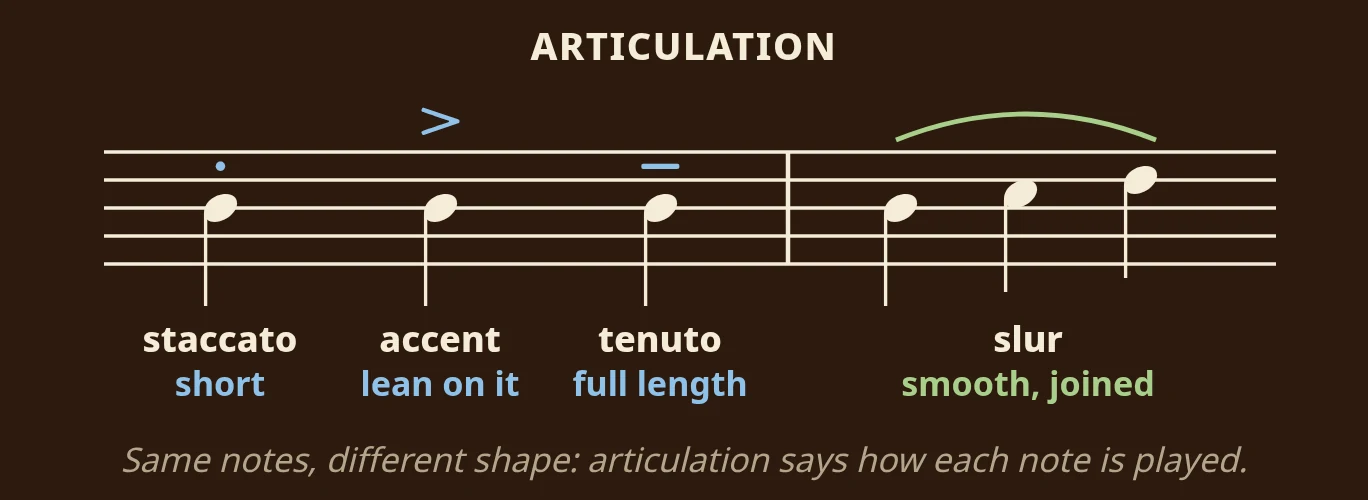
A dot above or below the note head means staccato: play it short and detached. A sideways V (>) is an accent: play that note a little stronger. A short line is a tenuto: hold the note for its full length. A curved line over notes of different pitches is a slur: play them smoothly, connected in one breath or one bow. Be careful not to mix up a slur with a tie, which joins two notes of the same pitch.
Step 6: Practice with a way to check yourself
Knowing the rules is one thing. Reading fluently takes practice, and the best practice is short, with a check after every attempt. Here is a simple routine that takes about ten minutes a day:
- Pick one line of new music that is a little easier than what you usually play.
- Before you touch your instrument, name the notes of the first bar and clap the rhythm while counting out loud.
- Play the bar once, slowly, without stopping to fix anything.
- Listen to how the bar is supposed to sound, and compare.
- Fix whatever was different, then move on to the next bar.
The listening step is the one most people skip, because it is hard to know what a bar should sound like before you can play it well. That is what we built Sheetly for. Take a photo of a printed page with your iPhone or iPad, and Sheetly plays it back to you with a playhead that follows the notes. You can slow it down, loop a single bar, or ask the built-in coach what a symbol means or why a bar does not add up. Whether you take lessons or teach yourself, it gives you an answer key for every bar you practice.
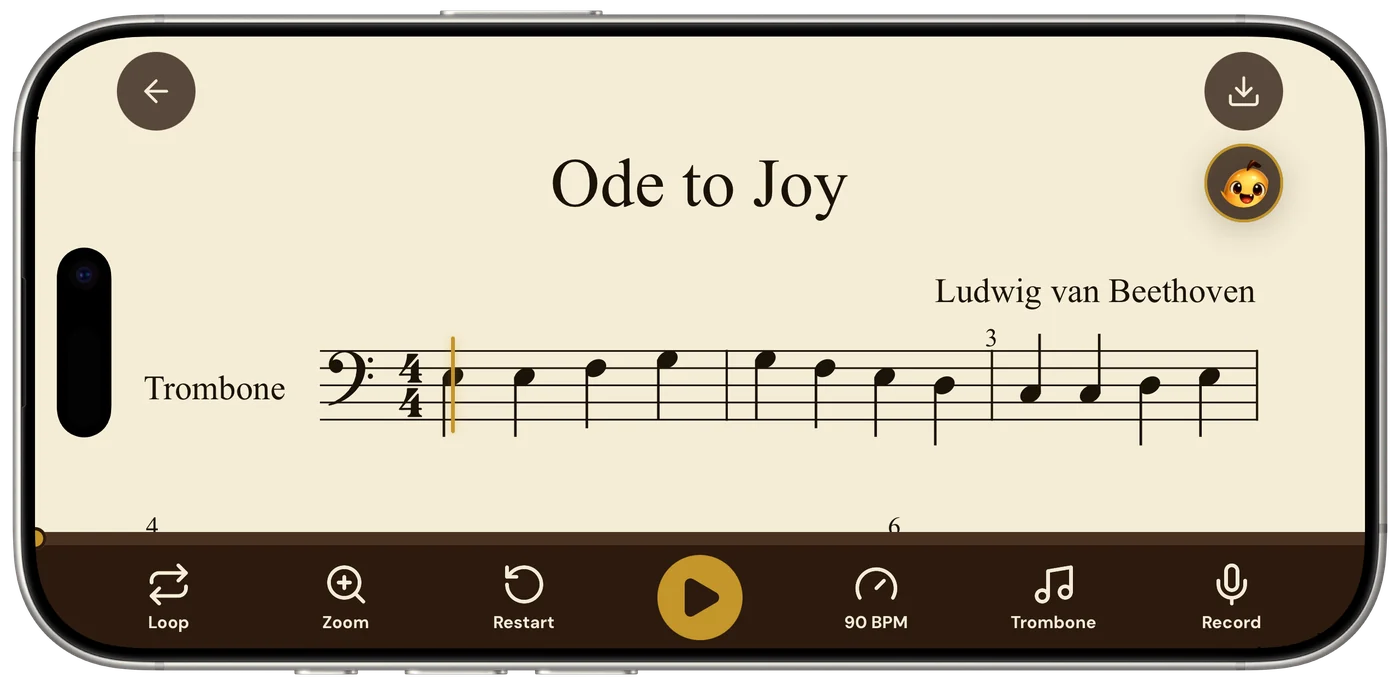
Use playback as your answer key, not as a shortcut: read the bar first, then press play. The gap between reading and checking is where you learn the most.
Questions
How long does it take to learn to read sheet music?
You can learn the basic rules in a few days. Reading comfortably, without working out each note one at a time, usually takes a few months of short daily practice. The more new music you read, the faster it comes.
Can adults learn to read sheet music?
Yes. The rules are the same at any age, and adults often pick up the theory faster than children because they can practice on purpose. Start with the steps above and read a little every day.
Should I learn the treble clef or the bass clef first?
Learn the clef your instrument uses. Piano players need both, and most start with the treble clef for the right hand, then add the bass clef for the left.
Can an app teach me to read sheet music?
An app can show you what a bar is supposed to sound like, so you can check yourself every time you practice. Sheetly plays a printed page you photograph, one bar at a time if you want, and its coach answers questions about the notes on that page. The reading itself still comes from your own practice.