The Music Symbols Sheetly Reads: All 118, Counted
Wondering which music symbols Sheetly can read from a photo? In this guide, we list all 118 printed notation marks it reads, family by family, how we count them, and the things it cannot read yet.

Have you ever photographed a page of music and wondered whether the app really read everything on it: the repeat signs, the first and second endings, the D.S. al Coda, the dynamics? It is a fair question. A scanner that misses one repeat sign plays the wrong bars, and one that misreads a clef shifts every note on the line.
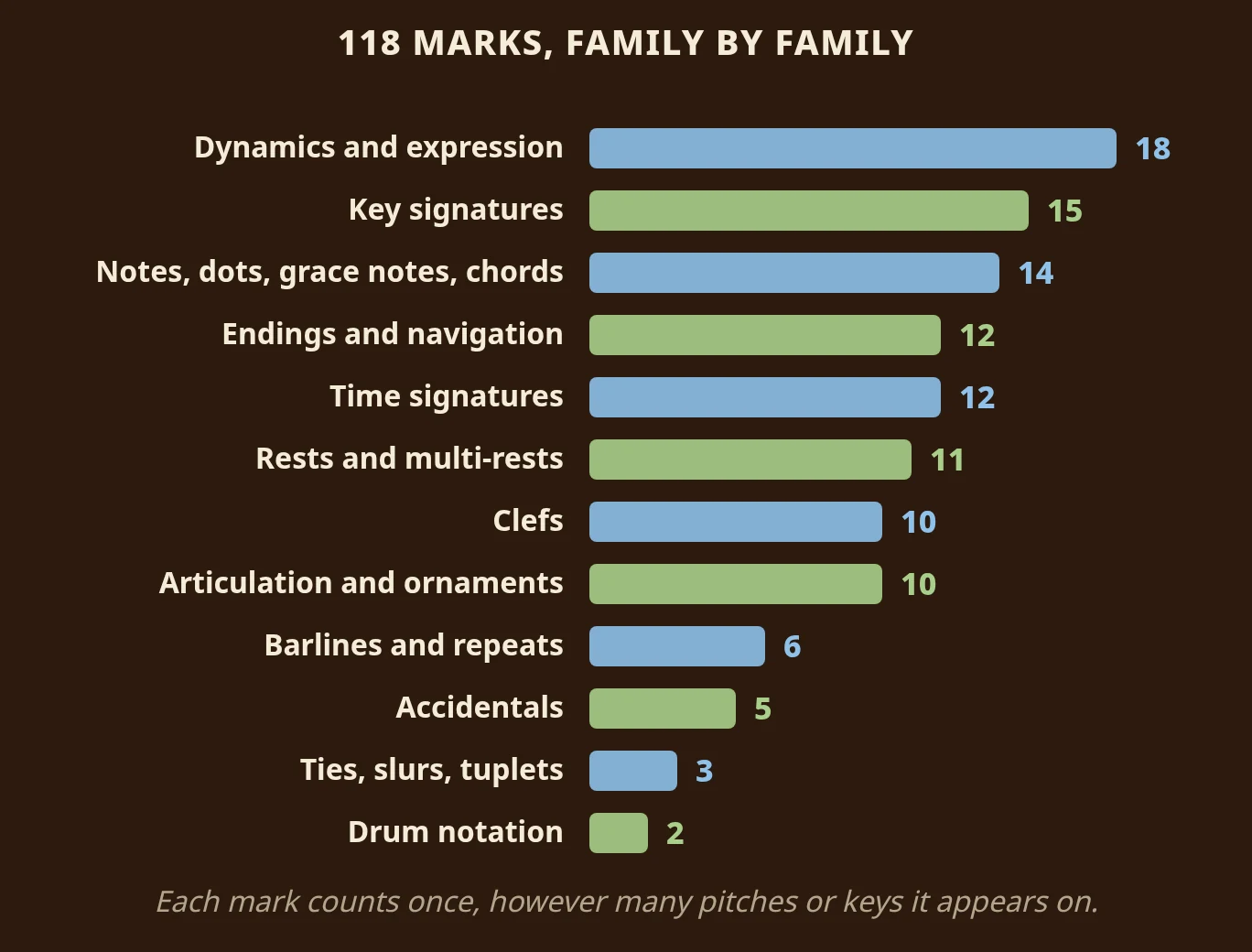
So here is the honest answer. Sheetly reads 118 distinct printed notation marks: every clef position, key signature and time signature, all five accidentals, repeats and endings, D.C. and D.S., ties, tuplets, articulations, ornaments, dynamics on single-line parts, and drum notation. Each mark is counted once, not once per pitch, octave or key.
In this guide, we explain how we count, then go through every family of symbols with what Sheetly reads and how. At the end is a plain list of the eight things Sheetly cannot read yet. If you want to know what each of these marks means for a player, our guide to sheet music symbols explained covers that side.
How we count: each mark once
It would be easy to make the number much bigger by counting every sharp on every line and space, or every dotted variant of every note. We would rather publish the small number and the rule behind it:
- A mark counts once, however many pitches, octaves or keys it can appear on. A sharp is one mark, not thirty-five.
- Combinations do not count extra. A staccato under a slur is two marks, not a third.
- An open-ended family, such as any multi-measure rest length, counts once.
This page says what the scanner can read. How often it reads it correctly is a separate question, answered by our open accuracy benchmark, which publishes the test pages, the answer key and the scoring code so anyone can check the figures. On that benchmark, Sheetly measures 97.37% strict note F1 on clean scores and 97.34% on phone photographs of the same pieces.
Clefs: 10 positions
Sheetly reads the treble (G) clef on lines 1 and 2, the bass (F) clef on lines 3, 4 and 5, and the C clef on all five lines. That covers alto and tenor clef for viola, trombone, bassoon and cello parts.
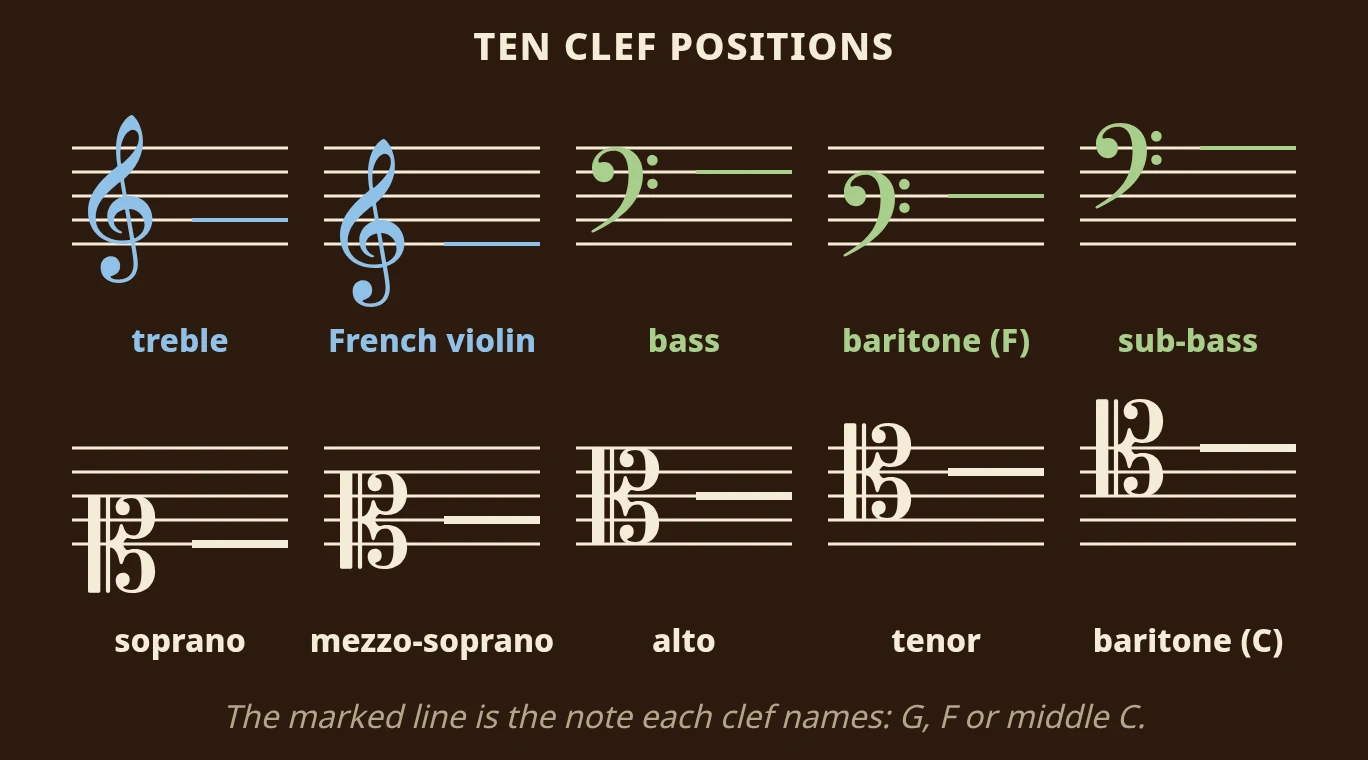
Each clef is also checked after the page is read. The clef's shape is matched against what the reader decided it was, so a treble clef misread as an alto clef, which would shift every note on the line, is caught and corrected.
Key signatures: all 15
C major and A minor with no sharps or flats, the seven sharp keys from one sharp (G major) to seven (C sharp major), and the seven flat keys from one flat (F major) to seven (C flat major). Key changes are read wherever a new key signature is printed. To name a key from its signature, see our guide to reading key signatures.
Time signatures: 12 forms
Number time signatures with bottom numbers of 1, 2, 3, 4, 6, 8, 12, 16, 32 and 48, plus common time (C) and cut time (C with a line through it). That covers everything from 2/2 and 3/4 to 6/8, 12/8 and unusual meters.
The time signature at the start of the first line also gets a second, separate read from the page image, which catches a 3/4 versus 6/8 mix-up. Meter changes are read where printed, and a short pickup bar at the start stays a pickup instead of being padded out.
Notes, rests and accidentals
Notes and durations: 13 marks, plus chords
Ten note values (long, breve, whole, half, quarter, eighth, sixteenth, thirty-second, sixty-fourth and hundred-twenty-eighth notes), plus the dot, the double dot and grace notes. Chords, meaning note heads that share a stem, are read as chords, and a staff with two independent voices, as in hymn books and a lot of piano music, keeps them separate. Pitch is read across the full printed range, ledger lines included.
Rests: 11 marks
The same ten values as notes, dotted where printed, plus the multi-measure rest: the thick bar with a number above it that squeezes many silent bars into one. Band and orchestra parts are full of these, so the bar and its number are located directly on the page image. A "12 bars of rest" sign becomes exactly twelve bars, in the right place, and in the player the rest is counted out bar by bar with a counter on screen. Our guide on counting multi-measure rests explains how to use that when you practice.
Accidentals: all 5
Sharp, flat, natural, double sharp and double flat, read note by note where printed, on top of whatever the key signature already applies.
Barlines, repeats, endings and navigation
Barlines and repeats: 6
Single, double and final barlines, plus the start repeat, the end repeat, and the back-to-back end-and-start repeat. Repeat dots are small and easily lost on a busy page, which makes them a classic scanner mistake. So a second, dedicated reader looks for the two dots beside a double barline, lined up with the staff, and combines its answer with the main read. A repeat sign is either on the page or it is not: nothing is guessed from context.
Endings and navigation: 12
- Ending brackets (3): first and second endings, and the open-ended form.
- Navigation (8): segno, coda, To Coda, Fine, D.C. al Fine, D.C. al Coda, D.S. al Fine and D.S. al Coda.
- One-bar repeat (1): the sign that means "play the previous bar again", which is expanded into the repeated bars rather than read as silence.
Written instructions like D.S. al Coda are read as text against a fixed list of words. The segno and coda signs, which have no text, are found by matching their shape above each staff.
Ties, articulation and dynamics
Ties, slurs and tuplets: 3
Every curved line is first read as a slur. A separate step then turns the ones that join two adjacent notes of the same pitch into ties, so a held note sounds held, not played twice. A tie needs both ends and matching pitches: if one end is missing, it is left out, not guessed. Tuplets are read with their ratios, triplets and unusual groups alike. For more on the difference, see dotted notes and ties and reading triplets.
Articulation and ornaments: 10
- Articulation (5): staccato, staccatissimo, accent, tenuto and fermata.
- Ornaments and effects (5): trill, turn, tremolo, arpeggio and breath mark.
Printed combinations, such as an accented staccato or a fermata over a trill, are read too, without adding to the count.
Dynamics and expression: 18
On a single-line part, meaning one instrument on one staff such as a band part or a solo line, Sheetly reads loudness and expression marks, and playback follows them: a p plays soft until the next dynamic, and an sfz lands on its note.
- Dynamics (14): ppp, pp, p, mp, mf, f, ff, fff, sf, sfz, fz, rfz, fp and sfp.
- Hairpins (2): crescendo and diminuendo.
- Rehearsal marks (1): the boxed letters and numbers a band uses to say "from letter B".
- Expression and tempo words (1): cresc., dim., rit., rall., accel., a tempo, dolce, Solo, Tutti and the other common ones, counted once as a family.
Piano music and scores with several parts are not read for these marks yet. Each mark is checked against a fixed list, and an uncertain one is left out rather than guessed.
Drum notation: 2
Drum parts are read on a five-line staff, or on a one-line staff for claps and single instruments. Each hit is matched to its drum by its place on the staff, and the part plays back on a drum kit. The two marks are the percussion clef and X note heads, used for hi-hat, cymbals and other x-headed hits.
Layout: read, but not counted
Some things are not symbols but are still part of reading a page: the grand staff (two braced staves, as in piano music), multi-staff systems, lines of unequal width, pickup bars, mid-piece key and time changes, and the printed title and composer, which are attached to the score. A clear printed metronome mark sets the starting tempo. Otherwise the tempo is estimated and labeled as estimated, never passed off as printed.
Eight things Sheetly cannot read yet
When a page contains one of these, the mark is skipped and everything around it is read normally.
- Dynamics on piano music and full scores. They are read on single-line parts, not yet on a grand staff or a score with several parts.
- Lyrics. The notes of a vocal line, yes. The words under them, no.
- Octave lines. 8va and 8vb passages are played at written pitch.
- Chord symbols and chord diagrams above the staff in lead sheets.
- Fingering numbers and pedal marks.
- Glissando lines.
- Handwritten music. Sheetly reads printed and engraved notation.
- Guitar tablature.
The rule across the whole reader is simple: read it from the page or leave it out, never invent it. If a mark you care about is on this list, tell us at hello@trysheetly.com. This page changes when the reader does.
See it read your own page
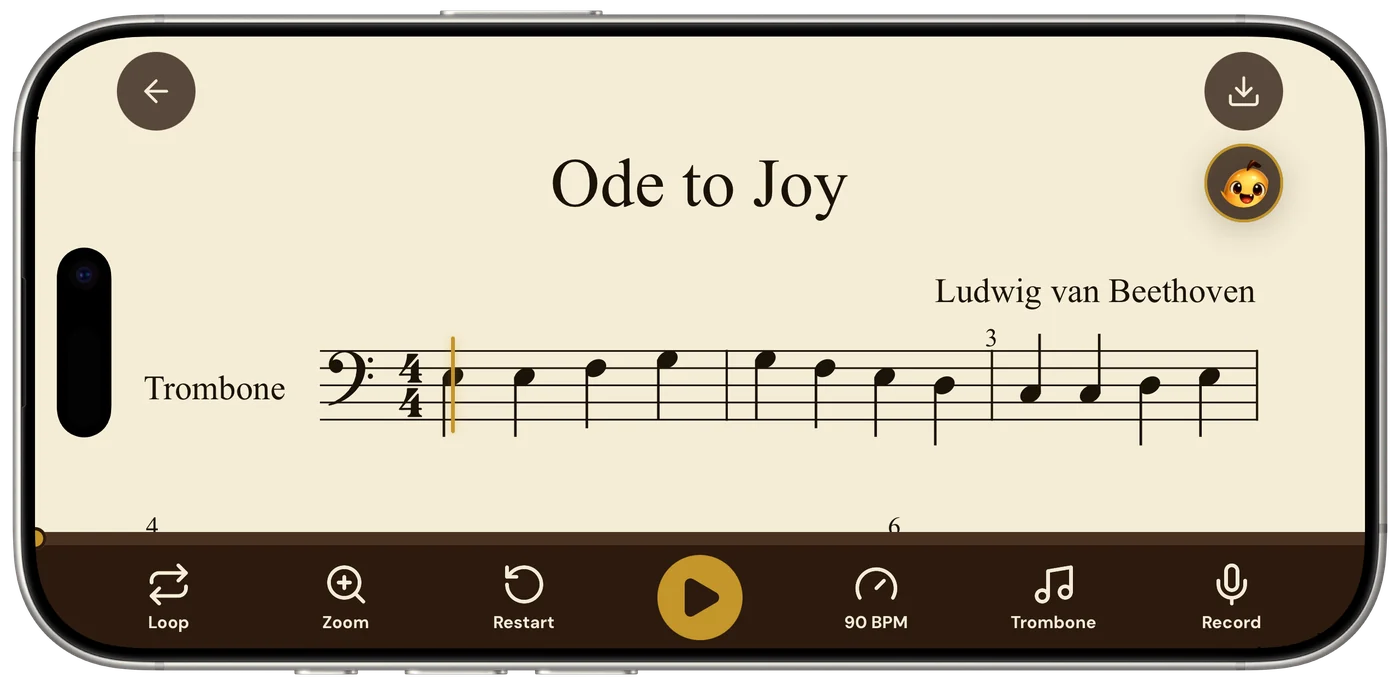
The quickest way to find out how Sheetly handles your music is to try it on a page you know. Take a photo of a printed page with your iPhone or iPad, and Sheetly plays it back with a playhead that follows the notes, through the repeats and endings it has read. If a symbol puzzles you, ask the built-in coach what it means in that bar of your page. Our guide on how to scan sheet music has tips for a clean photo.
Questions
Does Sheetly read repeat signs and D.S. al Coda?
Yes. It reads start and end repeats, first and second endings, segno, coda, To Coda, Fine, and all four D.C. and D.S. instructions, plus the one-bar repeat sign.
Does Sheetly read dynamics?
On single-line parts, such as a band part or a solo line, yes: fourteen dynamic marks, hairpins and common expression words, and playback follows them. On piano music and full scores, not yet.
What is the difference between common time and cut time?
Common time, written C, is 4/4: four quarter note beats in a bar. Cut time, written as a C with a vertical line through it, is 2/2: the same length of bar, felt in two half note beats.
What does D.S. al Coda mean?
Dal segno al coda means go back to the segno sign, play on until the To Coda mark, then jump to the coda. Da capo al coda is the same, except that you go back to the beginning instead of the segno.