How to Prepare for an All-State Band Audition: An Eight-Week Plan
Wondering how to prepare for an all-state band audition? In this guide, we share what judges usually ask for, an eight-week plan for your etudes, scales and sight-reading, and what to do on the day.


Have you just found out you are going to audition for all-state band? Maybe your director suggested it, maybe you have been dreaming about it for years, or maybe you are not quite sure what you have signed up for. Either way, the audition can feel huge: prepared music, scales, sight-reading, judges you may never even see.
The good news is that an all-state audition rewards steady, organized practice more than talent or luck. Most auditions combine the same three things: prepared etudes or excerpts, a set of scales and some sight-reading. If you practice all three a little every day, in the right order, you will walk into the room ready.
In this guide, we show you how to prepare for an all-state band audition step by step: how to find your exact requirements, an eight-week practice plan, how to practice each part, and what to do on the day itself. Each part comes with a picture, and the plan works whether you take private lessons or prepare mostly on your own.
Step 1: Get your state's exact requirements
Every state runs its auditions differently, often with district, region or area rounds first. The requirements also differ by instrument. So before you practice anything, get the official requirements for your instrument from your band director or from your state's music educators association, which publishes them each year.
Read them carefully and check:
- Which etudes or excerpts, from which book and which edition, with the exact start and end measures.
- The required tempo, if one is given.
- Which scales, how many octaves, whether they must be memorized, and at what tempo. Many states include a chromatic scale.
- Whether there is sight-reading, and how long you get to look at it.
- Whether the audition is screened, as it is in many states: the judges hear you but cannot see you.
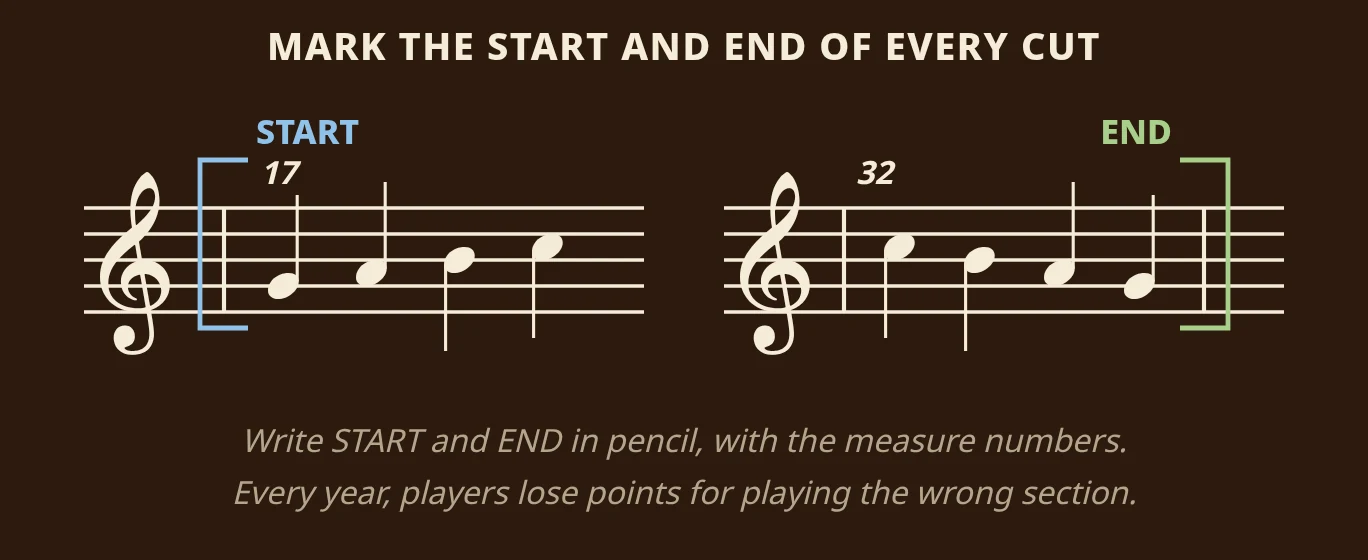
Then take a pencil and mark the start and end of every cut in your music, with the measure numbers. It sounds obvious, but every year some players lose points simply for playing the wrong section.
Step 2: Know what the judges listen for
Judging sheets differ from state to state, but most judges score the same handful of things.
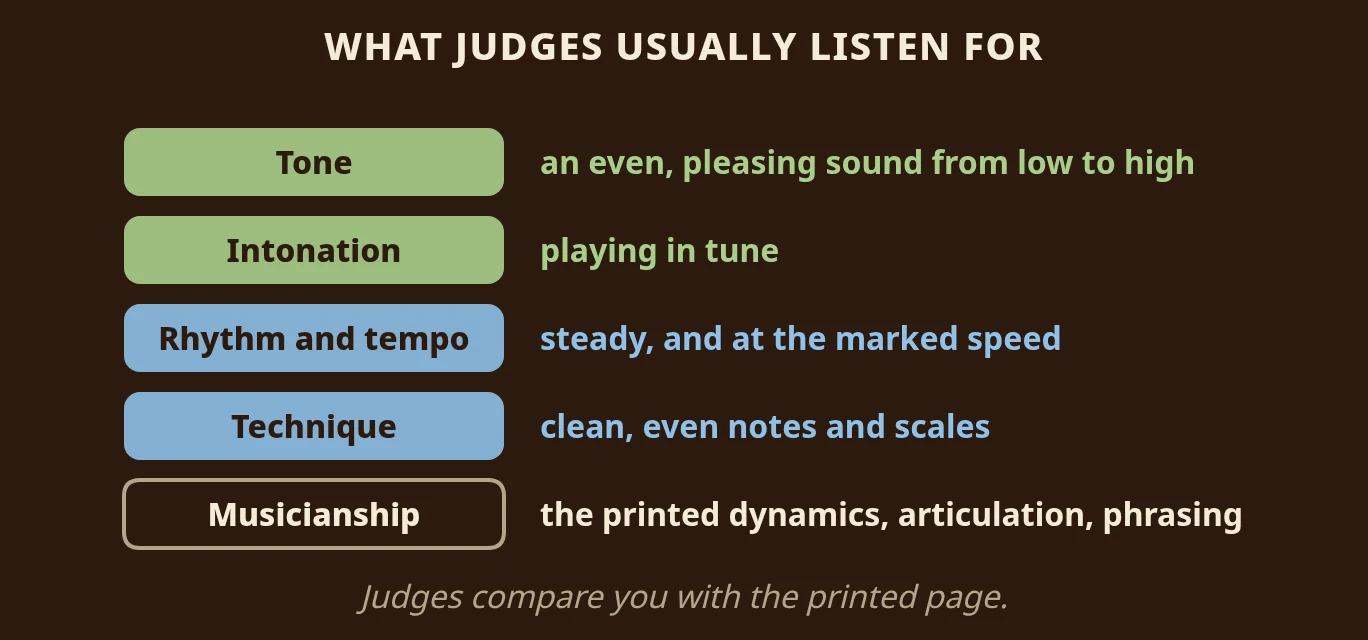
Tone is the quality of your sound, from your lowest notes to your highest. Intonation is playing in tune. Rhythm and tempo means steady, accurate rhythms at the marked speed. Technique is clean, even notes, especially in fast passages and scales. Musicianship is everything else printed on the page: dynamics, articulation and phrasing.
That last one surprises many students. Judges compare you with the printed music, so every dynamic, slur, accent and tempo change should be heard. Two players with the same notes can get very different scores because one played the markings and the other did not.
Step 3: Follow an eight-week plan
Practice 30 to 60 minutes a day, split across your etudes, your scales and a page of sight-reading. If your audition is more or less than eight weeks away, shift the weeks to fit your calendar. The order of the phases matters more than the exact dates.
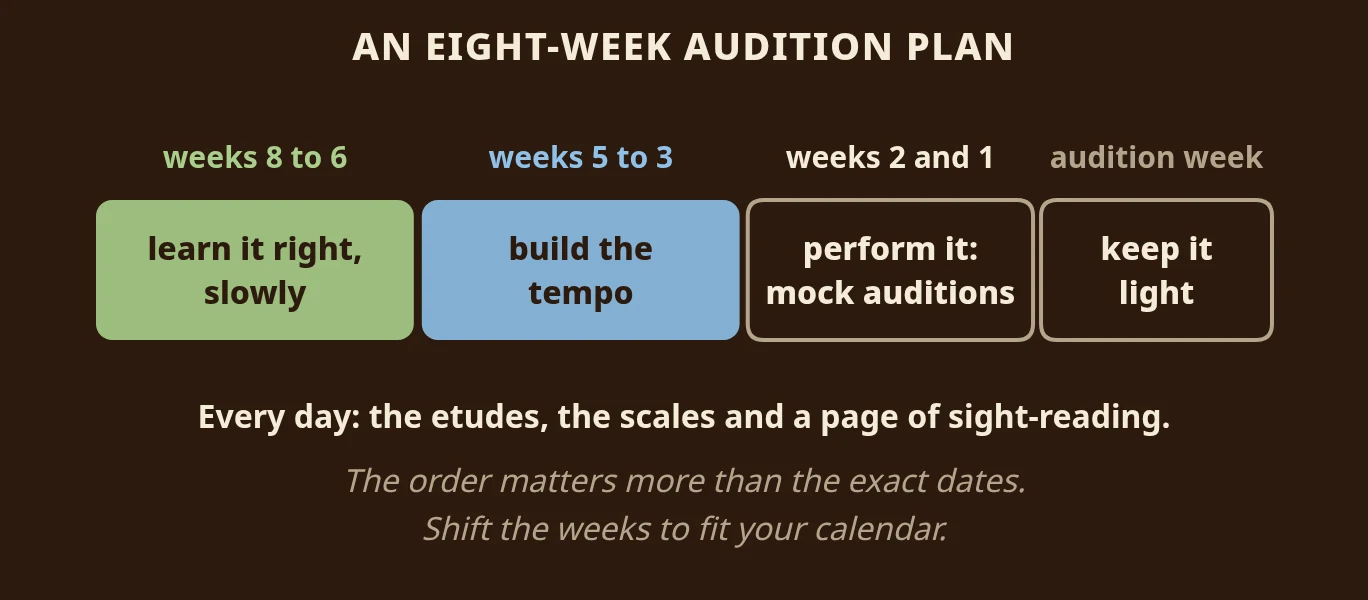
Weeks 8 to 6: learn it right, slowly
First, find out how each etude should sound: a recording, your teacher, or an app that plays the page. Then learn it slowly enough that every note, rhythm and articulation is correct from the start. Begin with the hardest passages, not the first line. If your etude has no recording, our guide on learning a piece you have never heard shows how to hear it before you practice it.
Weeks 5 to 3: build the tempo
Now bring the speed up. Loop the hard passages and raise the metronome by a few beats only after three clean repetitions in a row. Our guide on slowing it down and walking it back up explains this tempo ladder in detail. Rotate through all your scales every day, and record a full run of each etude once a week.
Weeks 2 and 1: perform it
By now you should be at full tempo. Hold mock auditions for family, friends or your teacher: one take, no restarts, and scales asked in a random order. Keep sight-reading a new page every day.
Audition week: keep it light
Shorter practice sessions, full run-throughs, and nothing new. Check your equipment: reeds, valve oil or slide cream, spare strings, and your music with the cuts marked.
Step 4: Practice each part the right way
Etudes and excerpts
Once the notes are secure, go through the etude one marking at a time: every dynamic, every slur, every accent. Then record yourself and listen as a judge would. Is the rhythm steady? Is your tone even from low to high? Do the dynamics really change, or only a little? Our guide on recording a take and hearing yourself back shows how to get the most out of it.
Scales
Use a metronome every time. A steady tempo and a good sound, in the articulation your state asks for, beat speed. Most players rush the chromatic scale or lose track of its range, so give it a few slow minutes every day. If you play a transposing instrument, make sure you know which written scales your state means: our guide to transposing instruments explains concert and written pitch.
Sight-reading
Ten minutes a day of new, easy music builds sight-reading faster than anything else. In the audition room, use the look-over time to check the key, time signature, tempo, hardest rhythm, accidentals and repeats. Then choose a tempo you can hold, and do not stop. Our guide on how to get better at sight-reading has the full daily routine.
Step 5: On the day, warm up and keep going
- Warm up properly. Long tones, a few scales, the opening of each etude, then tune.
- Set the tempo before you play. Hear the first measure in your head. If the tempo is given as a range, play where you are clean.
- Keep going after a mistake. Stopping costs more than a wrong note, because judges score the whole performance. Don't react, apologize or restart unless you are told you may.
- Follow the room rules. A screened audition may ask you not to speak, so you stay anonymous.
- Take your time between pieces. Breathe, reset, then start.
Practice an etude that has no recording
Many audition etudes have no recording, or only one at a different tempo or from a different edition. That makes the first weeks hard, because you cannot easily check that you are learning the right rhythms.
Sheetly helps here. Take a photo of the etude with your iPhone or iPad, and Sheetly plays it back in your instrument's sound, with a playhead that follows the notes. Loop the four measures that keep breaking, slow them down, walk the tempo back up, then record a take and hear yourself back against the score. On trombone, trumpet, euphonium, tuba, violin, viola and cello, the built-in coach can also tell you the slide position, valves or string for any note on your page. If you have never scanned a part before, our guide on how to scan sheet music and hear it played back shows how to take a photo of your etude that reads cleanly.
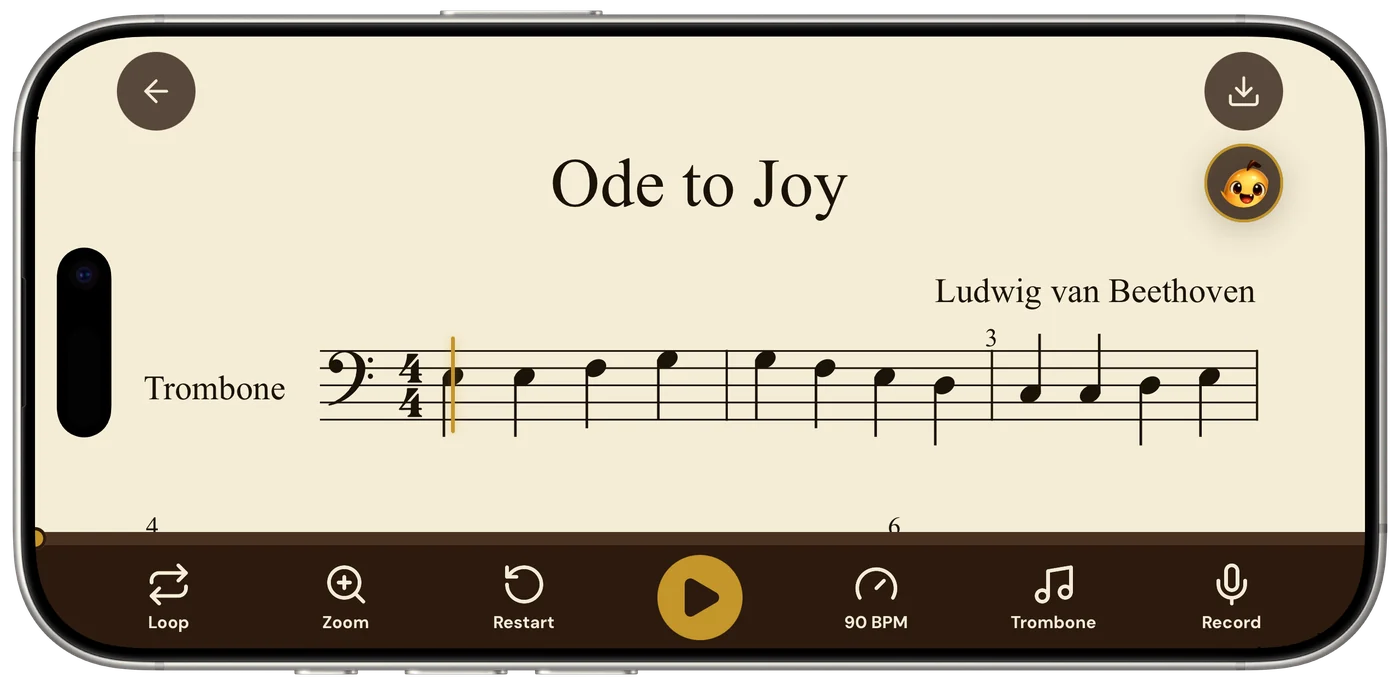
Use it as a guide in the first weeks and as a check later on. By audition day, the music should live in your hands and your ears, not on a screen.
Questions
How long should I practice for an all-state audition?
About 30 to 60 minutes a day for around eight weeks, split across your etudes, scales and sight-reading. Short daily practice works better than long sessions once a week.
What is a chromatic scale?
A chromatic scale moves up or down by half steps, playing all twelve notes in each octave, sharps and flats included.
What is an excerpt in an audition?
An audition excerpt is a passage cut from a longer band or orchestra work, with set start and end measures. Mark both in pencil so you play exactly the right section.
What should I do if I make a mistake in the audition?
Keep going. Judges score the whole performance, and a stop costs more than a wrong note. Don't react or apologize, and only restart if you are told you may.