Slow It Down, Then Walk It Back Up: How to Practice Slowly and Reach Full Tempo
Does a passage fall apart every time you play it at full speed? In this guide, we explain how slow practice works, how slow to go, and a simple tempo ladder that walks any passage back up to the written tempo.


Most of us practise a new passage the same way: we play it at full speed, it falls apart, and we play it at full speed again, a little more frustrated each time. If you have ever wondered why a passage never seems to get better no matter how often you play it, the answer is usually speed. The best fix is to slow it down, then walk it back up.
Slow practice is exactly what it sounds like: playing a passage much slower than the written tempo, so slowly that every note comes out right. Then, once it is clean, you raise the tempo in small, planned steps until you reach full speed. Musicians of every level use it, from beginners learning their first scale to professionals preparing a concerto.
In this guide, we explain why slow practice works, how to choose your starting tempo, and a simple tempo ladder that takes you from slow to full speed without losing what you have learned. There is a picture for the key ideas and a routine you can try today, whether you take lessons or teach yourself.
Why slow practice works
When you play faster than you can think, your hands guess. Some guesses are right and some are wrong, and every wrong guess is a small rehearsal of the mistake. Play a passage ten times at a speed where you get it wrong four times, and you have practised the wrong version four times.
Slowing down gives your brain time to plan each note before your hands play it. You can check the note name, the fingering and the rhythm, every time. The passage feels easier, and more importantly, every repetition you play is a correct one. Correct repetitions are the ones that count.
Why a metronome is not enough
A metronome is a device that clicks a steady beat at the tempo you choose. It is a great tool for keeping your tempo honest, but it only tells you where the beat is. It does not tell you what the notes are, how long each one lasts, or whether the dotted note you keep rushing is supposed to hang on for a beat and a half. It clicks, you guess, and if you guess wrong it clicks along happily anyway.
Hearing the music itself played correctly at a slow tempo is different. You hear every pitch, every note length and every rest in the right place, so your ear gets a model to copy.
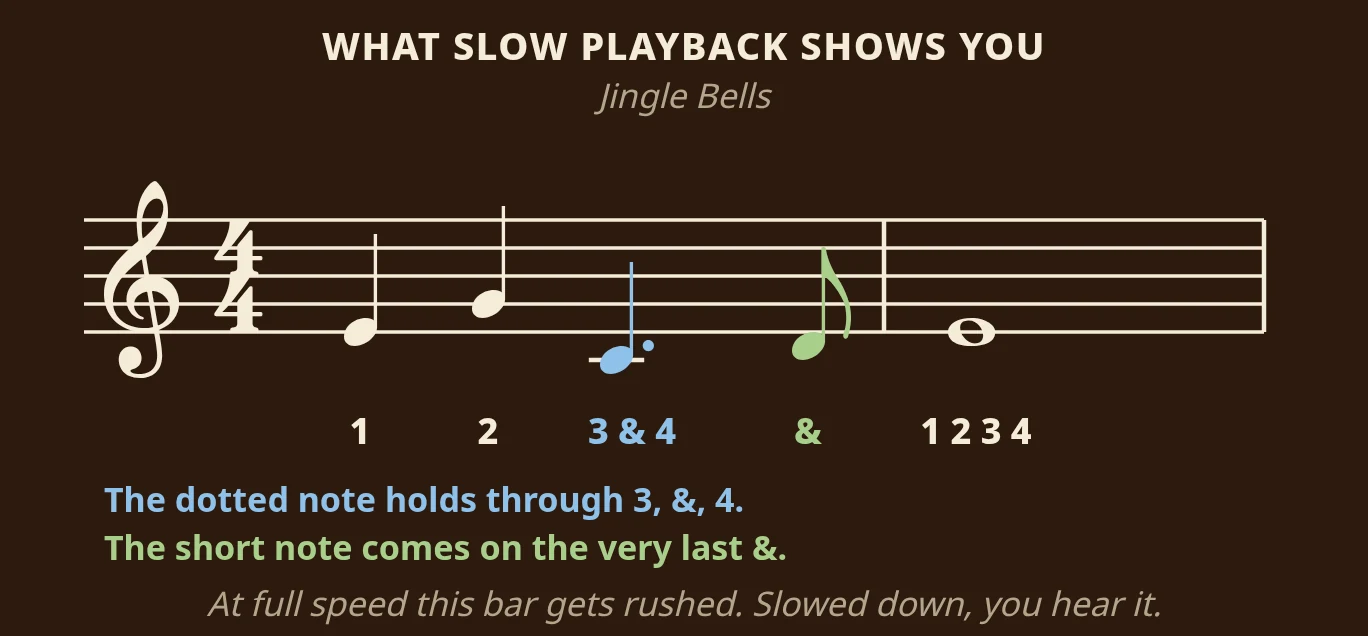
Here is an example from the chorus of Jingle Bells, on the words "jingle all the way". The third bar has a dotted quarter note (a dotted crotchet) on beat 3, which lasts one and a half beats, followed by an eighth note (a quaver) on the very last "and" of the bar. Count it as "1, 2, 3 and 4 and". At full speed almost everyone rushes this, clipping the dotted note and playing the eighth note too early. Played back slowly, you can hear exactly how long the dotted note hangs before the short note arrives.
So use both tools for what they are good at. Learn the notes and rhythms from a correct, slow version first. Then use a metronome to keep yourself steady once you know them.
How to slow it down and walk it back up
Step 1: Pick a short passage
Choose a passage of two to four bars, not a whole page. Slow practice takes time, and a short passage lets you repeat it many times in a few minutes. If there is one bar that keeps breaking, build your passage around it: the bar before, the hard bar and the bar after. Our guide to looping one bar explains how to choose it.
Step 2: Find a tempo where you play it right
The rule is simple: pick a tempo where you can play the passage without a single mistake. Not nearly without a mistake. Without one.
A good place to start is half the written tempo. If the piece is marked at 120 beats per minute (BPM, the number of beats in one minute), start at 60. If the passage still falls apart at 60, try 45. Nobody is listening, and it is far better to play it right at 45 than wrong at 90.
It is common to feel a little silly at this speed. That is a good sign. If slow practice feels comfortable straight away, you are probably still going too fast.
Step 3: Play along and listen for where you drift
At your slow tempo, play along with a correct version of the passage a few times. Listen for the places where you and the playback drift apart: a note that comes early, a held note that you let go of too soon, a pitch that does not match. Those are the notes you do not really know yet, however well you thought you knew them at full speed.
When you find one, stop and play just that spot two or three times, then go back to the whole passage.
Step 4: Climb the tempo ladder
Once the slow version is clean, walk it back up. Do not jump straight to full speed. Climb, one rung at a time.
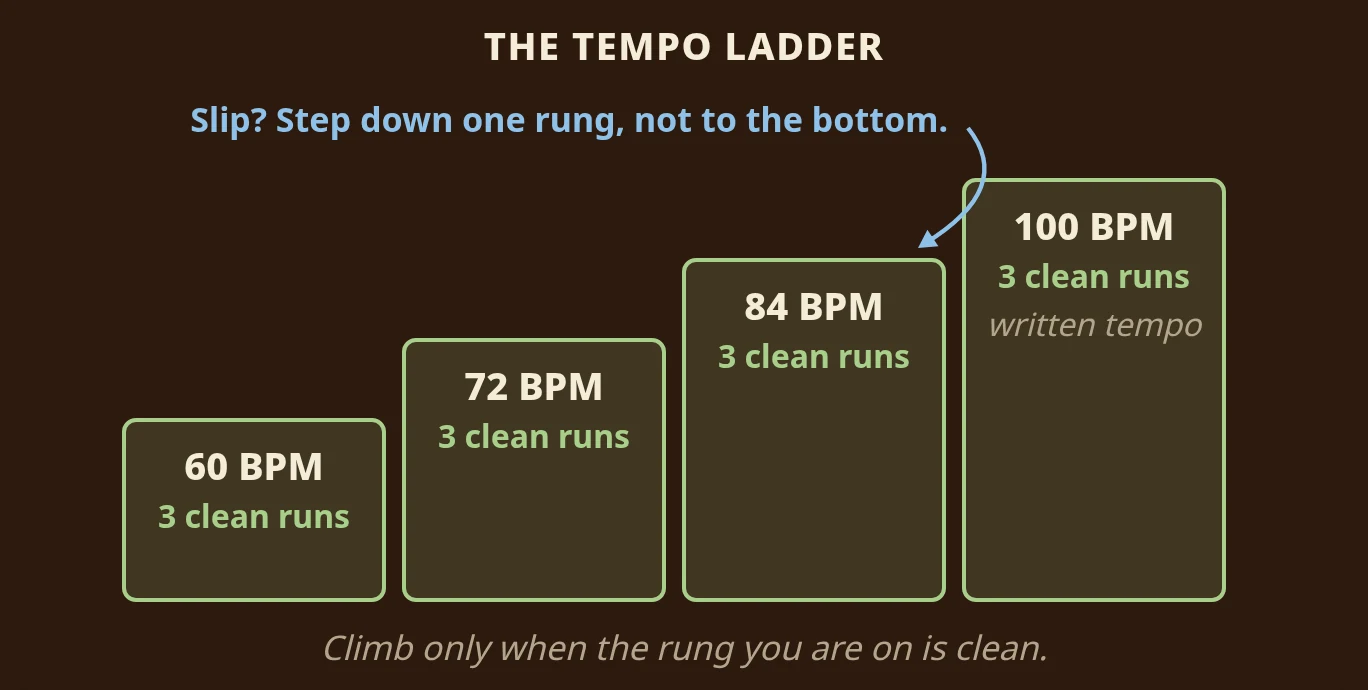
Here is the ladder for a piece marked at 100 BPM:
- 60 BPM. Play the passage until it is clean three times running. This is the floor.
- 72 BPM. A step, not a leap. If it breaks, loop the bar that broke and stay on this rung until it does not.
- 84 BPM. By now the notes should feel automatic, so you can start listening to the shape of the phrase instead of the fingering.
- The written tempo. The last rung. Here, 100 BPM.
If you slip on a rung, step down one rung, not all the way to the bottom. You have already earned the lower rungs, and they are still there. Spend a few clean runs one rung lower, then try again.
The steps in this ladder are about 12 BPM apart, which works well at these speeds. For a very fast piece, add more rungs rather than making bigger jumps. For a very slow piece, smaller steps of 6 to 8 BPM are fine.
Step 5: Finish clean, then start lower tomorrow
Stop for the day on a clean run, even if you have not reached the top of the ladder. Tomorrow, do not start at the rung where you finished. Start one or two rungs lower and climb again. It will usually go faster the second time, and within a few days the top rung will feel normal.
Common mistakes
- Jumping from slow straight to full speed. The jump is where the old mistakes come back. Take the rungs in between.
- Slow but sloppy. Slow practice only works if the slow version is correct. If you are still making mistakes, go slower.
- Slowing down only the hard bar. Play the whole passage at the same slow tempo, so the easy bars and the hard bar join up at one steady speed.
- Staying slow forever. Slow practice is a way to get to full speed, not a place to live. Climb a rung whenever you have three clean runs.
Slow it down in Sheetly
The hardest part of slow practice is knowing what the passage should sound like at your slow tempo. A recording of the piece only plays at one speed, and slowing a recording down usually makes it sound strange. That is what we built Sheetly for.
Take a photo of your printed page with your iPhone or iPad, and Sheetly plays it back with a playhead that follows the notes. The tempo button in the bottom bar shows 90 BPM to start with. Tap it, or hold the minus or plus button, and the whole score slows down or speeds up with it. Because Sheetly plays the notes from the score itself rather than stretching a recording, half speed sounds like the piece at half speed, at the same pitch.
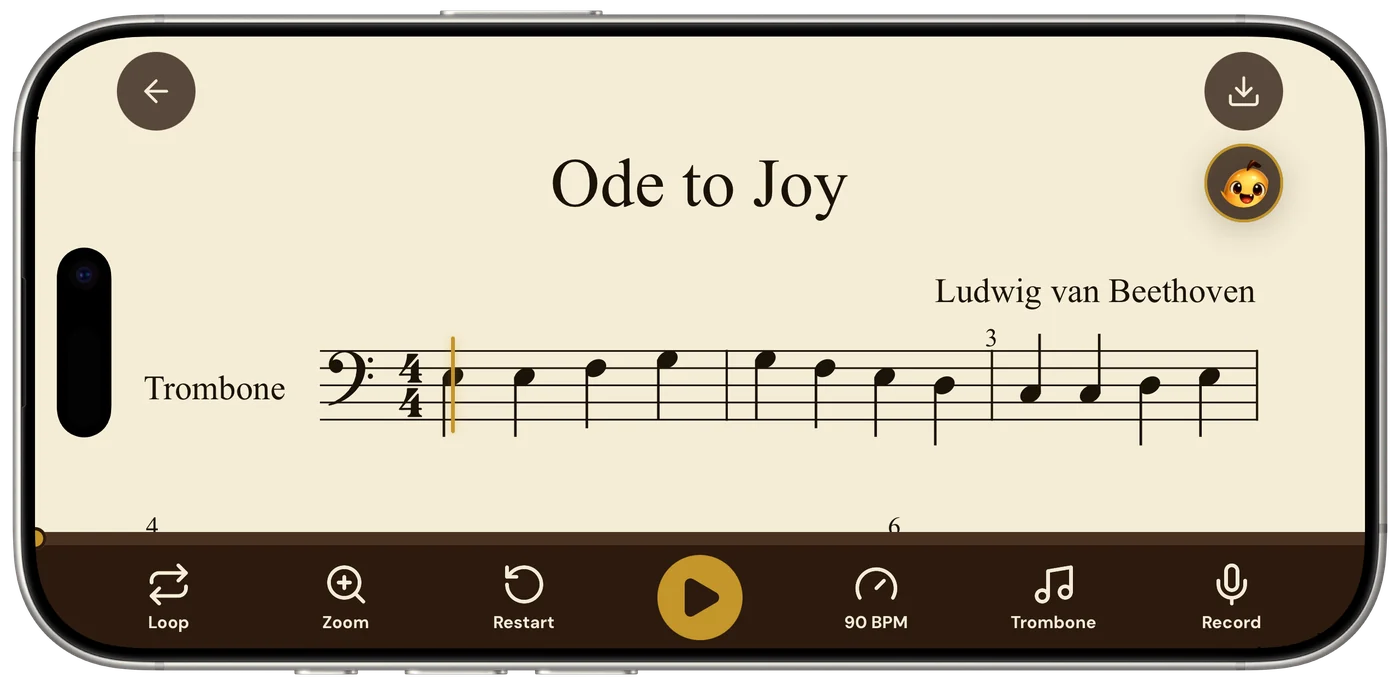
Combine it with Loop to run the ladder on just a few bars: set the loop, start at 60, and raise the tempo one rung at a time as each one comes out clean.
Questions
How slow should I practise?
Slow enough that every note is right, not just comfortable. Half the written tempo is a good start. If a passage falls apart at 60 BPM, try 45, then walk it back up in small steps.
Does slowing the tempo in Sheetly change the pitch?
No. Playback is made from the score itself, not stretched from a recording, so tempo and pitch are independent. Half speed sounds like the piece at half speed, not like a slowed-down tape.
Is slow playback better than practising with a metronome?
They do different jobs. A metronome tells you where the beat is; the score playing correctly at a slow tempo tells you what the notes are and how long each one lasts. Learn the notes from the score first, then use a metronome to keep your tempo steady.
How long should I stay on each tempo?
Until you have played the passage cleanly three times in a row. Then move up one rung. If you slip, go down one rung rather than all the way back to the start.