Transposing Instruments Explained: B Flat, E Flat and F Parts
Wondering why your clarinet part is in a different key from the piano? In this guide, we explain transposing instruments in plain words: what concert pitch is, how B flat, E flat and F parts work, and how to work out what a written note really sounds, with a picture for every step.

Have you ever played a note on your clarinet or trumpet, then played the same written note on the piano, and found that they did not match? Or looked at your alto sax part and seen three sharps, while the flute next to you has no sharps at all, in the very same piece? Nothing is wrong with your part. You have met a transposing instrument.
Transposing instruments are one of the most confusing ideas in music, mostly because they are explained in a hurry. The idea itself is simple: on some instruments, the note written on the page is not the note that sounds. The written note tells you the fingering. The sound comes out a fixed distance lower. Once you know that distance for your instrument, everything else follows.
In this guide, we explain transposing instruments step by step: what concert pitch and written pitch mean, why parts are written this way, how B flat, E flat and F instruments work, what happens to the key signature, and the mistakes to avoid. Each step has a picture, and at the end we share an easy way to hear your own part as you practice.
How transposing instruments work
Step 1: Learn concert pitch and written pitch
Two terms make everything easier. Concert pitch is the note that actually sounds, the one a piano would play. Written pitch is the note printed in the player's part.
For most instruments, these are the same. Piano, flute, oboe, violin, cello, trombone and many others are non-transposing: the note on the page is the note you hear. The transposing instruments are mostly in the wind families: clarinets, saxophones, trumpets and horns.
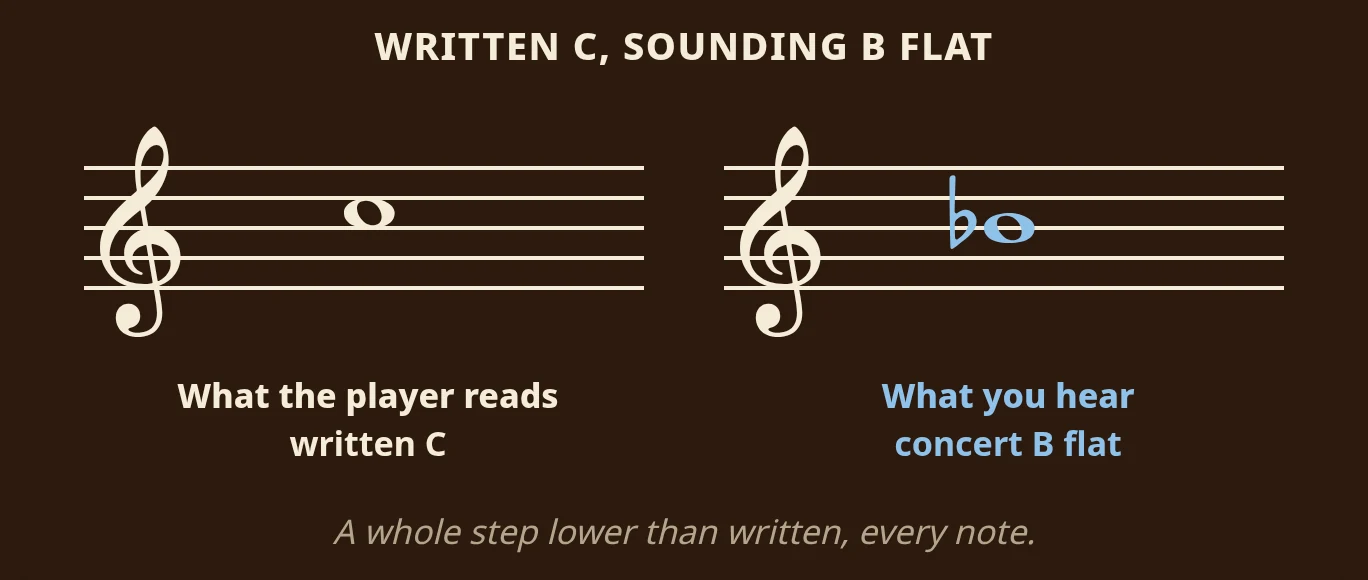
Take the B flat clarinet. When a clarinet player reads a C and plays it, the sound that comes out is a B flat, one whole step lower. The player thinks "C", fingers "C", and the audience hears B flat. That is all transposing means.
Step 2: Understand why parts are written this way
It seems strange to write a note that does not sound. The reason is that it makes life much easier for the player.
Parts are transposed so that one set of fingerings works for a whole family of instruments. On every saxophone, from soprano to baritone, the fingering a player learns as "C" is the same, even though each saxophone sounds a different note with it. Because every part is written so that this fingering is called C, a player can pick up any saxophone and read its part without learning new fingerings.
The same is true for clarinets, trumpets and horns. Historically, an instrument's sound depended on the length of its tube, builders made the lengths that played best, and the notation followed. Today, conductors, arrangers and anyone checking a clarinet part on the piano do the arithmetic, so that the player never has to.
Guitar does something related but simpler: its music is written an octave higher than it sounds, so the notes sit on the treble staff instead of on ledger lines below it. The note names stay the same, which is why guitar is not usually counted as a transposing instrument. Our guide on how to read guitar sheet music shows how that works, string by string.
Step 3: Learn the three common families
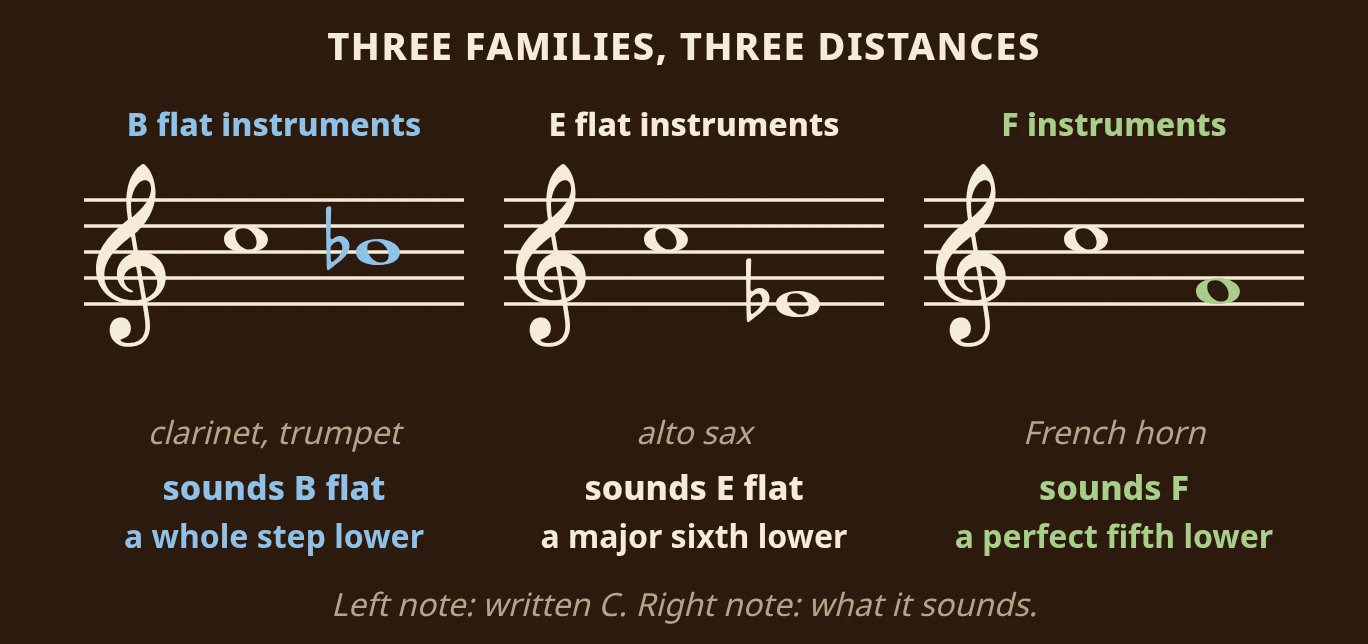
Most transposing instruments you will meet belong to three families, named after the note that sounds when the player reads a C.
B flat instruments
The B flat clarinet, the trumpet, the soprano saxophone and the tenor saxophone are all B flat instruments. A written C sounds as a B flat, a major second (one whole step) lower. Every note follows the same rule: a written D sounds C, a written G sounds F, and a written A sounds G.
E flat instruments
The alto saxophone and the baritone saxophone are E flat instruments. On an alto sax, a written C sounds as an E flat, a major sixth lower. A written G sounds B flat, and a written A sounds C. A quick check: the alto sax's written C and the piano's E flat are the same sound.
There is one unusual member of this family. The small E flat clarinet sounds higher than written, a minor third up. It is rare outside bands and orchestras.
F instruments
The French horn (and the cor anglais, or English horn) are F instruments. A written C sounds as an F, a perfect fifth lower. A written G sounds C, and a written D sounds G. Horn players sometimes meet old parts written in E flat or D in orchestral music, but modern horn parts are written in F.
See it on the keyboard
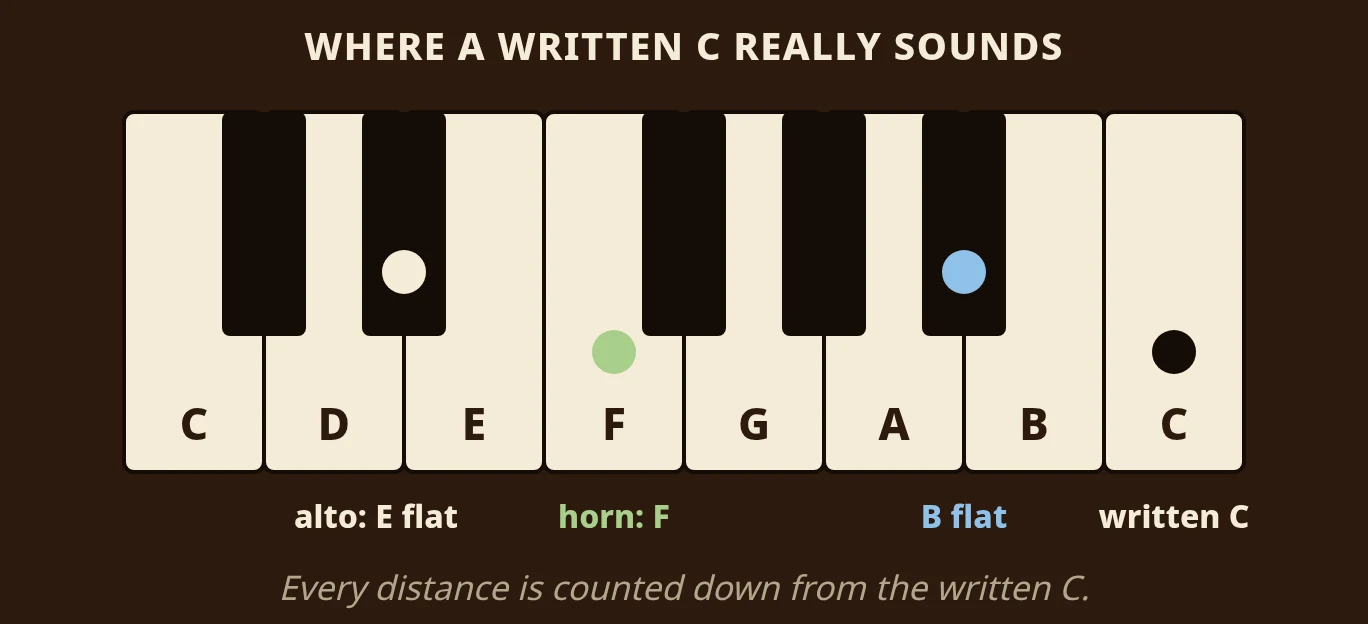
If the intervals are new to you, a keyboard makes them easy to picture. Start on the written C and count down: two keys down lands on B flat, seven keys down lands on F, and nine keys down lands on E flat.
Step 4: Get the direction right
For all three of these families, the sound is lower than written. That gives you one simple rule, with two directions:
- From written to concert (working out what a part sounds): go down by the instrument's interval.
- From concert to written (writing a part for the player): go up by the same interval.
| Family | Instruments | Written C sounds | Concert to written |
|---|---|---|---|
| B flat | Clarinet, trumpet, soprano and tenor sax | B flat (a major second lower) | Up a major second |
| E flat | Alto and baritone sax | E flat (a major sixth lower) | Up a major sixth |
| F | French horn, cor anglais | F (a perfect fifth lower) | Up a perfect fifth |
The interval never changes. Only the direction does. Most mistakes with transposing instruments are mistakes of direction, not of interval, so it is worth saying the rule out loud a few times: "written C on a B flat instrument sounds B flat, which is lower".
Tenor and baritone sax: one more octave
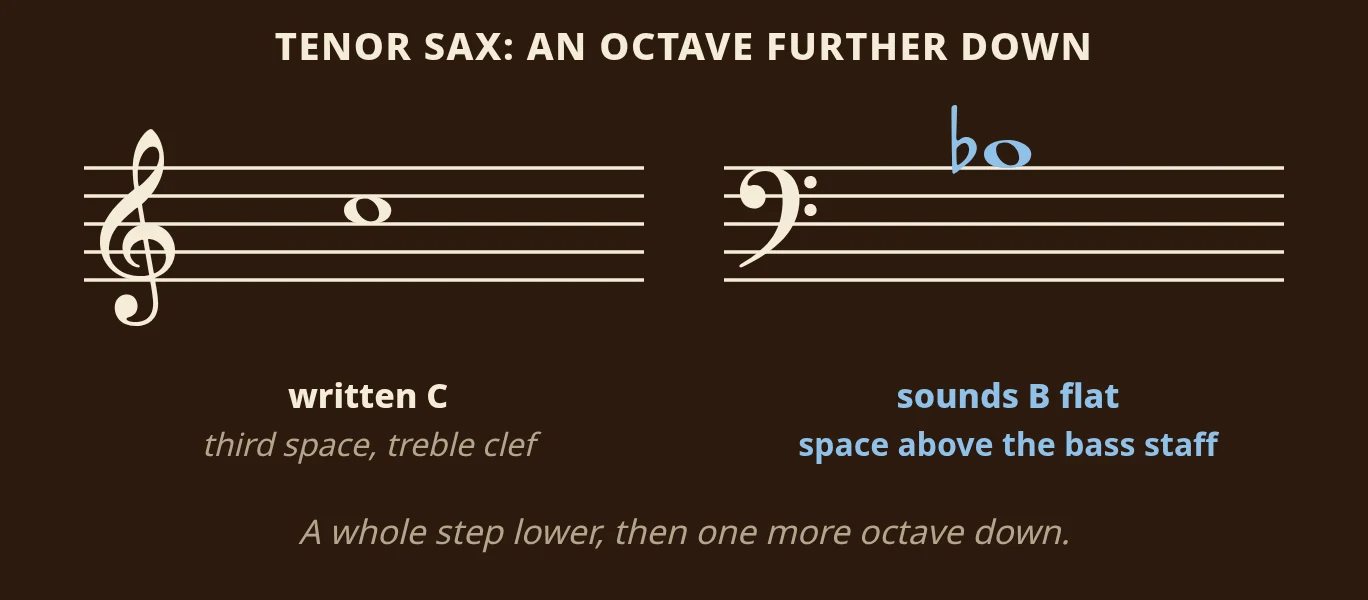
The bigger saxophones go one octave further. A tenor sax (like the bass clarinet) sounds a major second plus an octave lower than written, a major ninth. A baritone sax sounds a major sixth plus an octave lower, a major thirteenth.
Step 5: Expect a different key signature
When every note of a part moves by the same interval, the key moves too. That is why your part may have a different key signature from the piano or flute part in the same piece.
- B flat parts add two sharps (or take away two flats). A piece in concert B flat major (two flats) is written in C major (no sharps or flats). A piece in concert C major is written in D major (two sharps).
- E flat parts add three sharps (or take away three flats). Concert E flat major (three flats) becomes written C major. Concert C major becomes written A major (three sharps).
- F parts add one sharp (or take away one flat). Concert F major (one flat) becomes written C major. Concert C major becomes written G major (one sharp).
This also means the key signature on a transposed part is not the key of the piece. A clarinet part in D major belongs to a piece in concert C major. To find the real key of a band piece, look at the flute part, the piano part or the full score, which are all at concert pitch. Our guide to reading key signatures shows how to name any key from its sharps or flats.
Step 6: Work through one tune for four instruments
Let's see it all at once. Imagine a tune in concert B flat major that starts on B flat, C, D and F. Here is how it looks in four different parts:
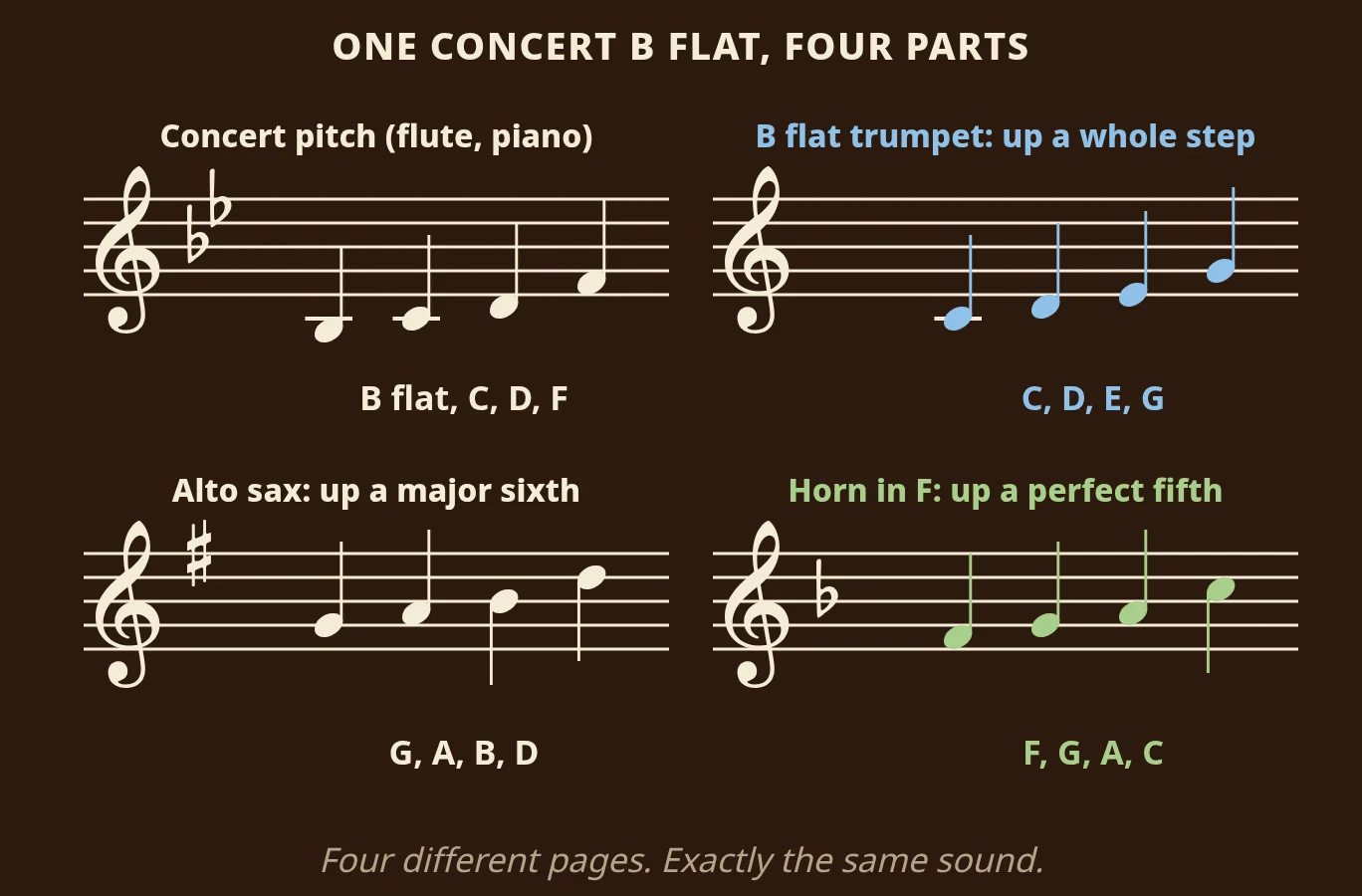
For B flat trumpet, every note moves up a whole step: C, D, E, G, and the key signature changes from two flats to none. For alto sax, every note moves up a major sixth: G, A, B, D, with one sharp (G major). For horn in F, every note moves up a perfect fifth: F, G, A, C, with one flat (F major).
Now check the other way. The trumpet player sees C, the sax player sees G and the horn player sees F, and all three sound a concert B flat. To check any part, take its first note, go down by the instrument's interval, and you should land on the concert note shown in the flute or piano part at the same spot.
Step 7: Know why your part sounds wrong on the piano
If you play a clarinet or trumpet part on the piano exactly as written, it comes out a whole step too high. An alto sax part comes out a major sixth too high, and a horn part a fifth too high. The tune is still recognizable, because the distances between the notes stay the same, but it is in a different key from the recording and it clashes with any accompaniment.
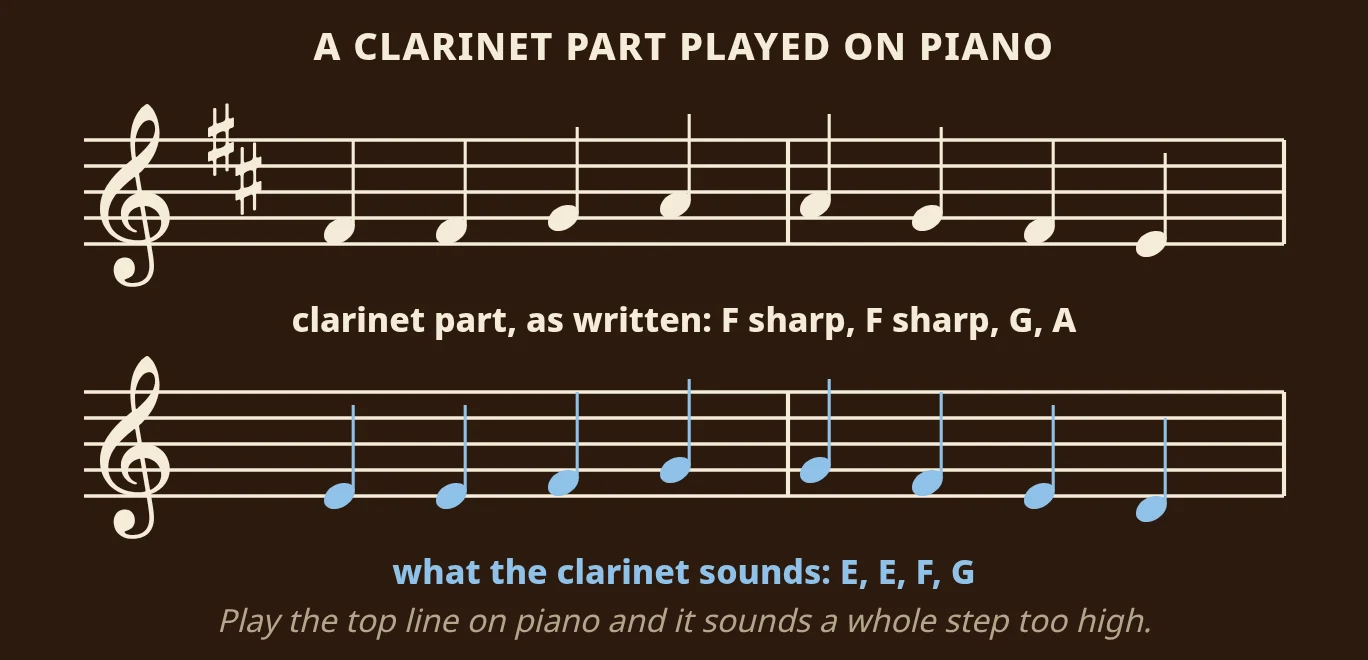
Here is the opening of Ode to Joy as a B flat clarinet part. The clarinet player reads F sharp, F sharp, G, A in D major, and the audience hears E, E, F, G in C major. A student checking the clarinet part on the piano might think the part or the piano is out of tune, when both are perfectly fine. To hear what the clarinet really sounds, play every note a whole step lower than written.
Step 8: Avoid the three common mistakes
- Transposing the wrong way. Going down when writing a part, or up when working out what it sounds. For these three families, concert to written is always up.
- Reading the part's key signature as the key of the piece. A clarinet part in D is a piece in C. Use the concert pitch parts or the score to name the key.
- Forgetting the octave on tenor and baritone sax. A tenor sax written C sounds the B flat a major ninth below, not the one just a whole step below. Work out the interval, then drop one more octave.
A two-minute daily drill
- Say the three families and their distances out loud: B flat down a major second, E flat down a major sixth, F down a perfect fifth, always down from written to sounding (20 seconds).
- Pick five written notes and say what each one sounds on clarinet, then alto sax, then horn. Check on a keyboard if you have one (1 minute).
- Take a short tune you know at concert pitch and say the notes a trumpet part would show: up a whole step every time (40 seconds).
Step 9: Practice with a way to hear your part
When you learn a new part, what you need most is to hear its shape: the rhythm, the melody and the hard bars. For that, hearing the notes in your own instrument's sound helps far more than a piano.
Sheetly makes that easy. Take a photo of your part with your iPhone or iPad and press play: you hear the notes as they are written, in a clarinet, saxophone or other instrument sound instead of a piano, with a playhead that follows along. Loop a passage, slow it down, and if you want to know what a note really sounds at concert pitch, ask the built-in coach about that bar. It has read your page, so it can tell you that the written A in bar 12 of your clarinet part is a concert G.
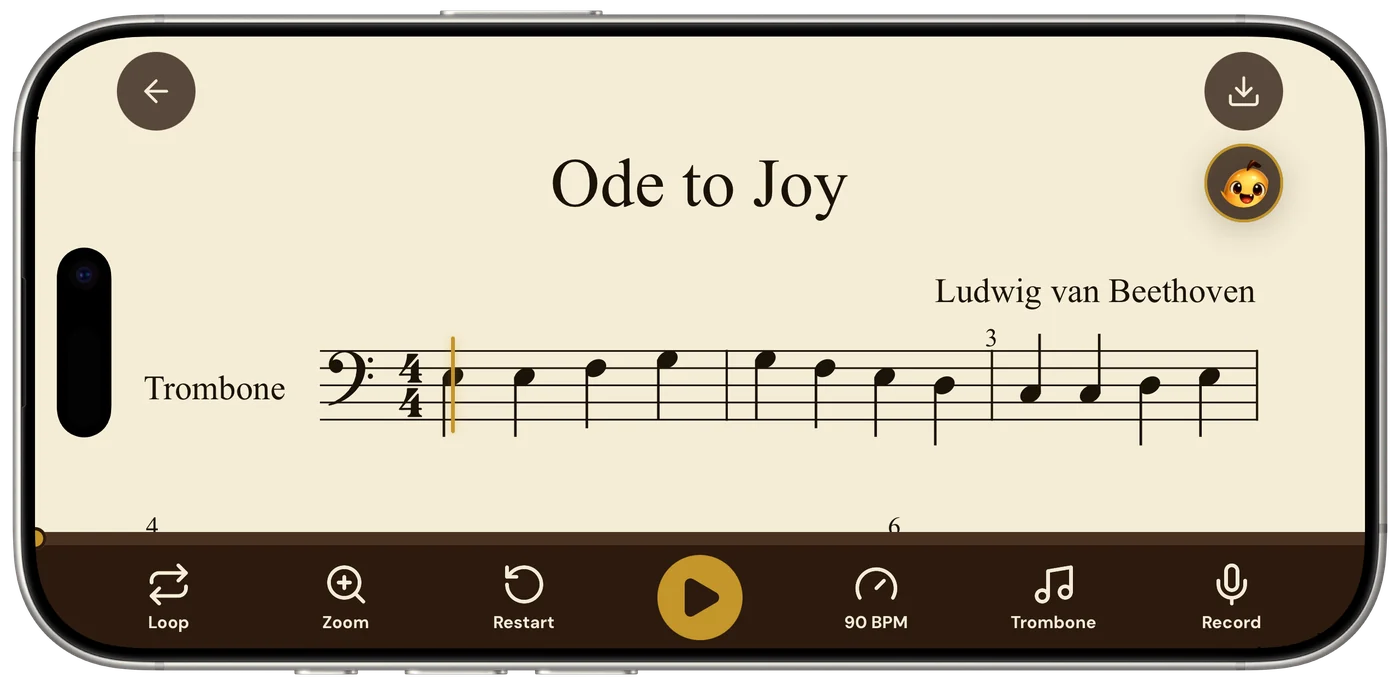
Read the part first, then listen and compare. When your part, your fingers and the sound you hear all agree, the transposition is doing its job.
Questions
What is a transposing instrument?
An instrument whose written notes sound at a different pitch. On a B flat clarinet or trumpet, a written C sounds B flat. On an alto sax it sounds E flat, and on a French horn it sounds F.
What is the clarinet in A for?
The clarinet in A sounds a minor third lower than written, so a written C sounds A. Clarinetists switch to it for pieces in sharp keys, where its part needs fewer sharps than a B flat clarinet part would.
Do guitar and bass parts transpose?
Guitar, bass guitar and double bass all sound an octave lower than written, which keeps their parts off ledger lines. The note names do not change, so they are not usually counted as transposing instruments in the B flat, E flat and F sense.
Is the trombone a transposing instrument?
In orchestra and concert band music, no. Trombone parts are usually written at concert pitch in bass clef, so the note on the page is the note that sounds.