How to Read Triplets in Sheet Music: Count Three in the Time of Two
Wondering how to read triplets in sheet music? In this guide, we explain what the little 3 means, how to count eighth note and quarter note triplets without rushing, and how triplets relate to 12/8, with a picture for every step.

Have you ever been reading along happily in 4/4 when a group of three notes appears with a little 3 above it, and suddenly you are not sure how to fit them in? Maybe you rush them, maybe the beat after them comes early, or maybe the whole bar just feels lopsided.
Triplets are one of those things that look complicated and turn out to be simple once you have the right way of counting them. A triplet is just a beat divided into three equal parts instead of the usual two. The beat itself does not move. The only change is what happens inside it.
In this guide, we show you how to read triplets in sheet music step by step: what the 3 means, how to count eighth note triplets, how to switch between twos and threes, how quarter note triplets work, and how triplets relate to 12/8 time. Each step has a picture, and at the end we share a short drill and a way to check that your triplets are even.
How to read triplets
Step 1: Know what a triplet is
A triplet is a group of three notes played in the time normally taken by two notes of the same kind. You will see a small number 3 above or below the group, sometimes with a bracket.
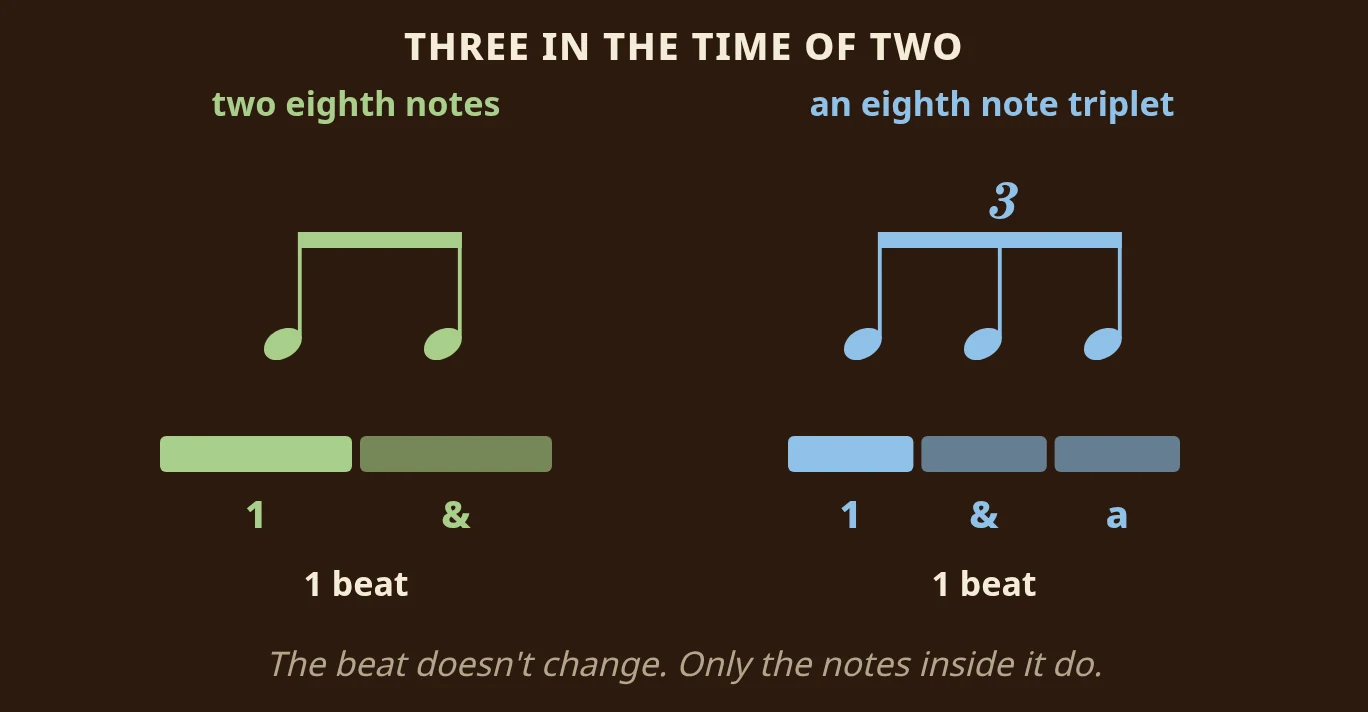
The most common is the eighth note triplet. Normally, one quarter note beat holds two eighth notes. An eighth note triplet squeezes three eighth notes into that same beat, so each one is a little shorter: a third of a beat instead of half.
Triplets belong to a bigger family called tuplets: any number of notes fitted into the space of a different number. Triplets are by far the most common. Duplets (two in the time of three) come next, and you will meet quintuplets and sextuplets in harder music. The rule never changes: the beat stays where it was, and only the notes inside it are divided differently.
Step 2: Count three even syllables per beat
To count an eighth note triplet, give each beat three even syllables, with the first one exactly on the beat. The most common way to say it is "1 and a, 2 and a, 3 and a, 4 and a". Some teachers use "1 trip let" or "1 la li". Any of these works, as long as the three syllables are even.
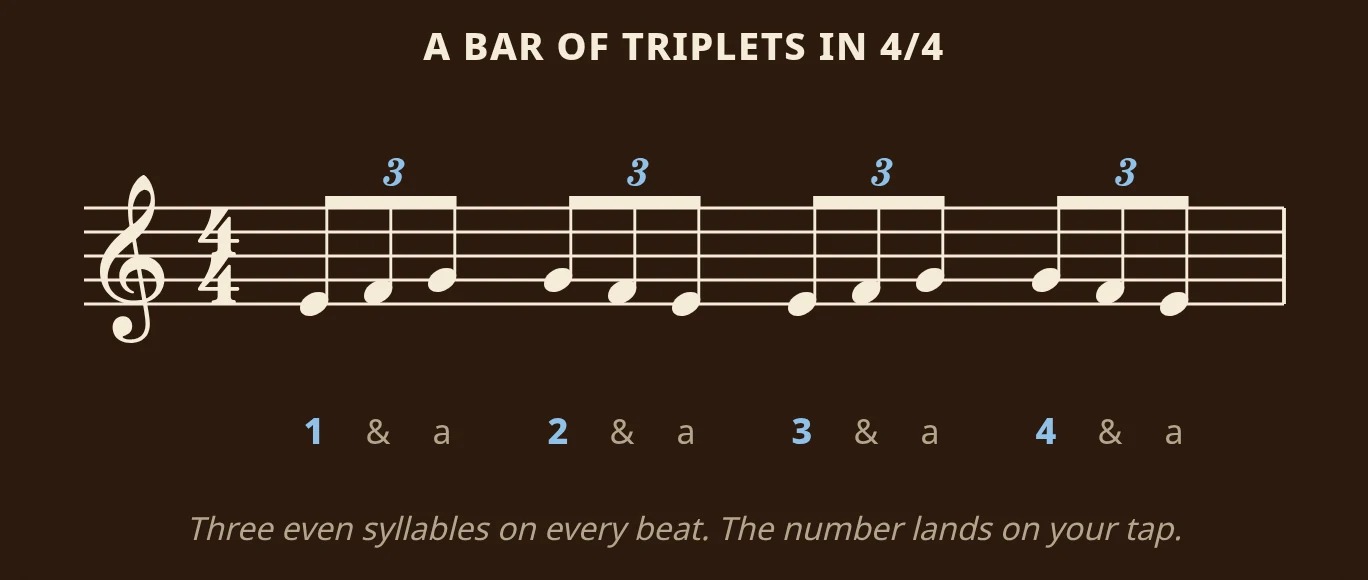
Here is the most important rule: protect the beat, not the three notes. Tap a slow, steady beat with your foot and say a plain "1, 2, 3, 4" on the taps. Then add "and a" between them without letting the taps move. If your taps speed up to make room for the extra syllables, the triplet has won and the beat has lost.
Use a three-syllable word
Words are a great shortcut. Say "straw-ber-ry" or "pine-ap-ple" on every tap. Nobody says those words unevenly, and the stress falls naturally on the first syllable, right where the beat is. Four words on four taps is a whole bar of eighth note triplets.
Step 3: Switch between twos and threes
Real music rarely uses triplets all the time. More often, a bar moves between normal eighth notes and triplets, and the switch is where most mistakes happen.
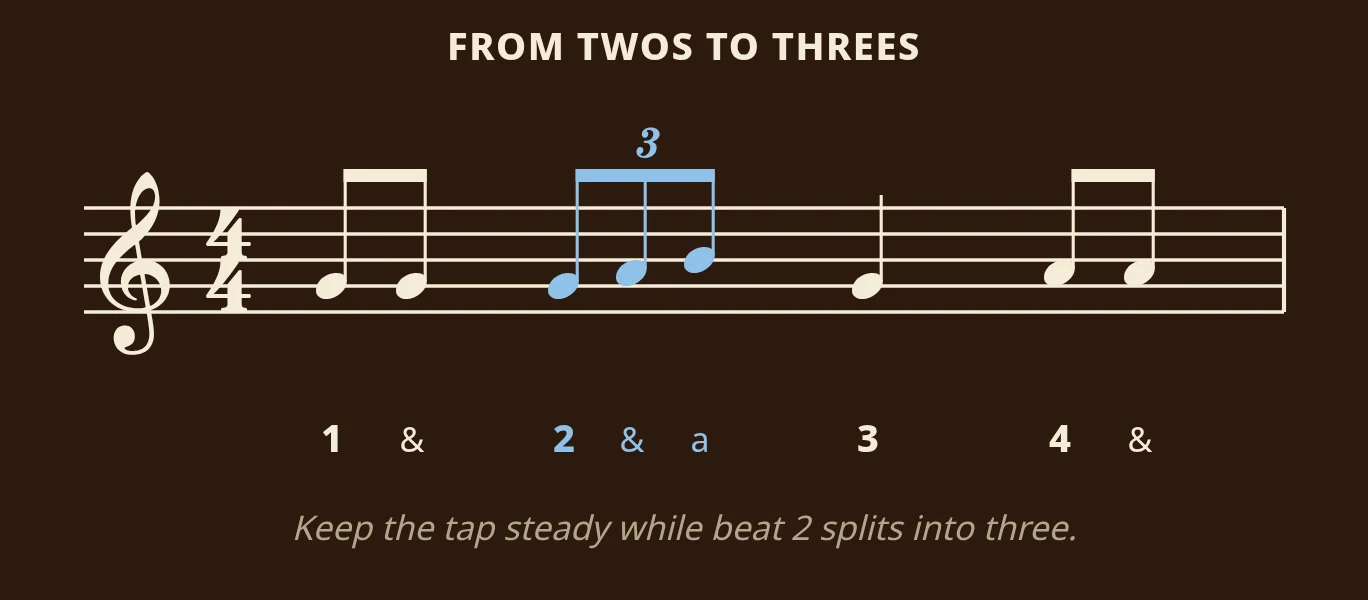
Take this 4/4 bar: two eighth notes on beat 1, an eighth note triplet on beat 2, a quarter note on beat 3 and two eighth notes on beat 4. It adds up by beats, not by notes: one beat each, four in total. Count it out loud: "1 and, 2 and a, 3, 4 and".
The hard part is the join from beat 1 to beat 2, where two even halves turn into three even thirds while your foot taps exactly the same. Practice just that pair: tap, "1 and", tap, "2 and a", until the change stops pulling your tap forward. Played right, the notes get busier in the middle of the bar and then open out again. Played wrong, beat 2 comes early and the bar lurches.
Step 4: Learn quarter note triplets
A quarter note triplet is three quarter notes under a 3, played in the time of two quarter notes. Together they fill two beats, so each note lasts two thirds of a beat.
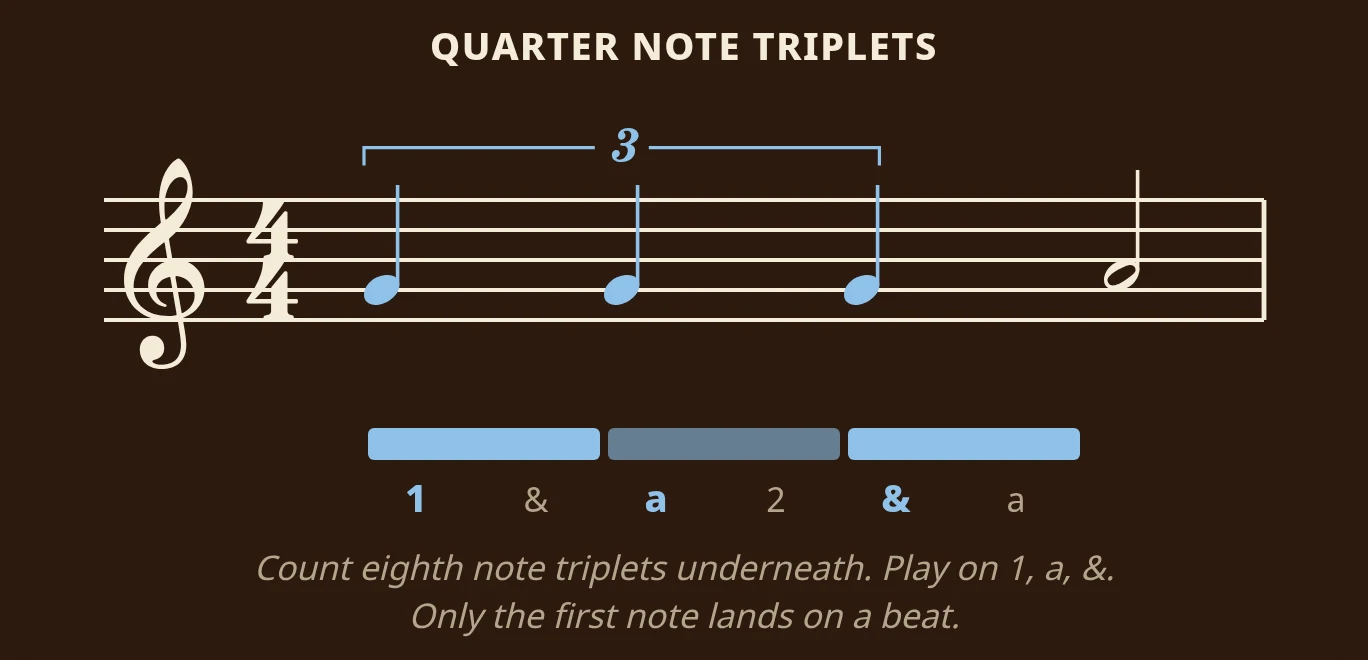
Quarter note triplets feel tricky because only the first note lands on a beat. The second falls two thirds of the way through beat 1, and the third falls one third of the way through beat 2. The notes float across the beat instead of sitting on it.
Here is the trick that makes them easy. Count eighth note triplets across the two beats, "1 and a 2 and a", and play on every second syllable: on "1", on "a", and on the "and" of 2. Once you can hear the shape, stop saying the in-between syllables and just feel it.
Step 5: Read triplets with rests and brackets
When all three notes of an eighth note triplet are joined by a beam, the 3 usually sits on its own above or below the beam. When the group cannot be beamed, for example because it contains a rest or quarter notes, a bracket shows which notes belong to the triplet.
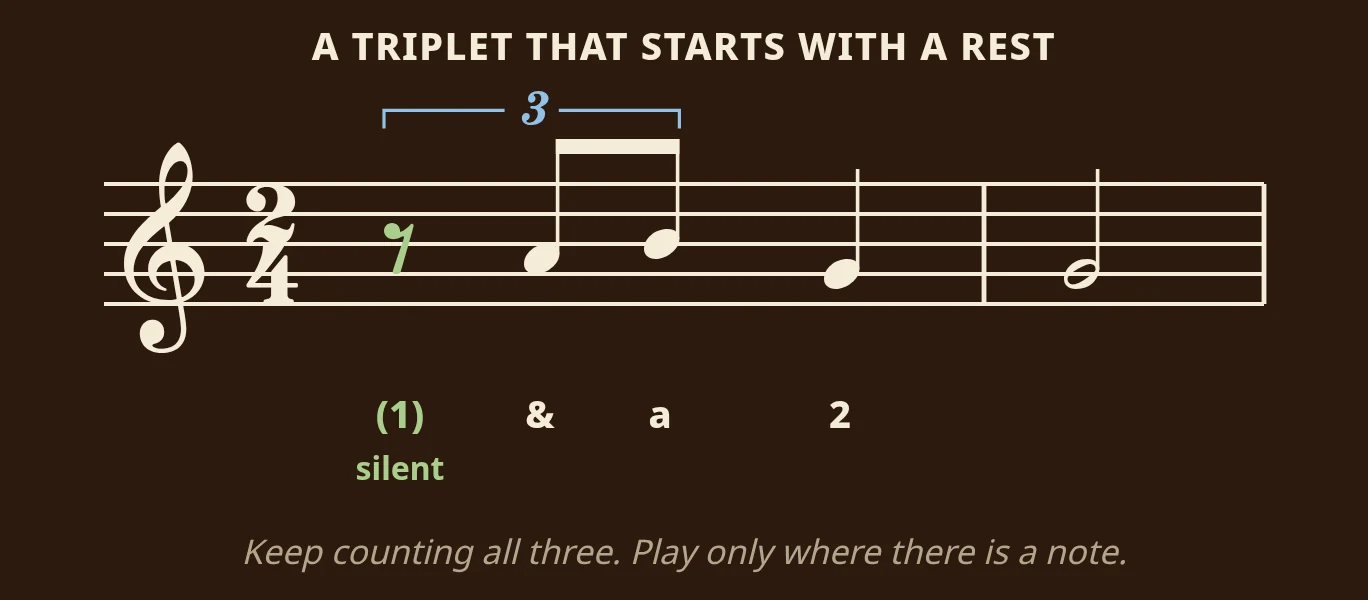
A triplet can start with a rest. The rest simply takes one of the three equal slots. Keep counting all three syllables, "(1) and a", and play only on the ones that have notes. The silent first syllable is still there, and it still lands right on the beat.
Common mistake: skipping the rest and playing the two notes as if they were ordinary eighth notes. Say the silent "1" in your head, or very quietly, every time.
Step 6: See how triplets relate to 12/8
A bar of 4/4 filled with eighth note triplets has four beats, each divided into three. That is exactly the definition of 12/8 time, and the two sound identical.
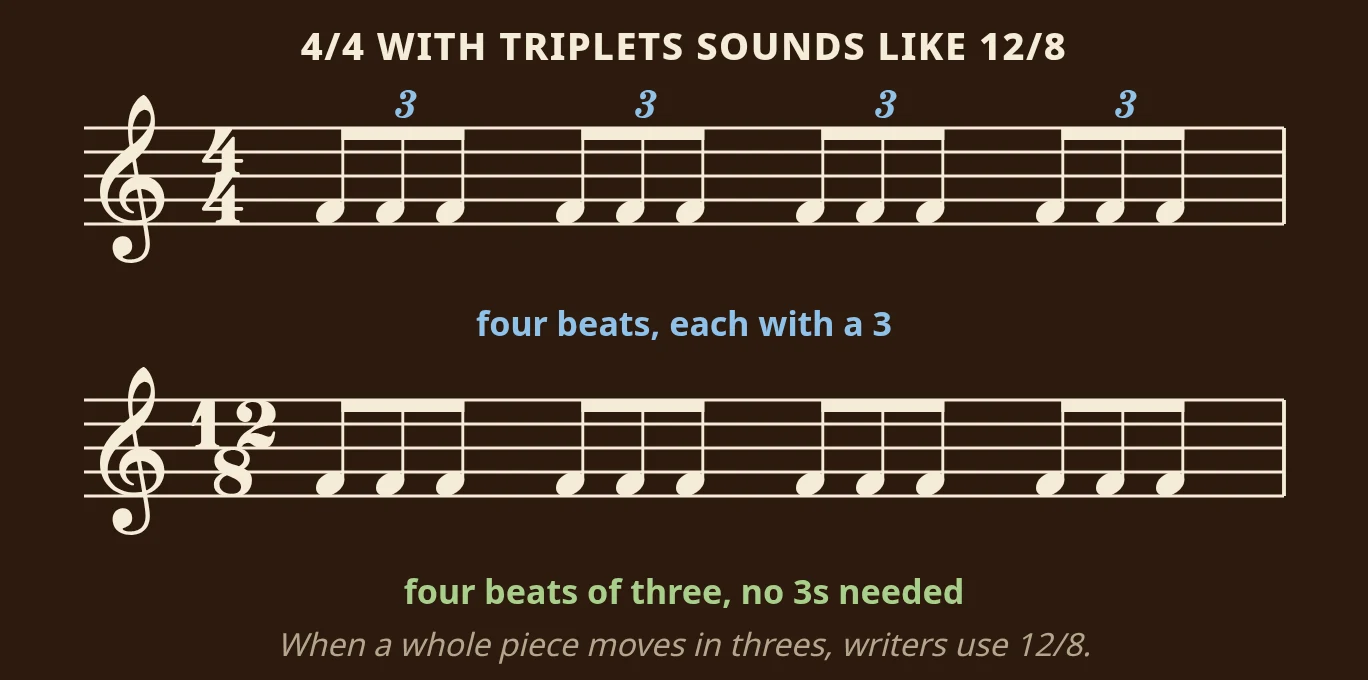
Composers use 4/4 with triplets when the three-feel comes and goes, and 12/8 when the whole piece lives in it, because a 3 over every single beat is tiring to read. Slow blues, doo-wop ballads and a lot of gospel music are written in 12/8 for exactly this reason.
There is one more spelling of the same feeling. A swing or shuffle tune is usually written in plain 4/4 with ordinary eighth notes and a word like "swing" at the top. The eighth notes are then played long-short, roughly like the first and third notes of a triplet. So the same lilt can be written three ways: triplets, 12/8, or swung eighth notes. If a 4/4 bar has triplets all the way through, count it like 12/8 and it will read itself. For more on compound time, see our guide to reading 6/8 time.
Step 7: Avoid the three common triplet mistakes
- Rushing the triplet. Three notes feel like more work, so the beat shrinks to fit them and the next beat arrives early. Count the beat out loud, slowly, and make the triplet fit the beat, not the other way round.
- Playing it dotted or swung. Long-short-short or long-short instead of three even notes. Say "straw-ber-ry" on the beat: the word will not let you make it uneven. Our guide to dotted notes shows how a dotted rhythm differs.
- Drifting in quarter note triplets. Two of the three notes are off the beat, so players lose the pulse. Count eighth note triplets underneath, play every second syllable, then drop the counting once the shape is in your hands.
A two-minute daily drill
- Twos against the tap. Tap a slow beat and say "1 and 2 and 3 and 4 and" (30 seconds).
- Threes against the same tap. Switch to "1 and a 2 and a 3 and a 4 and a" without changing the tap. If the tap speeds up, go back to step 1 (30 seconds).
- Alternate by the bar. One bar of twos, one bar of threes, round and round on the same tap (1 minute).
Step 8: Practice with a way to check yourself
It is surprisingly hard to tell whether your own triplets are even. They can feel perfect while you play them and still be lopsided, or still be pulling the beat forward. The quickest way to find out is to hear them played evenly and compare.
That is where Sheetly helps. Take a photo of a printed page with your iPhone or iPad, and Sheetly plays it back with a playhead that follows the notes, so you can hear exactly where each note of the triplet falls. Slow it down until the three notes are easy to follow, loop the bar that switches from twos to threes, and play along. If a bracket or a small number puzzles you, ask the built-in coach about that bar of your page.
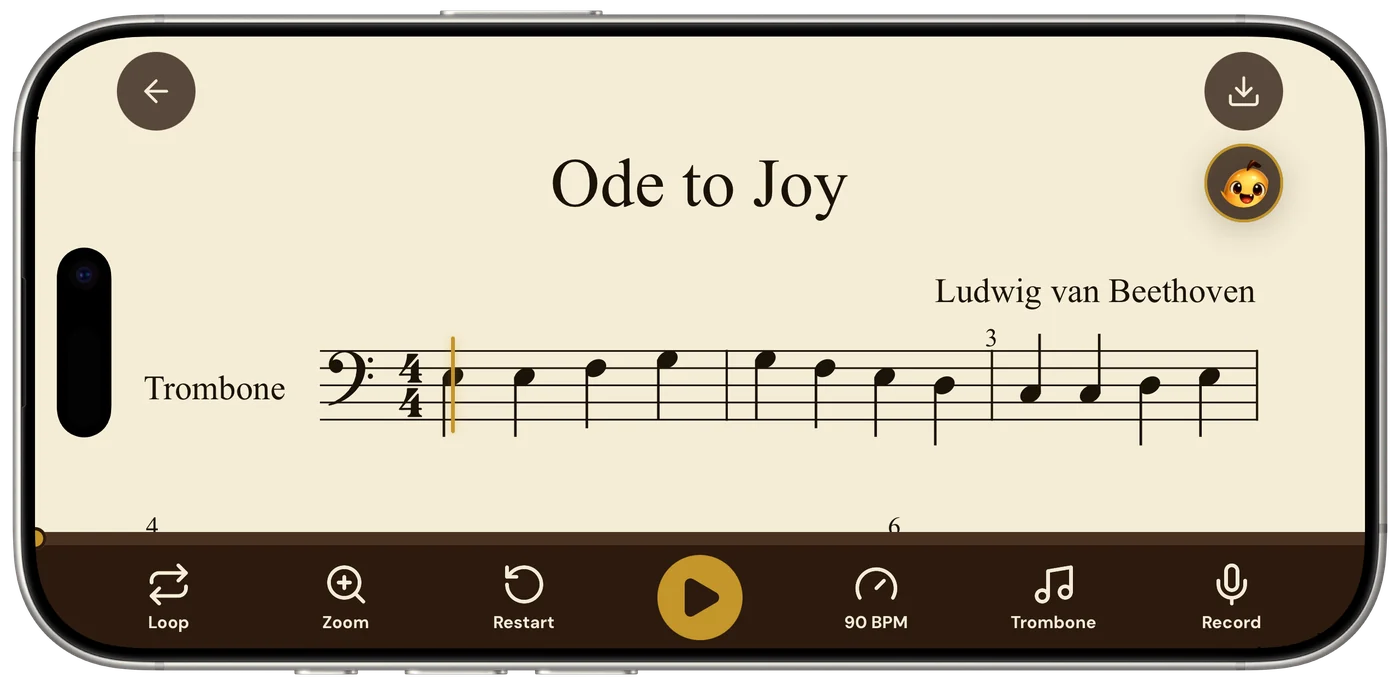
Clap or play the bar first, then press play and compare. At a slower tempo, a rushed triplet is easy to hear in a way that counting alone never quite shows you.
Questions
What does the 3 above notes mean in sheet music?
It marks a triplet: three notes played in the time normally taken by two of the same kind. Three eighth notes under a 3 fill one quarter note beat, and three quarter notes under a 3 fill two beats.
What is the difference between a triplet and a dotted rhythm?
A triplet divides the beat into three equal parts. A dotted eighth and sixteenth divide it into two unequal parts: three quarters and one quarter. A swung pair sits in between, gently uneven, and is usually written as plain eighth notes.
Can a triplet start with a rest?
Yes. The rest takes one of the three equal slots. Keep counting all three syllables and play only on the ones that have notes.
How do you count triplets?
Say three even syllables on every beat, such as "1 and a, 2 and a", with the number exactly on the beat. A three-syllable word like "straw-ber-ry" on each tap works just as well.