How to Read Key Signatures: Name Any Key in Seconds
Wondering how to read key signatures? In this guide, we explain what the sharps and flats at the start of the line mean, the order they always come in, two quick rules for naming the key, and how relative minors work, with a picture for every step.


Have you ever played through a piece, hit every note exactly where it sits on the staff, and still had it sound slightly wrong? Very often the culprit is a little sharp or flat at the very start of the line that you read once and then forgot. Those signs are the key signature, and learning how to read key signatures is one of the most useful things you can do as a reader.
A key signature is a shortcut. Instead of writing a sharp in front of every single F in a piece, the composer writes it once, right after the clef, and you carry it in your head for the whole piece. Once you understand the shortcut, and a couple of easy patterns behind it, you can look at any key signature and name the key in a few seconds.
In this guide, we walk you through what a key signature means, the fixed order of sharps and flats, two rules that name the key at a glance, how every key signature also belongs to a minor key, and how key signatures work together with accidentals. Each step has a picture, and at the end we share a short drill and a way to check yourself as you practice.
How to read key signatures
Step 1: Know what a key signature means
A key signature is the group of sharps or flats printed right after the clef at the start of every line of music. It tells you which notes are sharp or flat for the whole piece, so you do not have to see a sign in front of each one.
If you need a quick refresher: a sharp (♯) raises a note by a half step, the next key up on the piano, and a flat (♭) lowers it by a half step. Our guide on how to read sheet music covers these from the beginning.
The sign means a letter, not a line
Here is the most important idea in this whole guide. The sharp or flat is drawn on one particular line or space, but it applies to a letter name, in every octave.
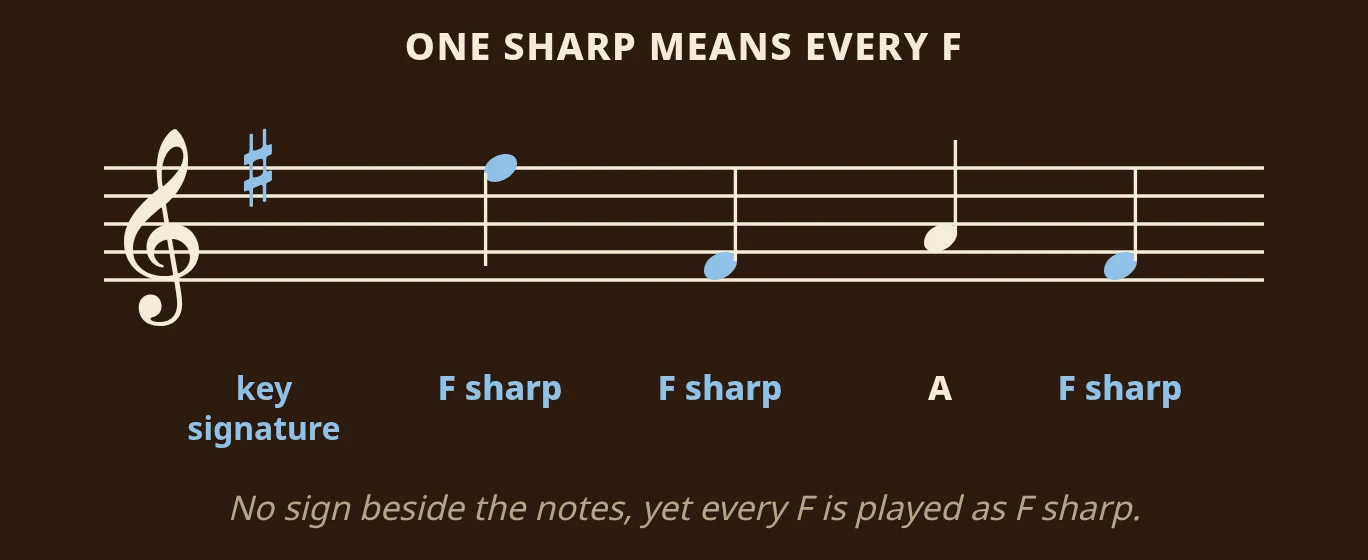
In the picture, the key signature has one sharp, drawn on the top line, which is F. That sharp does not only affect the F on the top line. It affects the F in the bottom space too, and the F on a ledger line, and every other F in the piece. None of those notes has a sharp printed in front of it, but every one of them is played as F sharp.
Common mistake: raising the F on the top line, where the sign is printed, but playing the lower F as a plain F. Read the key signature as a list of letters ("every F is F sharp"), not as a position on the staff.
Step 2: Learn the order of sharps and flats
Key signatures are not random. Sharps and flats are always added in the same order, so once you know the order, you know which notes are altered just by counting the signs.
The order of sharps
Sharps always appear in this order: F, C, G, D, A, E, B. A key with one sharp always has F sharp. A key with two sharps always has F sharp and C sharp. A key with three sharps has F, C and G sharp, never any other three.
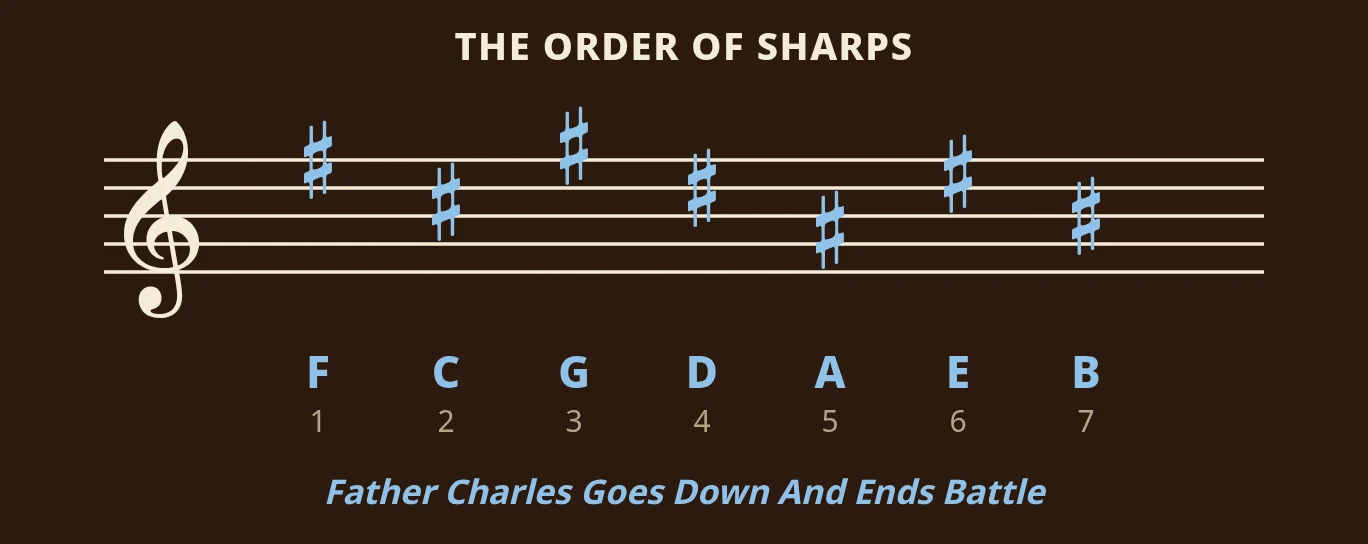
A popular way to remember the order is Father Charles Goes Down And Ends Battle. The signs are drawn left to right in that same order, in a zigzag pattern on the staff, so the last sharp (the one furthest to the right) is always the newest one.
The order of flats
Flats come in exactly the reverse order: B, E, A, D, G, C, F. One flat is always B flat. Two flats are B flat and E flat. Three flats are B, E and A flat.
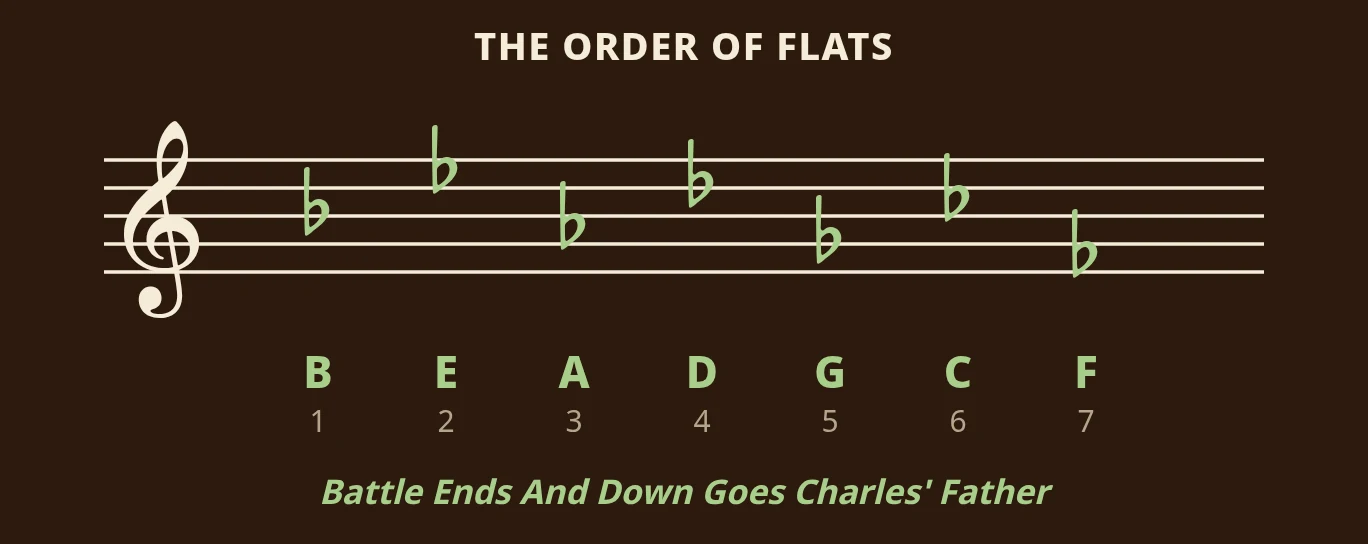
To remember it, just read the sharp phrase backwards: Battle Ends And Down Goes Charles' Father. Notice that the first four flats spell the word BEAD, which is another handy memory hook.
Now you can read a key signature by counting. Four sharps? Count F, C, G, D: those four letters are sharp. Five flats? Count B, E, A, D, G: those five letters are flat.
Step 3: Name the key with two quick rules
Knowing which notes are sharp or flat is enough to play the piece. But it also helps to know the name of the key, because it tells you which note feels like "home". There are two simple rules, one for sharps and one for flats.
Sharp keys: go up a half step from the last sharp
Find the last sharp, the one furthest to the right, and go up one half step. That is the name of the major key.
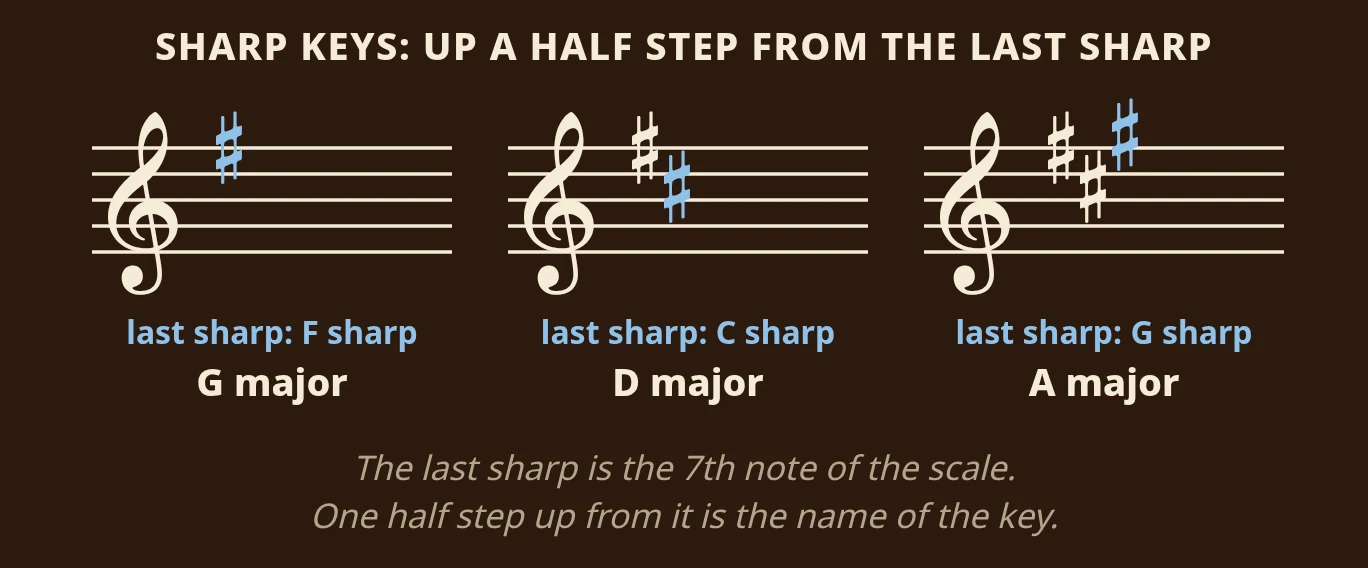
One sharp, F sharp: a half step up is G, so the key is G major. Two sharps, ending on C sharp: a half step up is D, so the key is D major. Three sharps, ending on G sharp: the key is A major. Four sharps, ending on D sharp, is E major, and five sharps, ending on A sharp, is B major.
This rule works because the last sharp is always the seventh note of the major scale, the note just below home. Step up from it and you land on the key note.
Flat keys: read the second to last flat
With flats, the rule is even quicker: the second to last flat is the name of the key.
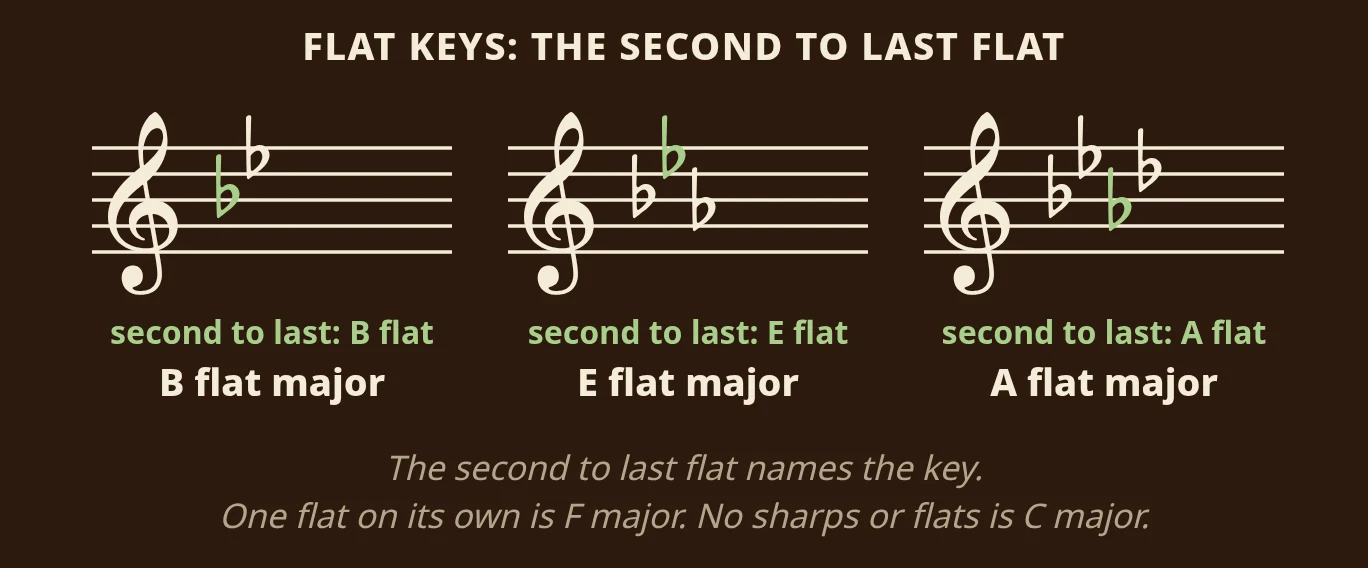
Two flats, B flat and E flat: the second to last is B flat, so the key is B flat major. Three flats, B, E and A: the key is E flat major. Four flats, B, E, A and D: the key is A flat major. Five flats is D flat major.
Two exceptions to remember
One flat has no "second to last", so you simply memorize it: one flat is F major. And no sharps or flats at all is C major, which uses only the white keys of the piano. With two rules and two exceptions, you can name every major key you are likely to meet.
| Key signature | Major key | Relative minor |
|---|---|---|
| No sharps or flats | C major | A minor |
| 1 sharp (F) | G major | E minor |
| 2 sharps (F, C) | D major | B minor |
| 3 sharps (F, C, G) | A major | F sharp minor |
| 4 sharps (F, C, G, D) | E major | C sharp minor |
| 1 flat (B) | F major | D minor |
| 2 flats (B, E) | B flat major | G minor |
| 3 flats (B, E, A) | E flat major | C minor |
| 4 flats (B, E, A, D) | A flat major | F minor |
Step 4: Remember that every key signature also has a minor key
Every key signature belongs to two keys: a major key and its relative minor. The relative minor uses exactly the same sharps or flats and starts three half steps lower than the major key.
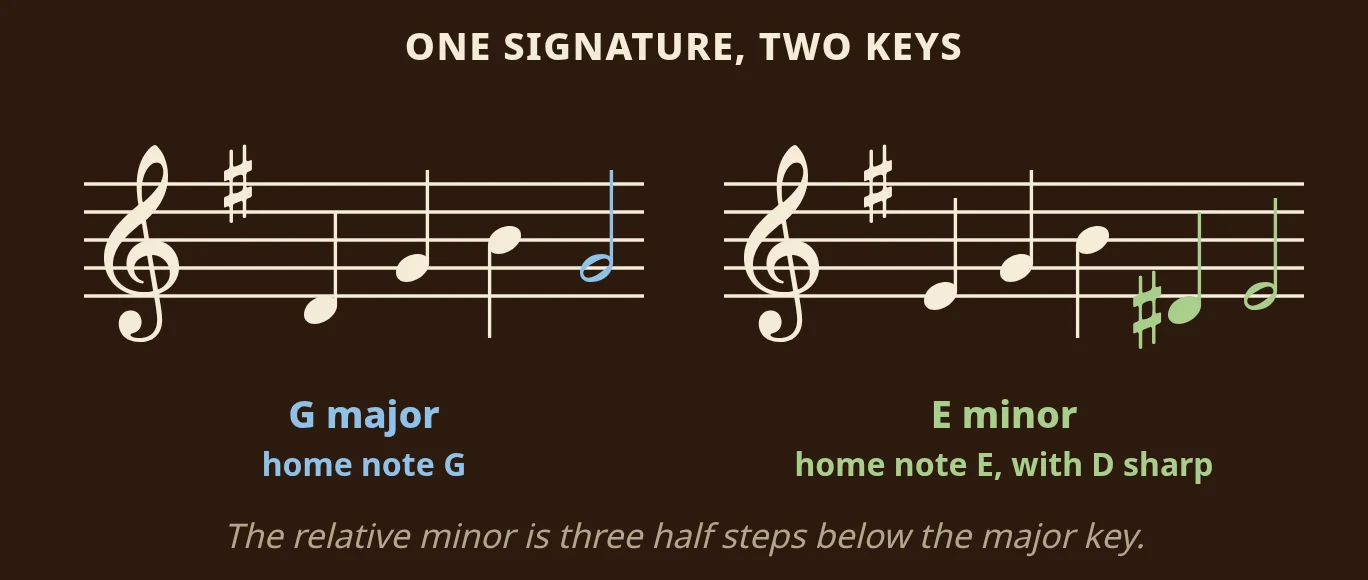
Take one sharp. It is G major, but it is also E minor, because three half steps down from G (G, F sharp, F, E) lands on E. In the same way, three flats is E flat major or C minor (E flat, D, D flat, C). The table above lists the most common pairs.
How to tell major from minor
The key signature alone cannot tell you which of the two keys a piece is in. The music can. Look at the first and last notes, especially the lowest note of the final chord: a piece in E minor usually starts and ends on E, and a piece in G major usually starts and ends on G.
There is a second clue. Minor keys often raise their seventh note, and because that note is not in the key signature, it shows up as an accidental. A piece with one sharp and lots of D sharps written into the music is very likely in E minor.
Step 5: Know how key signatures and accidentals work together
An accidental is a sharp, flat or natural printed directly in front of a note inside a bar. It changes that note for the rest of the bar, and then the key signature takes over again.
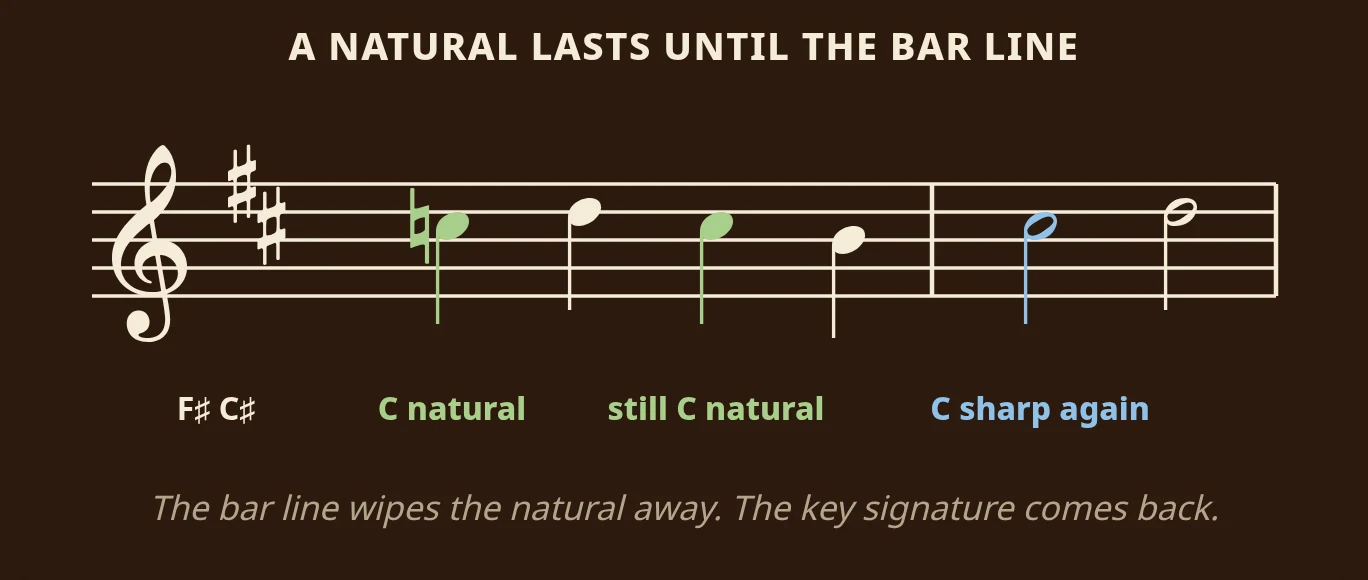
The example above is in D major, with two sharps: F sharp and C sharp. In the first bar, a natural sign cancels the C sharp, so the note is a plain C. The second C in the same bar has no sign, but it is still C natural, because the accidental lasts until the bar line. In the next bar, the natural is gone and the key signature is back in charge, so the C is C sharp again.
A few more details are worth knowing:
- Strictly speaking, an accidental applies only to the note at that exact pitch. A sharp on one G does not change a G an octave lower in the same bar, though many editions add a reminder anyway.
- A courtesy accidental, often in brackets, is just a friendly reminder after a bar line. It does not change anything.
- When a tie carries a note across a bar line, its accidental carries with it, but only for that tied note.
- A piece can change key in the middle. You will see a double bar line, often some naturals cancelling the old signs, and a new key signature. That new signature applies from then on.
A worked example: a violin piece in D major
Picture a violin piece with two sharps: F sharp on the top line and C sharp in the third space. The last sharp is C sharp, and a half step up is D, so the piece is in D major or B minor. It starts on the D just below the staff and ends on a D chord, so it is D major.
In bar 4, a note sits in the bottom space of the staff. That is F, with no sign in front of it, so you play F sharp because the key signature says so. In bar 6, a natural sign appears before a C in the third space, so that C and any other C on the same space later in the bar are C natural. In bar 7, the C is C sharp again.
Step 6: Avoid the most common key signature mistakes
- The forgotten sharp. This is the most common wrong note in beginner playing. A player in G major reads every note correctly and plays every F as F natural, because nothing next to the note said otherwise. The fix: say the key signature out loud before you play ("one sharp, F sharp, G major"), and for the first few readings, circle every F in pencil.
- The octave trap. Raising only the F on the line where the sharp is drawn. Remember that the sign names a letter, in every octave.
- Carrying an accidental too far. A natural in one bar does not carry into the next. But inside the bar it does apply, so a second G in the same bar after a G sharp is also G sharp, even with no sign.
A two-minute daily drill
- Write the order of sharps (F C G D A E B) and flats (B E A D G C F) from memory (30 seconds).
- Name eight keys out loud: one to four sharps are G, D, A and E major. One to four flats are F, B flat, E flat and A flat major (1 minute).
- Say each one again with its relative minor: E, B, F sharp and C sharp minor, then D, G, C and F minor.
- Open any piece, count its sharps or flats, name the key, say which letters are altered, and play the first bar with every altered note in place (30 seconds).
Step 7: Practice with a way to check yourself
The tricky thing about a forgotten sharp is that you often cannot see it. Every note looks right on the page. You can only hear it, and only if you already know how the bar should sound.
That is where Sheetly helps. Take a photo of a printed page with your iPhone or iPad, and Sheetly plays it back with a playhead that follows the notes. Play a bar yourself first, then press play and listen: a forgotten F sharp jumps out right away. You can slow it down, loop the bar, and ask the built-in coach what key your piece is in or why a note in bar 12 has a natural sign.
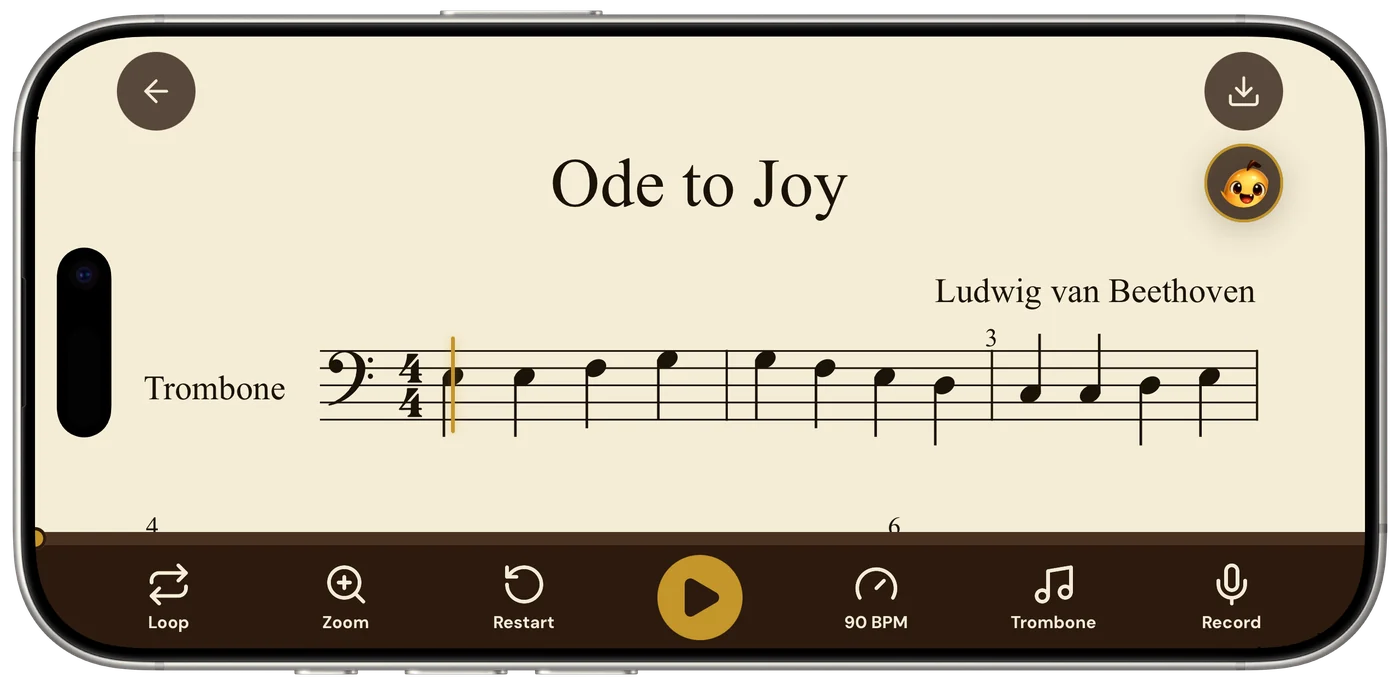
Read the signature, play the bar, then compare. After a few weeks, the key signature becomes something you hear, not just something you remember.
Questions
Where do the sharps and flats sit in the bass clef?
The order is the same in the bass clef: F, C, G, D, A, E, B for sharps, and the reverse for flats. Each sign simply sits on that letter's line or space of the bass staff. F sharp, for example, is drawn on the fourth line, the line the bass clef names F.
How do I know if a piece is in a major or a minor key?
Look at the first and last notes, especially the lowest note of the final chord. If a piece with one sharp ends on G, it is in G major. If it ends on E, and has D sharps written in, it is in E minor.
Why do F sharp major and G flat major sound the same?
F sharp major (six sharps) and G flat major (six flats) use exactly the same keys on a piano. They are the same sounds spelled two ways, and composers choose whichever spelling suits the music around it.
Why does a clarinet part have a different key signature from the piano?
A B flat clarinet sounds a whole step lower than written, so its part is written a whole step higher than the piano's. A piece in concert E flat major (three flats) appears in the clarinet part in F major (one flat).