How to Read Bass Clef: A Step-by-Step Guide for Beginners
Wondering how to read bass clef? In this guide, we walk you through the F line, the name of every line and space, middle C and the notes below the staff, with a clear picture for each step and an easy way to check yourself.

Have you just started the cello, the trombone or the bass guitar, or opened a piano book and found that the left hand is written in a clef you have never learned? You are not alone. Learning how to read bass clef is one of the first real hurdles for almost every musician, and it usually feels harder than it is.
The bass clef works exactly like the treble clef. It uses the same five lines, the same seven letters and the same rule that higher on the page means higher in sound. The only difference is the starting point. Once you know where that starting point is, and a couple of landmark notes near it, the whole staff falls into place.
In this guide, we walk you through the bass clef one step at a time: what the symbol means, the name of every line and space, three landmark notes, how the bass staff meets the treble staff at middle C, and the notes that hang below the staff. Each step comes with a picture. At the end, we show you a simple way to check your reading as you practice, whether you take lessons or teach yourself.
How to read bass clef
Step 1: Know what the bass clef tells you
A clef is the symbol at the start of every line of music. On its own, a staff is just five lines. The clef is what tells you which note each line stands for, a bit like the key on a map.
The F clef
The bass clef is also called the F clef, because it marks where the note F lives. Look at the two dots to the right of the curl. They sit on either side of the fourth line from the bottom, and that line is F. It is the F just below middle C on the piano.
The treble clef does the same job for a different note. Its curl wraps around the second line from the bottom, and that line is G. So each clef pins one note to one line, and every other note is counted from there.
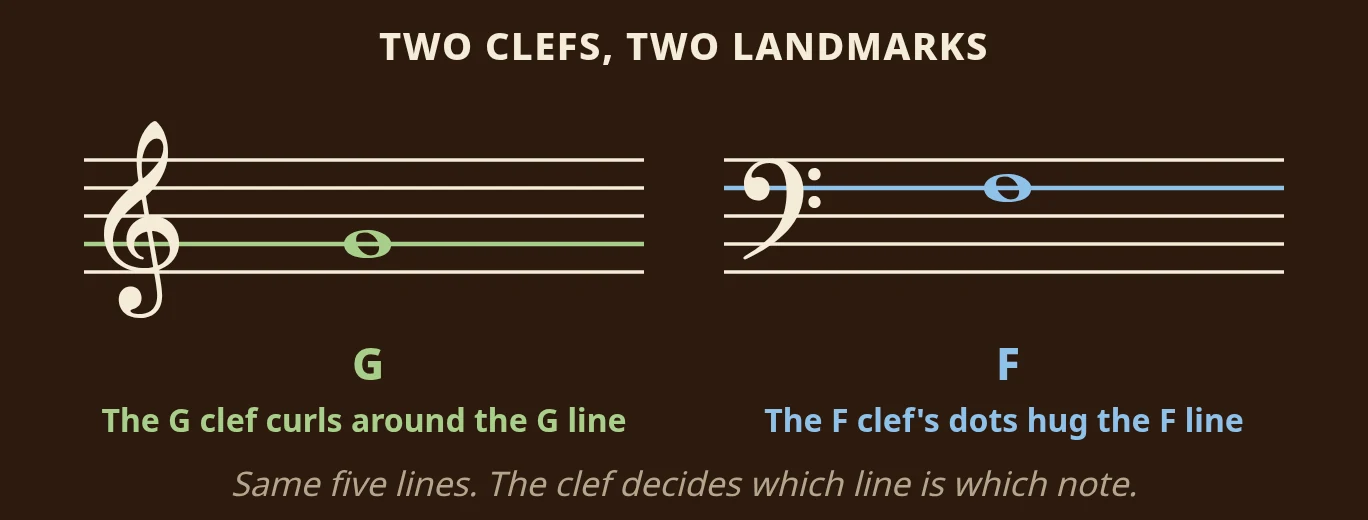
That is the whole secret, and also the whole difficulty. A line in the bass clef is not harder to read than a line in the treble clef. It is simply a different note. If you learned treble clef first, your brain will want to use the old names, and the main job of the next few weeks is to stop that habit from firing.
Who reads bass clef?
Any instrument or voice that sounds mostly below middle C reads bass clef, because in treble clef its notes would need a pile of extra lines. That includes the cello, double bass, bass guitar, bassoon, trombone, euphonium, tuba and timpani, bass and baritone singers in choir music, and the left hand of the piano most of the time.
A few of these instruments switch clefs now and then. The cello, bassoon and trombone move to tenor clef for passages that sit high for a while. The double bass and bass guitar read bass clef but sound an octave lower than written. You do not need to worry about either of these yet: the bass clef itself works the same way for all of them.
Step 2: Learn the lines and spaces
Now that you know the fourth line is F, you can name every other line and space by stepping up or down through the alphabet: A, B, C, D, E, F, G, and then back to A.
The notes from bottom to top
From the bottom line to the top line, the bass staff climbs G, A, B, C, D, E, F, G, A. Lines and spaces take turns, so every step up the ladder is one letter higher.
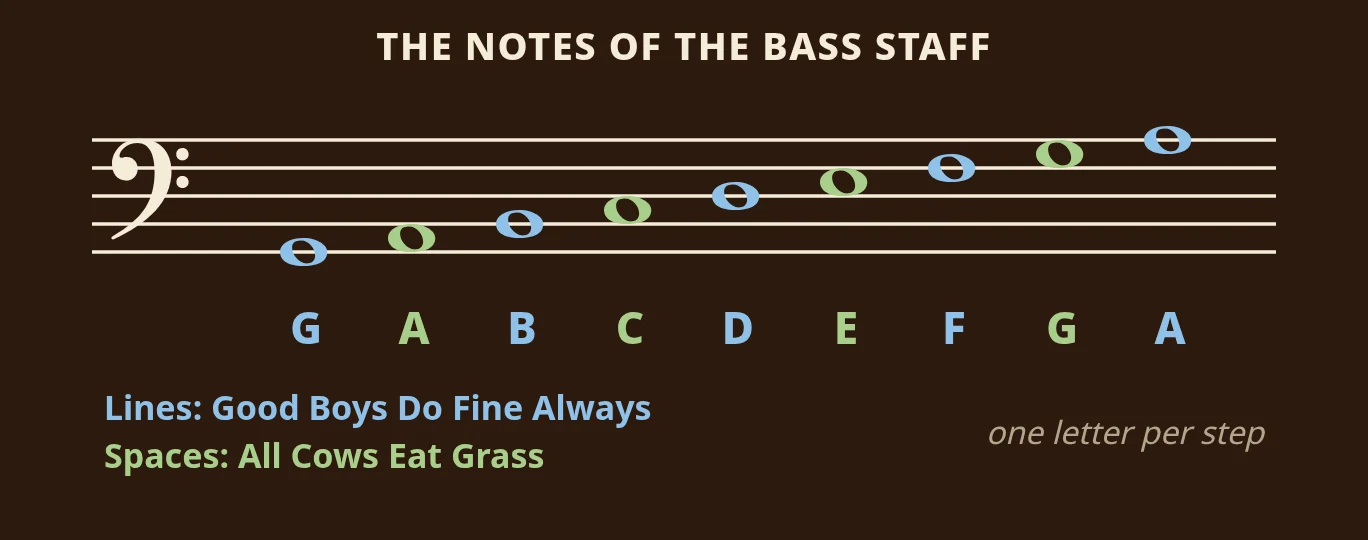
The lines, from bottom to top, are G, B, D, F and A. Most people remember them with the phrase Good Boys Do Fine Always (some teachers use Great Big Dogs Fight Animals). The spaces, from bottom to top, are A, C, E and G, which you can remember as All Cows Eat Grass.
What these notes sound like
The bass staff covers about an octave and a half just below middle C, which is where the piano's left hand spends most of its time. The bottom line G is quite low: it is the G an octave and a fourth below middle C. The C in the second space is exactly one octave below middle C. The F on the fourth line, the clef's own note, is the F just below middle C, and the G in the top space is the G just below middle C.
If you have a piano or keyboard, find middle C, then walk down to these notes so you can hear and feel where the bass staff lives.
A common mistake
The phrases are a great start, but if you recite Good Boys Do Fine Always every time you meet a note, your reading will stay slow. Use them for the first couple of weeks, and then move on to the landmark method in the next step.
Step 3: Memorize three landmark notes
Fluent readers do not count up from the bottom line. They know a handful of notes by heart and read every other note as a step or two away from the nearest one. In bass clef, three landmarks cover almost everything.
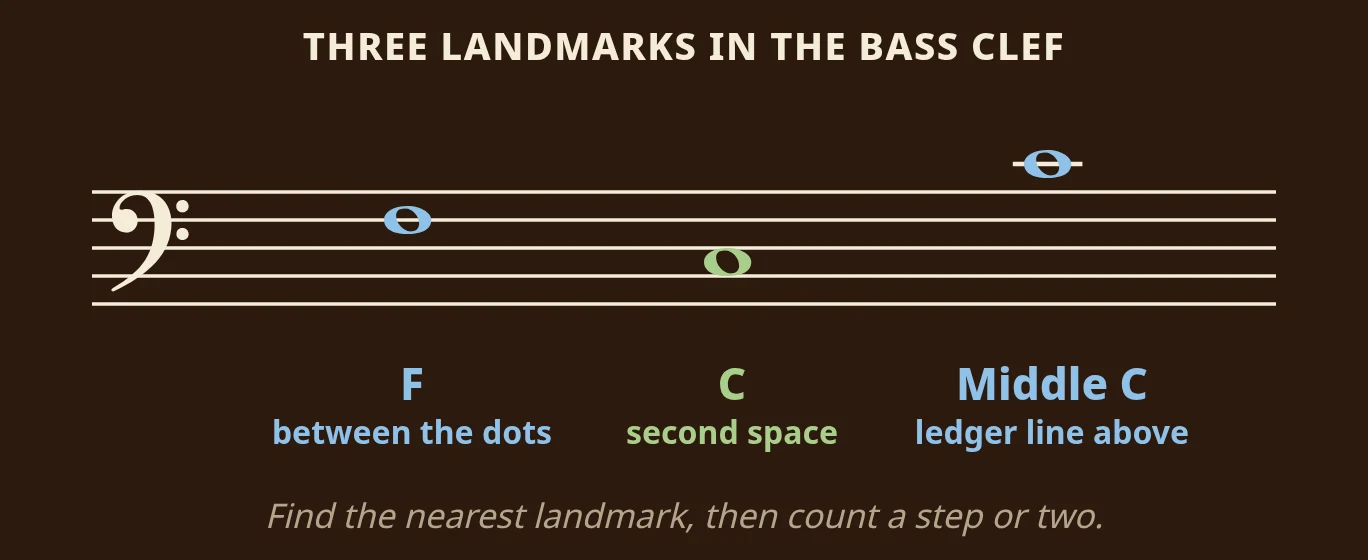
The first landmark is F, on the fourth line between the clef's two dots. The clef practically points at it. The second is C, in the second space from the bottom. The third is middle C, on the short extra line just above the staff.
Here is how it works in practice. The space just above the F line is one step up, so it is G. The line just below the C space is one step down, so it is B. The note on the middle line is one step up from the C space, so it is D. Instead of counting all the way from the bottom, you never have to move more than two or three letters from a landmark.
Practice the landmarks
Say each landmark out loud and point to it on a page of bass clef music: "F, between the dots. C, second space. Middle C, the line above." Then find each one on your instrument. Do this for a minute a day and within a week you will spot them without thinking.
Step 4: Don't read bass clef with treble clef eyes
If you already read treble clef, this step matters most. The most common mistake in bass clef is to name a note as if it were in the treble clef.
Same line, different note
Look at the second line from the bottom. In the treble clef it is G. In the bass clef it is B. The note looks identical on the page, and only the clef at the start of the line tells you which one it is.
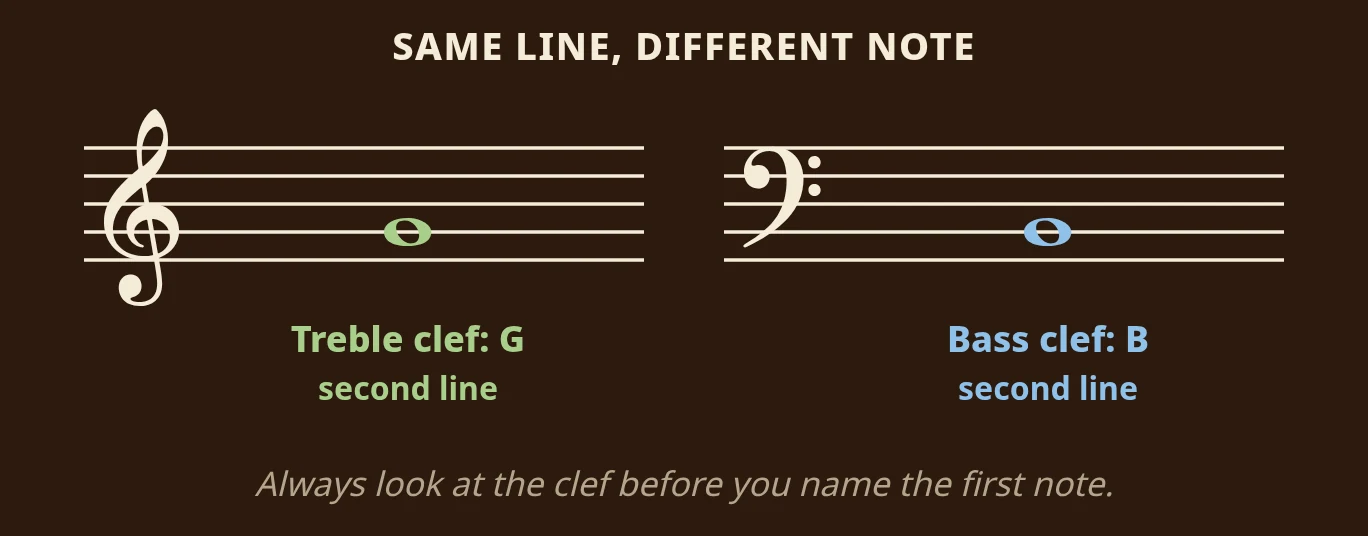
A treble reader who forgets to switch will read every note wrong by the same amount, so a bass line comes out as a strange, shifted melody. There is no simple rule for converting one clef into the other, so don't try to translate. Read the clef itself.
The fix is a tiny habit, not more memorizing. Before you play the first note of every line, look at the clef and say "bass" to yourself, then find the F line with your eye. After a few weeks the pause disappears and the right names come by themselves.
Watch for clef changes
In piano music, the lower staff is usually in bass clef, but not always. When the left hand climbs above middle C for a few bars, the music may switch to a treble clef and back again later. The clef at the start of each line, and any small clef in the middle of a line, is the instruction. "The lower staff is bass clef" is a habit that is wrong just often enough to catch you out.
Step 5: Find middle C and the grand staff
Piano music joins a treble staff and a bass staff with a brace. This is called the grand staff, and it shows you something useful: the two staves are really one long ladder of notes with a gap in the middle.
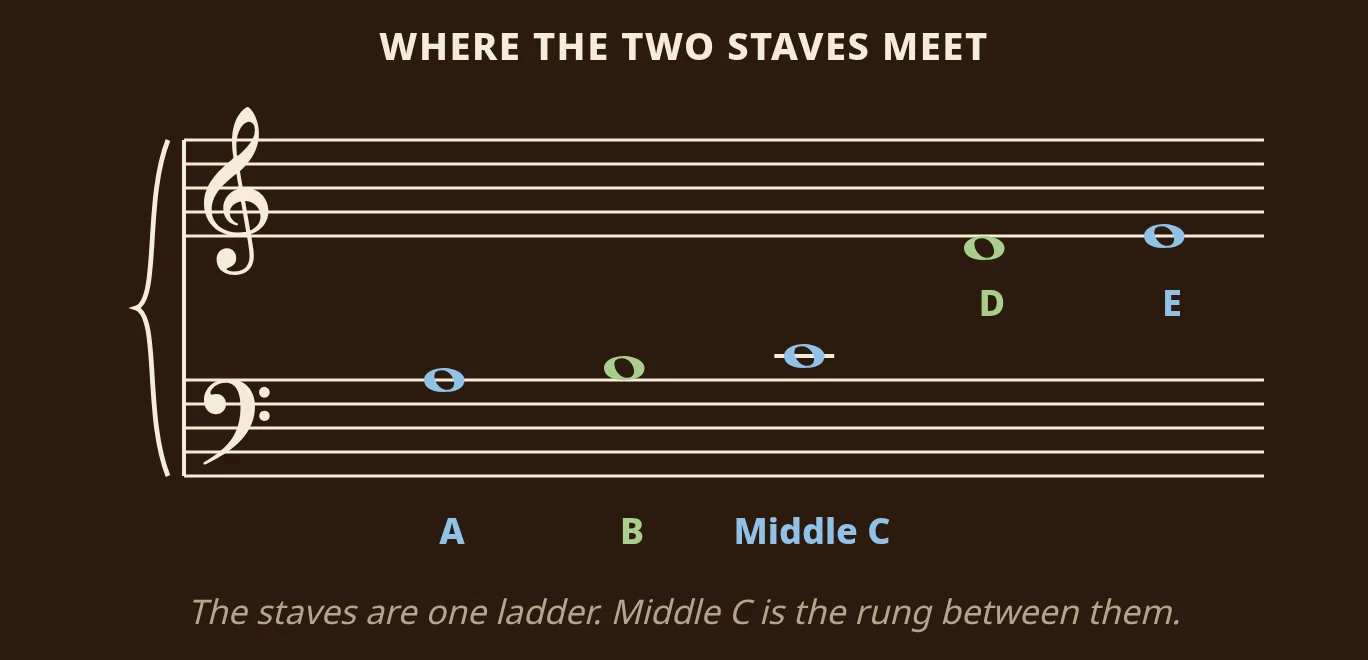
Climb up from the top of the bass staff. The top line is A. The space above it is B. The short line above that is middle C. Keep going and you reach D, which hangs just below the treble staff, and then E, on the bottom line of the treble staff.
Middle C is the hinge between the two clefs. It sits on the first ledger line above the bass staff and on the first ledger line below the treble staff, and both are the same key on the piano. Because the hands share this area, a note just above the bass staff and a note just below the treble staff can be exactly the same pitch. Engravers simply pick whichever clef needs fewer extra lines.
A common mistake
Beginners sometimes look for middle C below the bass staff, because it is below the treble staff. Remember the hinge: middle C is above the bass staff and below the treble staff. The first ledger line under the bass staff is a very different note, as you will see in the next step.
Step 6: Read the notes below the staff
Low instruments often go below the bottom line. These notes use ledger lines: short extra lines that carry the staff on downward, one note per line or space.
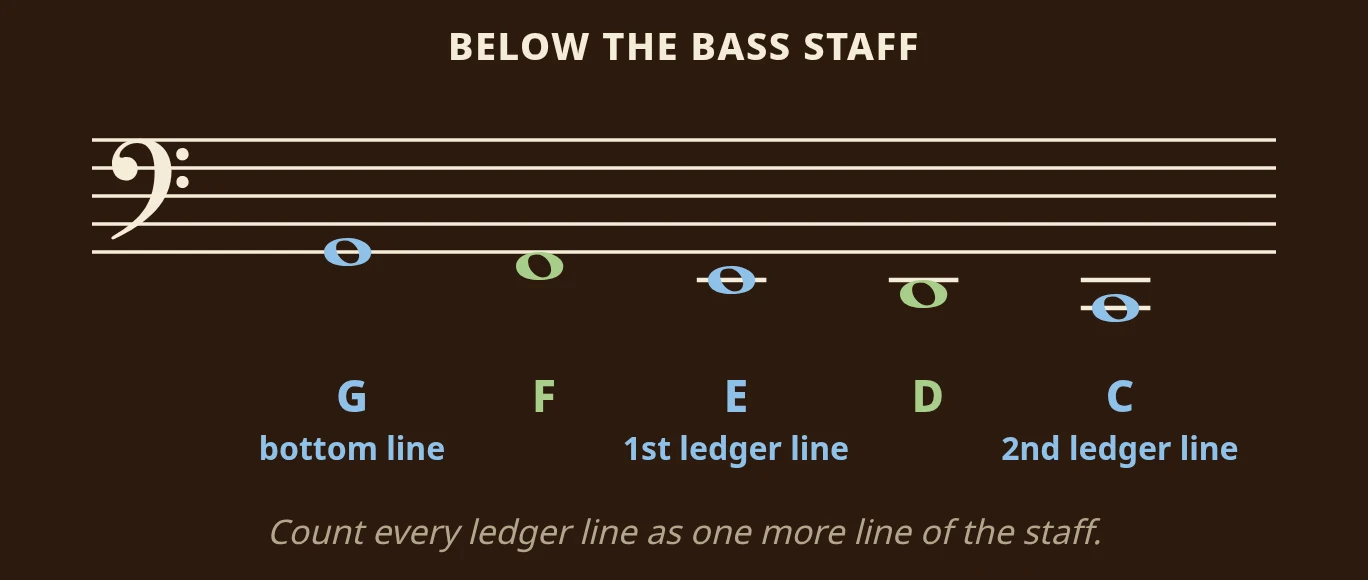
Start at the bottom line, G. The space just below it is F. The first ledger line below the staff is E, which is the lowest open string on a standard bass guitar and double bass. The space below that is D, and the second ledger line is C, two octaves below middle C.
The most common mistake here is counting one ledger line too few. Count slowly the first few times, touching each line with a pencil tip, and remember that two ledger lines below the bass staff is always C. For the full method, including the notes above the staff, read our guide to reading ledger lines.
Step 7: Read a real bass line
Let's put it all together with a short left-hand line in 4/4 time. Try to name each note before you read the answers below.
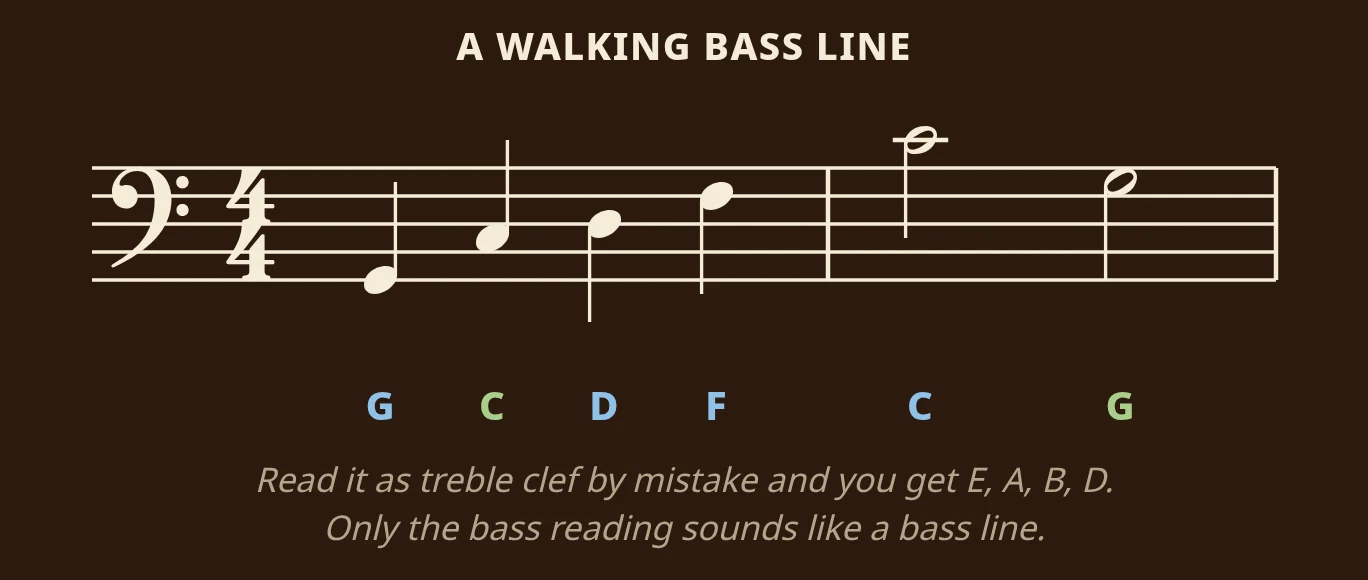
The first bar has four quarter notes. The first sits on the bottom line, so it is G. The second is in the second space, the C landmark. The third is on the middle line, one step above C, so it is D. The fourth is on the fourth line, between the clef's dots, so it is the F landmark. The bar is G, C, D, F: a line that walks upward, the kind you hear in a lot of jazz and pop bass playing.
The second bar has two half notes. The first is on the ledger line above the staff, so it is middle C, held for two beats. The second is in the top space, one step below the top line A, so it is G, also held for two beats.
Now try the trap on purpose. Read the first bar as if it were treble clef and you get E, A, B, D. Sing or play both versions. Only one of them sounds like a bass line, and noticing that difference is a great way to catch your own mistakes.
A two-minute daily drill
- Say the three landmarks out loud and find each one on your instrument (30 seconds).
- Open a piano book or a bass part to any page. If it is piano music, cover the treble staff with a sheet of paper.
- Point at ten notes on the bass staff and name each one by its distance from a landmark: "one above F, G" or "one below C, B" (1 minute).
- Play the notes you hesitated on. Those are the ones to drill again tomorrow (30 seconds).
Step 8: Practice with a way to check yourself
Naming notes on paper is a great start, but the real test is whether what you play matches what is written. The quickest check is your ear: when you read a bass line correctly, it sounds like a bass line. When you read it with treble clef eyes, it sounds wrong in a way you can hear.
That is where Sheetly helps. Take a photo of a printed page with your iPhone or iPad, and Sheetly plays it back to you with a playhead that follows the notes, so you can hear the left hand or the bass part on its own terms. Slow a busy passage down until you can follow each note with your finger, loop a bar or two until the line is in your ear, and if you are unsure about a note, ask the built-in coach about that bar of your page: which note it is and why.
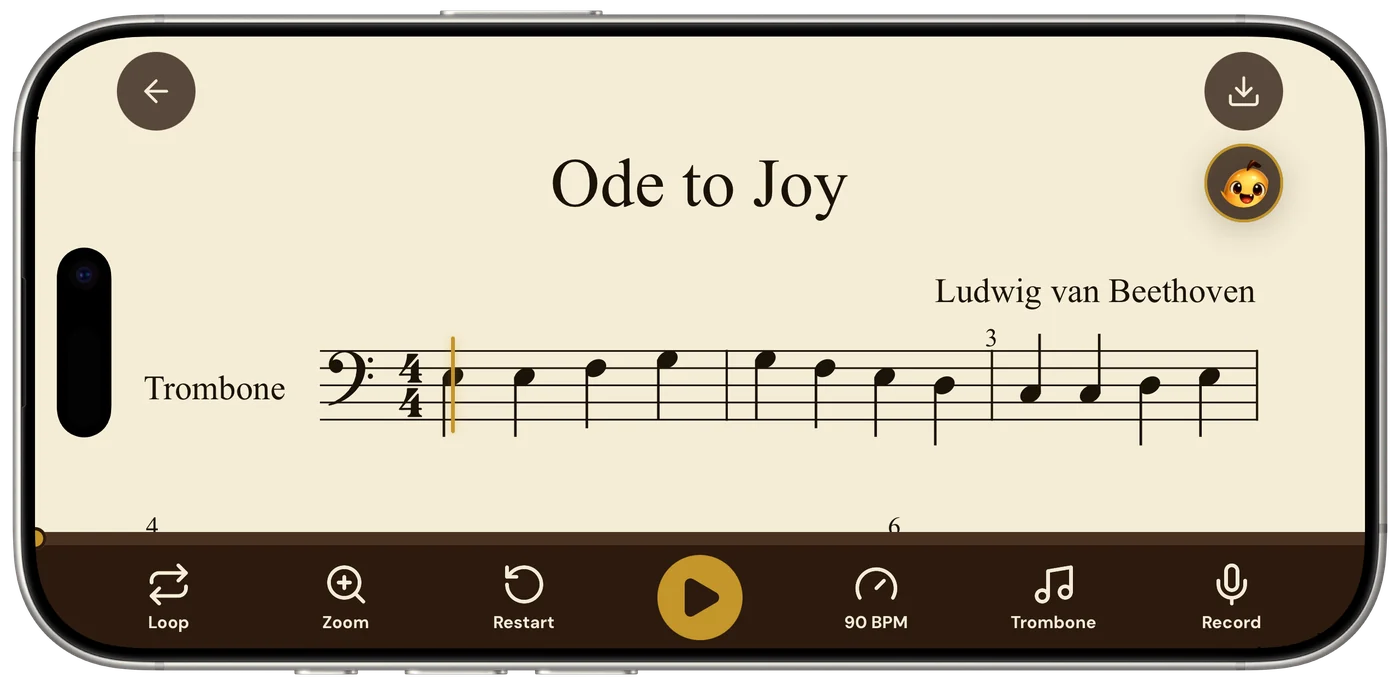
Read first, then listen. Name the notes of a bar, play or sing them, and only then press play to compare. The moments where your version and the playback disagree show you exactly which notes to practice tomorrow.
Questions
Why is it called the F clef?
Because it marks the note F. The two dots of the bass clef sit on either side of the fourth line from the bottom, and that line is the F just below middle C. Every other note on the staff is counted from there.
Where is middle C in the bass clef?
On the first ledger line above the bass staff. It is the same note as the first ledger line below the treble staff, which is why the two staves join so neatly in piano music.
What is the difference between bass clef and tenor clef?
The tenor clef is a C clef: it marks middle C on the fourth line of the staff, where the bass clef has F. Cello, bassoon and trombone use it for high passages that would otherwise need many ledger lines above the bass staff.
Is the F clef always on the fourth line?
In modern music, yes. The F clef always sits on the fourth line, and that is the bass clef. Some very old editions put it on the third line, where it is called the baritone clef, but you are unlikely to meet it.