Choir Sheet Music Scanner: How to Read SATB Music and Learn Your Part
Looking for a choir sheet music scanner so you can learn your line at home? In this guide, we show you how to find your part in an SATB score, read the tenor line, follow the words and find your entry notes, with a picture for each step.


The director hands out a new anthem, the choir sings it through once, and you go home with a page of four staves and a vague memory of the alto line. Next week everyone is expected to know their notes. If you have ever wished for a choir sheet music scanner that could play the page back so you can practise your part at the kitchen table, this guide is for you.
A choral score looks busy, but it is built from a few simple ideas. Each voice part has its own line. The lines are stacked so you can see what everyone sings at the same moment. Words sit under the notes. Once you know where to look, your part is easy to follow, even when the page holds four or five staves at once.
In this guide we walk you through reading a choral score step by step, with a picture for each part. Then we show you how to scan a choral page and practise your line against the others, whether you read fluently or are still learning.
How to read choir sheet music
Step 1: Find your line in open score
SATB stands for soprano, alto, tenor and bass, the four voice parts of a standard mixed choir, from highest to lowest. In open score, each part has its own staff, stacked in that order from top to bottom and joined on the left by a straight bracket.
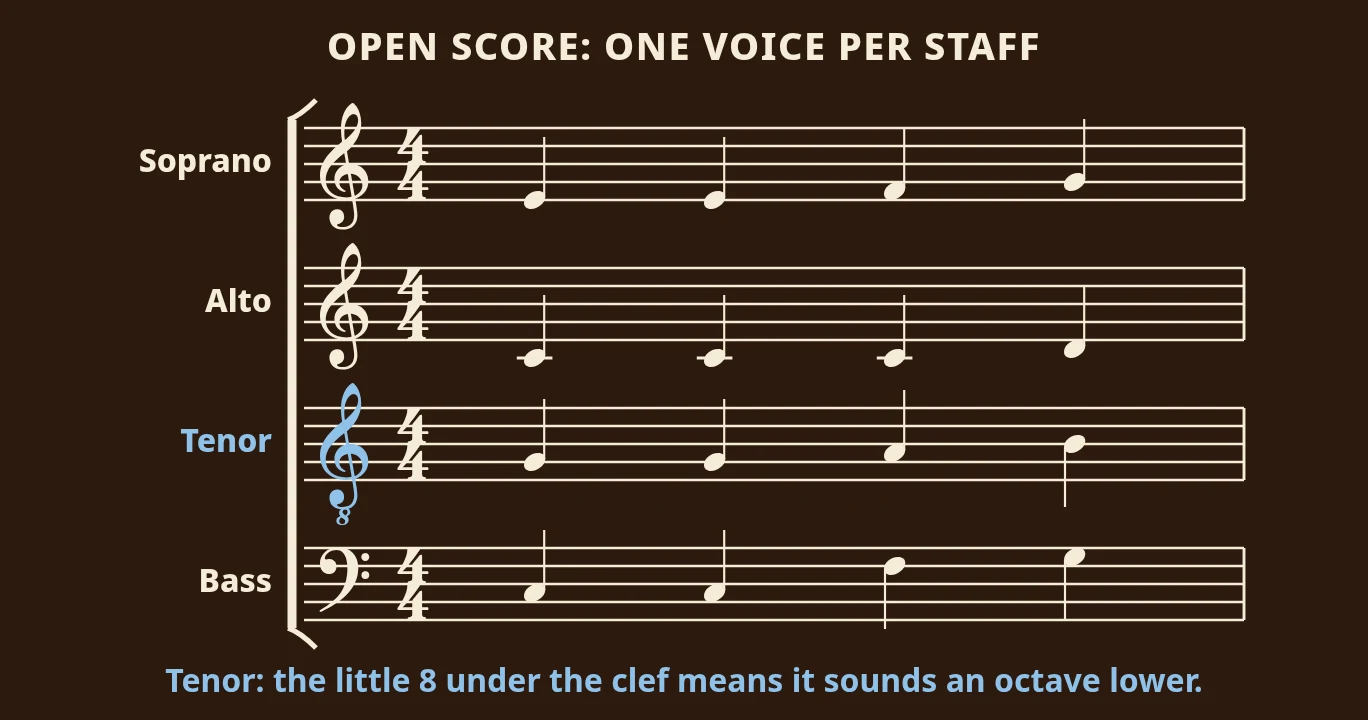
The soprano and alto staves use the treble clef. The bass staff uses the bass clef. The tenor staff usually uses a treble clef with a small 8 underneath, which means "sing this an octave lower than written". Tenors read the treble clef notes as usual and sing them an octave down.
Many open scores add a piano reduction under the four voices: two more staves that show what the accompanist plays, or a summary of the voices for rehearsal. That makes five or six staves per line of music, but your part is still just one of them.
The common mistake is losing your place when you turn from one line of music to the next. Before you sing, find your staff in every system on the page and mark the start of it with a small pencil tick.
Try it today: take your current piece and, for each system, point to your staff and say the name of your first note. Then read across the four staves at one moment and notice who sings the highest and lowest note.
Step 2: Read closed score
Hymnals, many congregational books and older anthems use closed score: all four parts squeezed onto two staves. Soprano and alto share the treble staff. Tenor and bass share the bass staff.
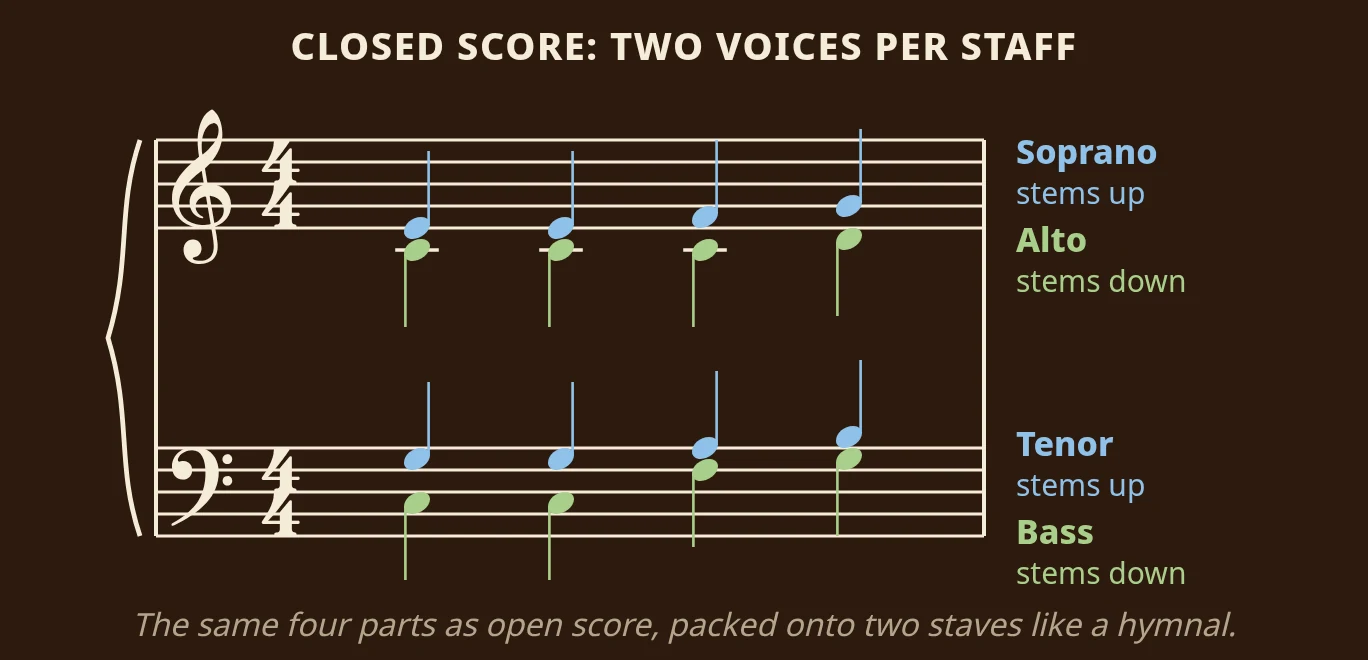
To tell the parts apart, look at the stems. On the treble staff, soprano notes have stems pointing up and alto notes have stems pointing down. On the bass staff, tenor stems point up and bass stems point down. When two parts sing the same note, it may share one note head with stems in both directions.
Notice that in closed score the tenor part is written at its real pitch in the bass clef. These are the same four parts as the open score above, chord for chord. Tenors who usually read the treble clef with the little 8 need to switch to reading the bass clef here.
The common mistake in closed score is drifting onto the other part's notes when the two lines cross or get close together. Follow your stem direction, not just the nearest note.
Step 3: Follow the words under the notes
Lyrics are written under the notes, one syllable per note. Words with more than one syllable are split with hyphens. When a syllable is sung over several notes, it is called a melisma, and a slur over the notes shows which ones belong together.
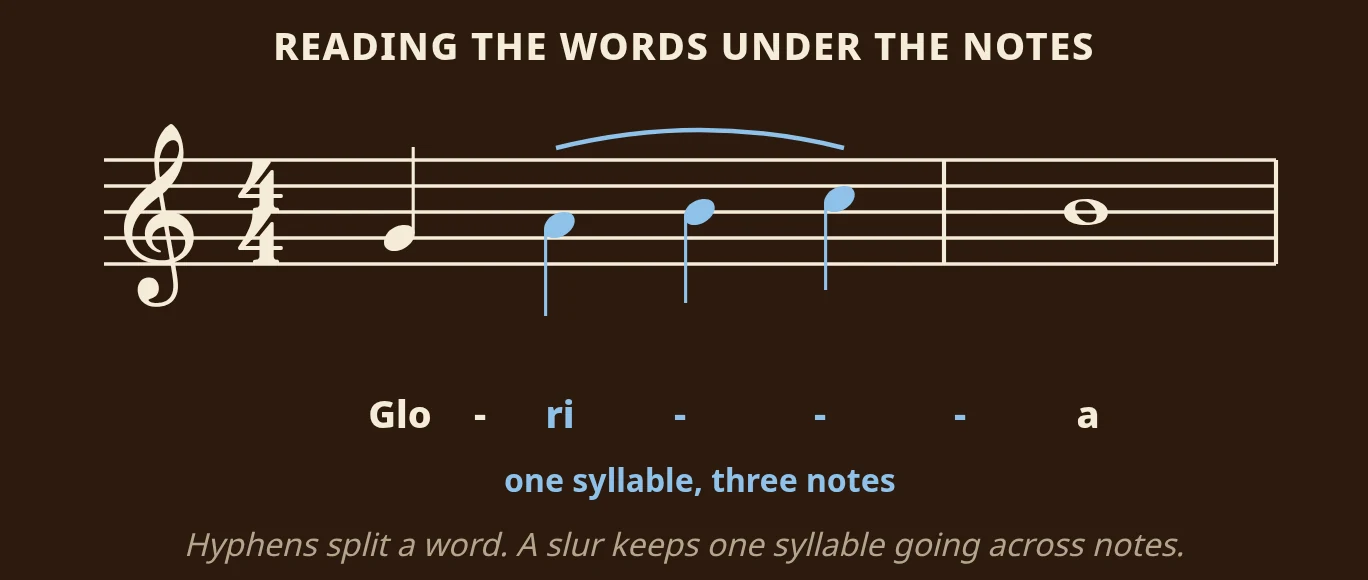
In the example, "Glo" is sung on the first note. "ri" starts on the second note and carries on over the next two, under the slur, while the hyphens show that the word continues. Then "a" arrives on the whole note in the next bar. Sing the vowel of "ri" through all three notes and only move to the next syllable when the hyphens end.
The common mistake is rushing to the next syllable early, which makes the melisma sound like separate words. Sing the line on one vowel first, then add the words once the notes are secure.
When verses of a hymn are printed in stacked rows under the same notes, read straight down to your verse each time. A small number at the start of each row tells you which verse it is.
Step 4: Find your entry note
Almost every wrong note in a choir comes right after a rest, when your part comes back in. The trick is to find where your note comes from: very often, another part has just sung it.
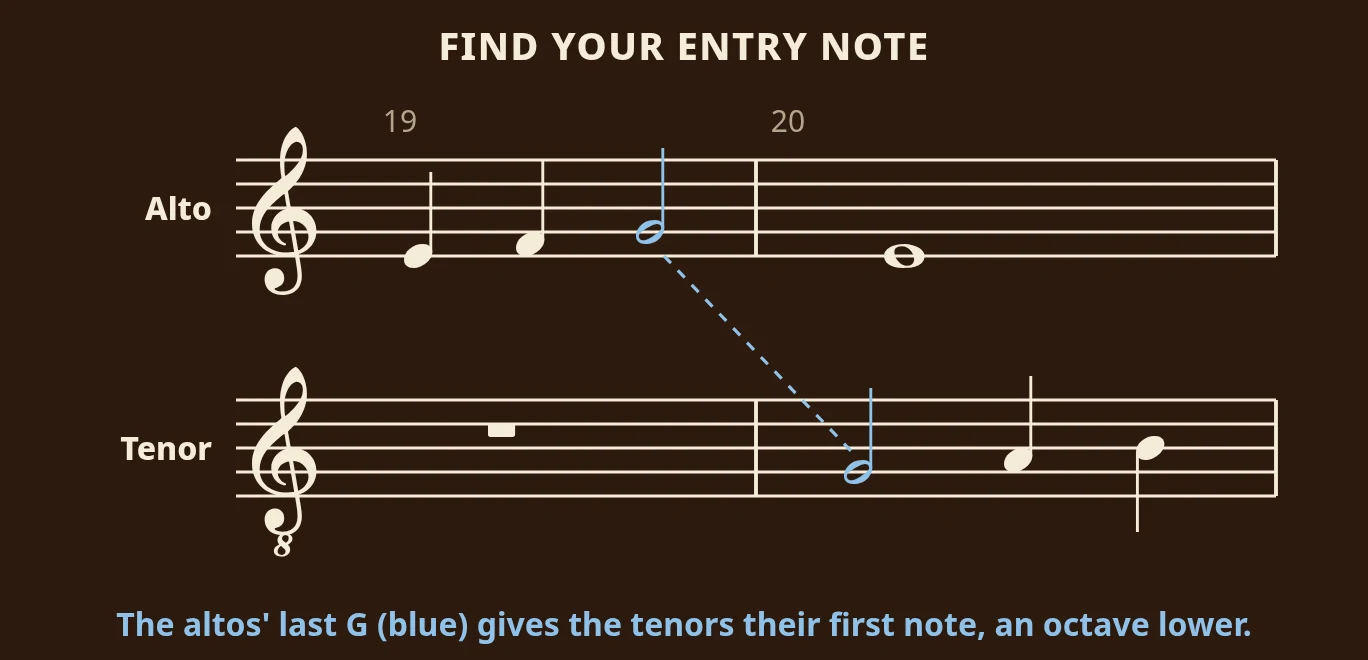
In the example, the tenors rest through bar 19 while the altos sing E, F, G. At bar 20 the tenors come in on G, the same G the altos just finished on. Because the tenor line is written with the little 8, it sounds an octave lower. Listen for the altos' last note and you already have yours.
Try it today: for every entry in your part, look at the other staves in the bar before it. Circle any note that matches your first note, even in a different octave, and draw a small arrow to your entry.
Step 5: Count the rests
Choral parts often have long stretches of rests while another section sings. Count every bar of rest, and follow the other parts with your eyes as you go. A multi-bar rest is often printed as a thick bar with a number above it, such as 8, which means rest for eight bars.
The common mistake is counting in your head without looking at the page, then losing a bar. Follow the words of the part that is singing instead. When their words reach the bar before your entry, you know it is nearly time.
How to scan a choral score
Each staff of a choral page is simple, since vocal writing is mostly one note at a time. The hard part for any scanner is grouping the staves: working out which ones belong to the same line of music and keeping the bar lines aligned between voices. If that goes wrong, the alto line arrives as a separate piece playing at the same time. It is the same problem piano music poses, multiplied by the number of voices.
Open score is the cleaner case, because every staff is a single voice and all the work is in the grouping. Closed score reads well too, like piano music, with stems up and down. A shared staff is where a note can land in the wrong part, so listen for a line that suddenly leaps. Sheetly also detects the tenor's octave clef and plays the line where it sounds. A tenor part an octave too high is the most common way a choral playback sounds wrong.
- One page, not the spread. Octavos and anthologies open to two pages. Photograph one at a time; the pages join together in the app and each keeps its full detail.
- Flatten the gutter. Stapled and bound choral books curl at the centre, and curved staves are the first thing that breaks the grouping.
- Square-on, full width. Hold the phone parallel to the page with every staff of the system in the frame. On a tall page, keep the bottom staff (usually the piano reduction) in the shot.
- Check the grouping first. When the score comes back, make sure the staves play together as one piece. If a voice arrived as a separate instrument, rescan that page.
- Listen straight through once. An entry in the wrong octave or a line leaping out of its range stands out right away.
If the director has sent a PDF, import it directly and skip the camera and the gutter. That is also the better route for very large scores, such as double choir with an orchestral reduction, which are hard to photograph in one frame at a usable size. If you do photograph the pages, our step-by-step guide on how to scan sheet music and hear it played back goes through the light, angle and framing habits with a picture for each.
A few things are outside what a scanner reads. Lyrics are not read or sung: the playback is instrumental, so you learn the notes from the playback and the words from the page. Dense divisi, with three or four notes on one staff, is where mistakes gather. Handwritten parts will not read reliably (here is what to do instead), and chant, shape notes and graphic notation are outside what optical music recognition reads.
Learn your line with the page playing back
Choirs spend a lot of rehearsal time teaching notes, and singers who do not read fluently have no way to learn their line in between. That is what we built Sheetly for. Photograph your choral score with an iPhone or iPad, and Sheetly plays every staff back together, as one piece, with a playhead that follows the notes. Here is a simple way to learn your part in four passes:
- Hear the whole texture first. Play the piece at tempo with everything sounding. Listen for where your line sits in the chord, where it moves and where it holds.
- Slow down and follow your line. Drop the tempo until your eye and ear can follow your staff together, and sing along quietly. The playback holds your note against the other parts, which is exactly what you need.
- Loop the entry. Loop the two bars before an entry and the bar after it, and learn where your note comes from.
- Record yourself against it. Sing your line over the playback and record it, to catch the flat entry or the rhythm that was not quite what was printed.
The built-in coach has the notes of every staff on the page, so you can ask why your section keeps going flat in bar 14, where an entry gets its pitch from, or which bars to rehearse first. Directors can use the same page as a rehearsal pianist on call: playback for note-learning at any tempo, a loop for the passage the tenors cannot find, and a quick way to hear a piece before choosing it.
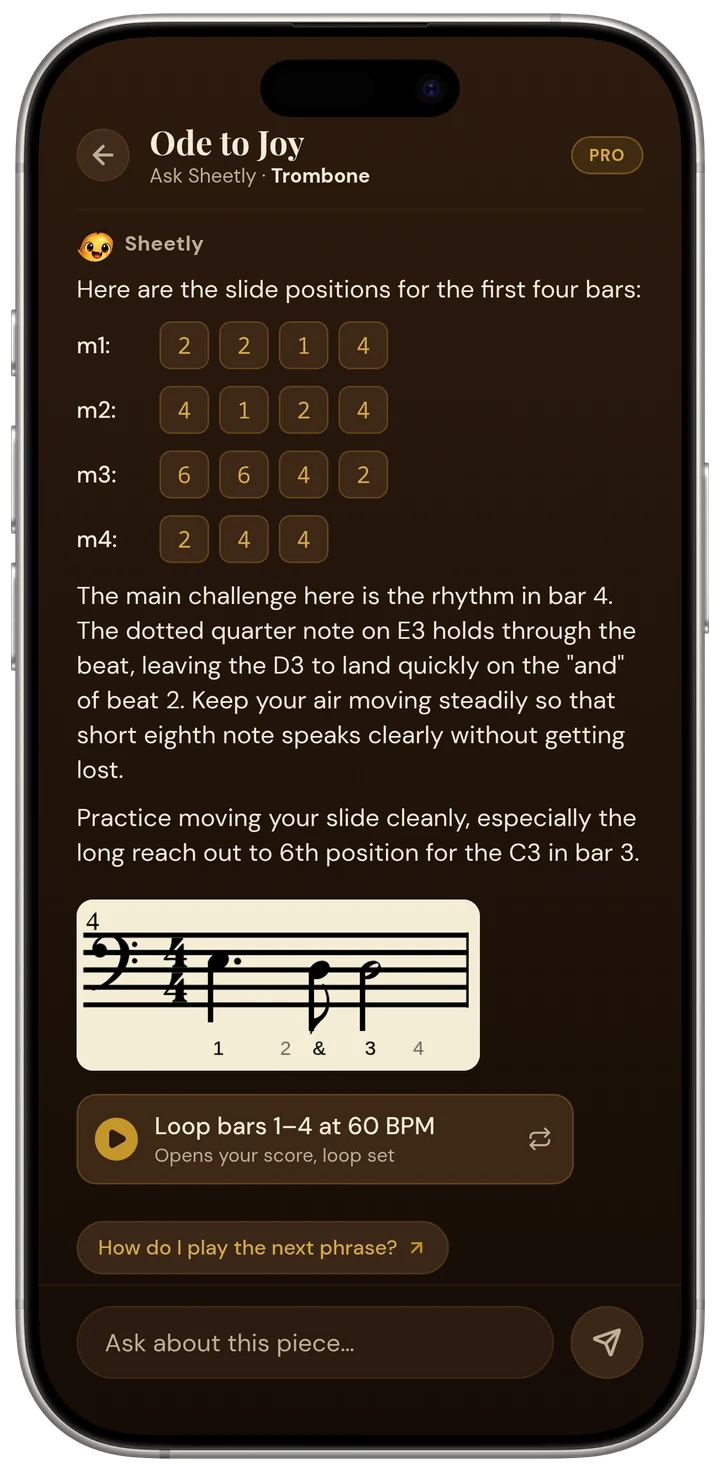
Use the playback to check your reading, not to replace it. Read your line first, then press play and compare.
Questions
What does SATB stand for?
SATB stands for soprano, alto, tenor and bass, the four voice parts of a standard mixed choir from highest to lowest. A score marked SATB has a line for each, on four staves in open score or two in closed score.
Can I hear just my voice part?
In Sheetly you hear the full score and learn your line within it, using the tempo and loop controls, which is how most singers rehearse. The MusicXML export keeps the parts on separate staves if you want to isolate one in notation software.
Why does the tenor clef have an 8 under it?
The small 8 under the treble clef means the part sounds an octave lower than written. It lets tenors read in the familiar treble clef while singing at their real pitch.
Does a choir sheet music scanner read the lyrics?
Sheetly reads and plays the notes, not the words. The playback is instrumental, so you learn the line from the playback and the text from the page.