Piano Sheet Music Scanner: How to Scan Piano Music and Read the Grand Staff
Looking for a piano sheet music scanner that plays both hands back? In this guide, we show you how to read the grand staff and how to photograph a piano page so it reads cleanly, with a clear picture for every step.

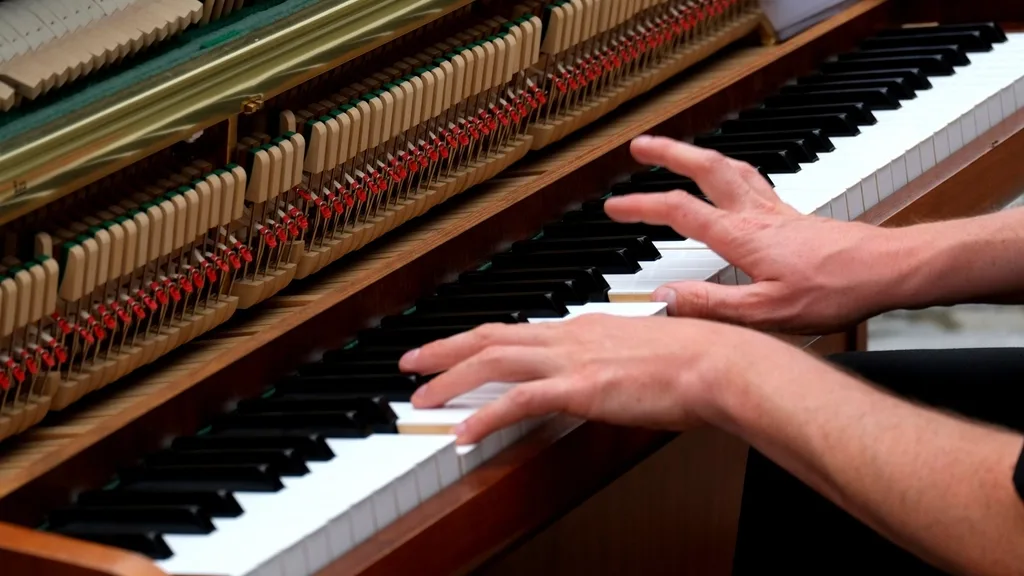
You open a new piece of piano music and there it is: two staves at once, notes stacked on top of each other, a left hand that seems to be doing something completely different from the right. Maybe you are coming back to the piano after years away, maybe your child just brought home their first exam book, or maybe you want a piano sheet music scanner that can play the page so you know what it is supposed to sound like.
Piano music looks harder than a single melody line because it is two lines of music read at the same time. But it follows the same rules as any other sheet music. Once you know how the two staves fit together, where the landmark notes are and what a few extra piano habits look like, the page starts to make sense, one bar at a time.
In this guide we walk you through reading piano music first, step by step, with a picture for each idea. Then we show you how to photograph a piano page so a scanner reads both hands cleanly, and how to practise with the page playing back to you.
How to read piano sheet music
Step 1: Understand the grand staff
Piano music is written on the grand staff: two staves joined on the left by a curly bracket called a brace. The brace tells you that both staves belong to one player. You read them together, as one piece of music.
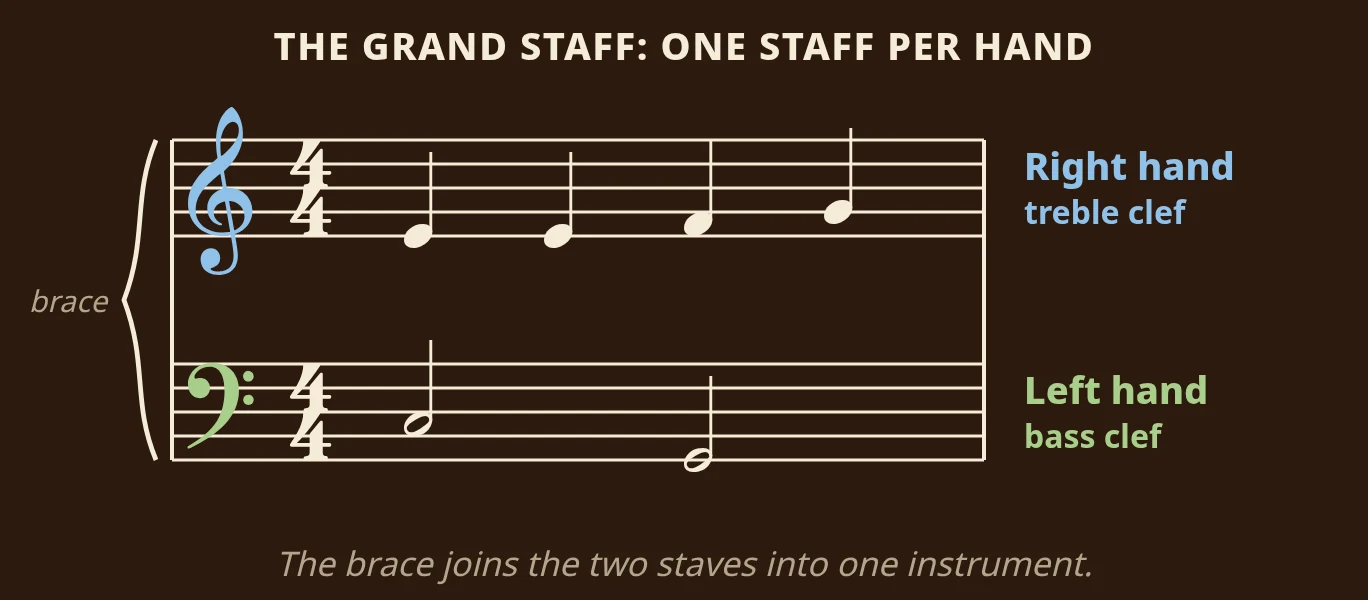
The top staff almost always uses the treble clef, and it is usually played by your right hand. The bottom staff almost always uses the bass clef, and it is usually played by your left hand. In the picture above, the right hand plays four quarter notes (E, E, F, G) while the left hand plays two half notes (C, then G). Both hands start together on beat 1.
The most common mistake is reading the staves one after the other, like two lines of text. They are not two lines: they happen at the same time. Get into the habit of letting your eyes take in both staves bar by bar, like reading a two-row table from left to right.
Try it today: open any piano piece and, without playing, point to the first note of each hand in bar 1. Say which hand plays it and which clef it is in. Then do the same for bar 2.
Step 2: Learn the landmark notes
You can name any note by reciting a phrase like Every Good Boy Does Fine, but on the piano that is too slow, because you need to read two staves at once. A faster way is to learn a handful of landmark notes by heart and find every other note by counting up or down from the nearest one.
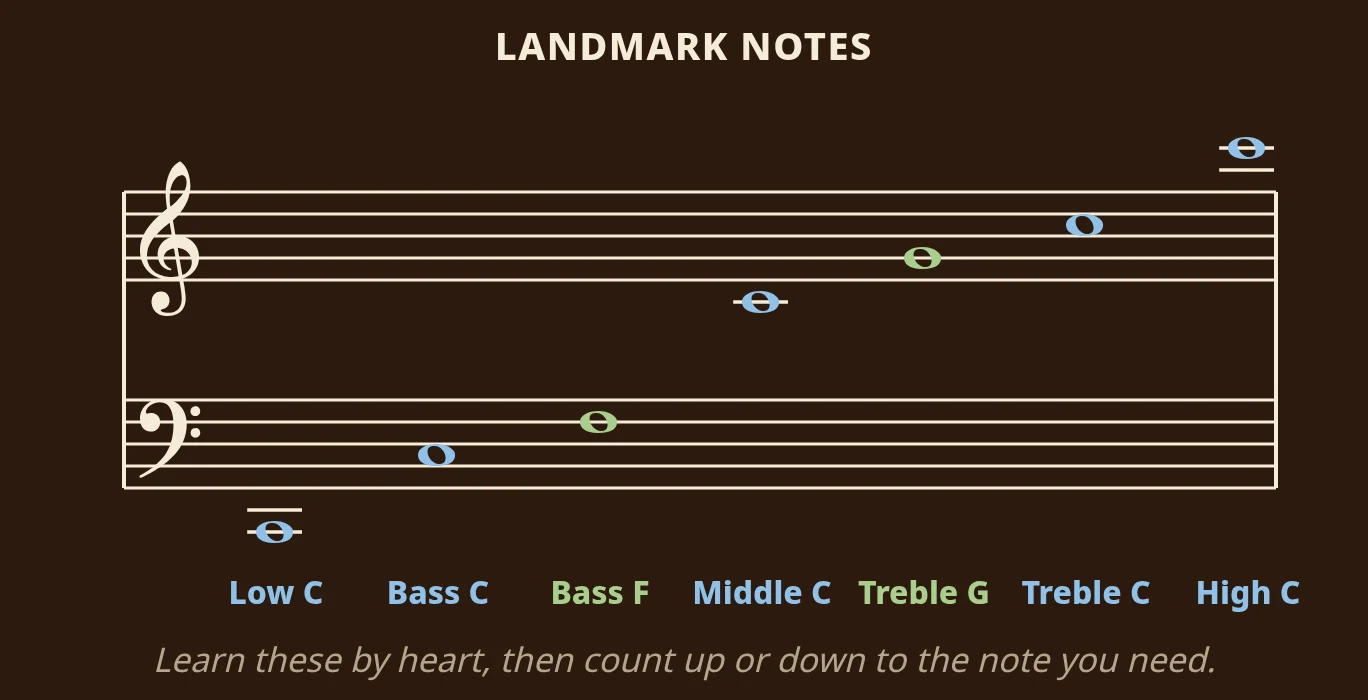
Here are the seven landmarks most piano teachers use:
- Middle C sits on a short extra line (a ledger line) between the two staves. It is the C nearest the middle of the keyboard.
- Treble G is the second line of the treble staff, the line the treble clef curls around.
- Treble C is the third space of the treble staff, one octave above middle C.
- High C sits on the second ledger line above the treble staff, two octaves above middle C.
- Bass F is the fourth line of the bass staff, the line between the two dots of the bass clef.
- Bass C is the second space of the bass staff, one octave below middle C.
- Low C sits on the second ledger line below the bass staff, two octaves below middle C.
Notice the pattern: the C's are spaced an octave apart, and each one sits in a mirror position. Treble C and bass C are both in a space near the middle of their staff. High C and low C both sit on a second ledger line. Once you see that, the landmarks are much easier to remember.
To use them, find the nearest landmark and count lines and spaces. Every step from a line to the next space (or from a space to the next line) is one letter of the alphabet. A note one space above treble G is A. A note one line below bass F is D.
The common mistake is counting from the bottom of the staff every time. It works, but it never gets faster. Counting one or two steps from a landmark does get faster, until one day you stop counting at all.
Try it today: play each landmark on the piano with your eyes on the page, not on your hands. Then take any line of music and, for each note, say out loud which landmark it is closest to before you name it.
Step 3: Read down as well as across
Here is the idea that makes piano music click. Time on the page runs from left to right, so notes that line up vertically, one above the other, are played at the same moment. That is true inside a staff (a chord) and across the two staves (your two hands).
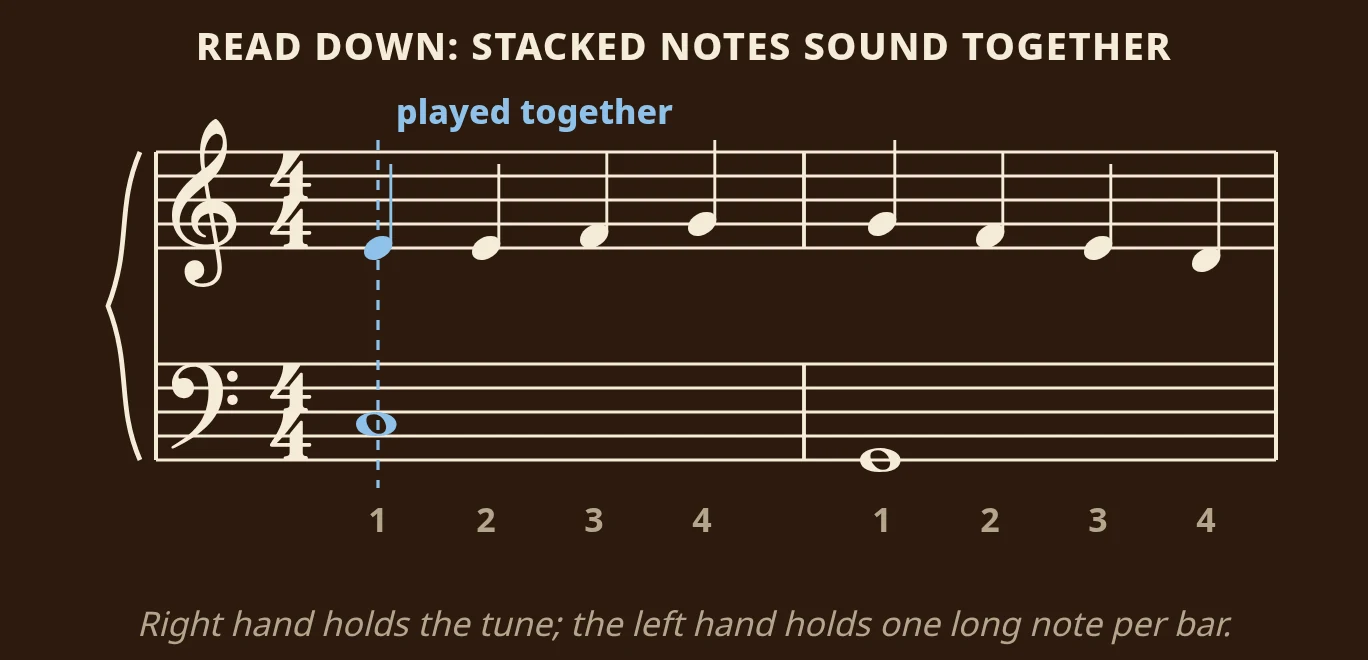
In this opening of Ode to Joy, the right hand plays the tune: E, E, F, G in bar 1, then G, F, E, D in bar 2. The left hand plays one whole note per bar: C under bar 1 and G under bar 2. The first E of the tune and the left-hand C sit on the same vertical line, so you press them together on beat 1. Then the left hand holds its note through beats 2, 3 and 4 while the right hand keeps moving.
Count out loud while you play: "1, 2, 3, 4". Each right-hand note gets one count. The left-hand whole note is held for all four. If your left hand lets go early, you will hear a gap under the tune.
The common mistake is to play one hand, then look across and play the other, so the two hands drift apart by a fraction of a beat. When you practise slowly, slow down the counting, not just the notes: both hands land exactly on "1".
Try it today: learn a few bars hands separately first. Then put them together at half your usual speed, counting out loud and checking that every vertical line of notes starts at the same instant.
Step 4: Spot two voices in one hand
Sometimes one staff carries two separate lines of music at once. These are called voices. Piano music shows them with stem direction: one voice has its stems pointing up, the other has its stems pointing down, even when that breaks the usual rule about stem direction.
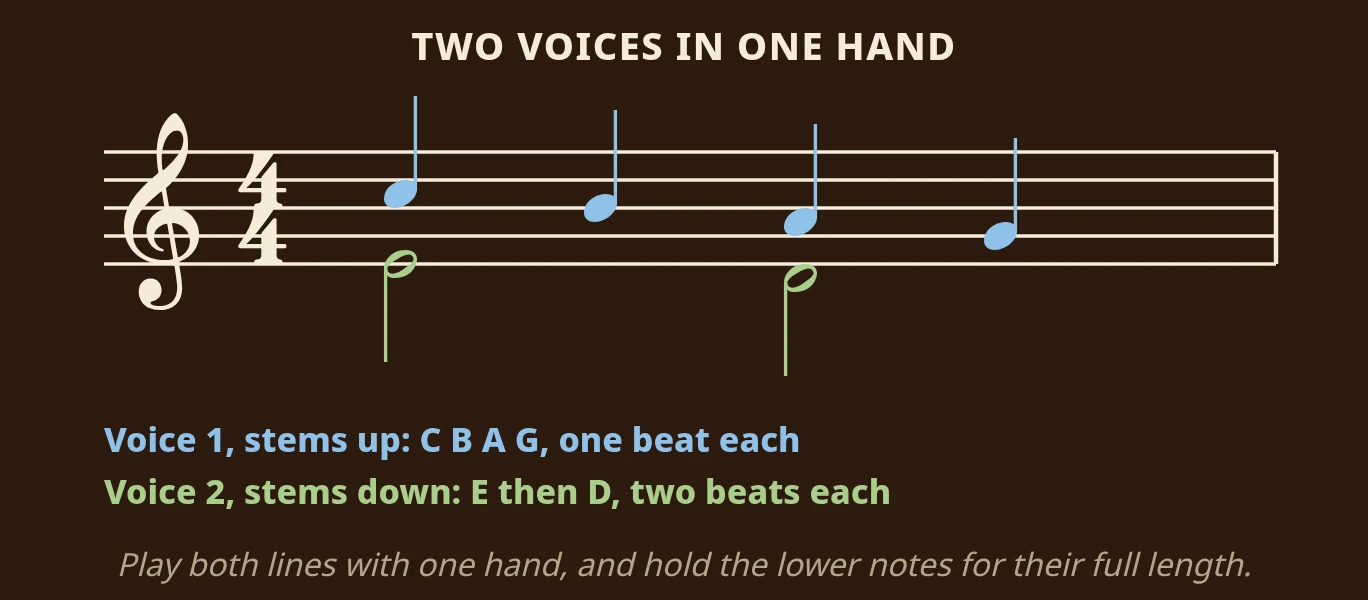
In the example, the upper voice (stems up) moves in quarter notes: C, B, A, G. The lower voice (stems down) holds half notes: E for the first two beats, then D for the last two. Your right hand plays both. On beat 1 you play C and E together, on beat 2 you play only B while you keep holding the E, and so on.
The common mistake is to lift the lower note when the upper voice moves, which chops the long notes short and changes the music. Read each voice's rhythm separately before you play. A useful check: each voice should add up to a full bar on its own. Here, four quarter notes make four beats, and two half notes also make four beats.
Try it today: play just the stems-up voice, then just the stems-down voice, then both. You will hear right away whether you are holding the long notes for their full length.
Step 5: Watch for clef changes
The top staff is not always treble and the bottom staff is not always bass. When the left hand climbs high, composers often switch its staff to the treble clef partway through a line, so the notes do not need a long ladder of ledger lines. They switch back when the hand comes down again.
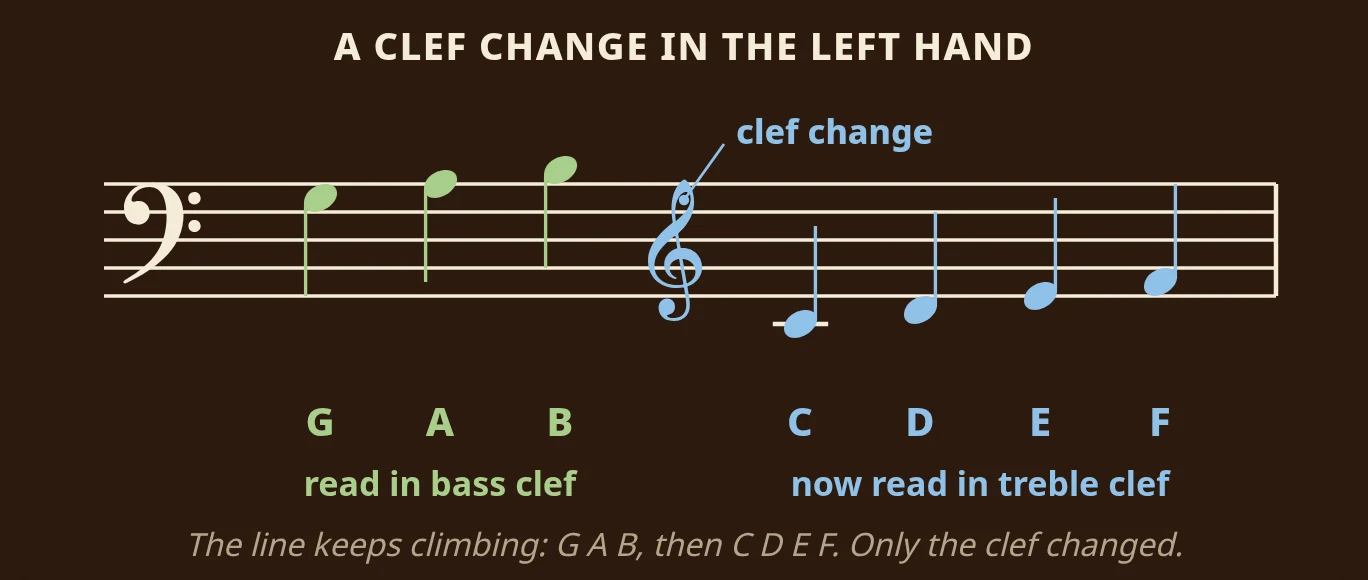
A clef change is drawn as a smaller clef in the middle of the staff. From that point on, every note on that staff is read in the new clef, until the next clef appears. In the example, the left hand plays G, A, B in the bass clef, then the treble clef appears and the next notes are C, D, E and F. The line simply keeps climbing.
The common mistake is to miss the small clef and keep reading in the old one. Your notes will all be wrong by the same distance, and the passage will suddenly sound like it jumped to a different place on the keyboard. Before you start a new piece, scan the whole page for small clefs and circle them in pencil.
Two more piano habits are worth knowing. A cross-staff beam joins notes on both staves, which usually means the melody passes from one hand to the other. And notes far above or below a staff use ledger lines: count them carefully from the nearest landmark, or look for an 8va sign, which tells you to play an octave higher than written.
How to scan piano sheet music
Once you can read the grand staff, a piano sheet music scanner becomes a way to check your reading. You photograph the page and Sheetly reads the grand staff as one instrument, so both hands come back together and play at any tempo. But piano is the hardest kind of page for any scanner to read, and it helps to know why.
Why piano is the hardest page for a scanner
A flute part is one line of notes. A piano page is two braced staves with independent voices and chords stacked several notes deep. Each of these is a place where a scanner can go wrong:
- Grouping the staves. Two staves might be one piano, or a flute and a bassoon. If the brace is missed, two unrelated instruments play at once.
- Two clefs at once. A missed clef change moves a whole passage to the wrong place, just as it does for a human reader.
- Voices within a hand. Collapsing two voices into one destroys the rhythm of both.
- Cross-staff writing. Notes beamed across the brace belong to the other hand, and the scan has to record that.
- Ledger lines. Counting four ledger lines in a photo taken at a slight angle is harder than it sounds.
That is why a scanner that handles a violin part beautifully can still struggle with a dense Romantic piece, and why a Classical or Baroque texture usually reads more reliably than a page of Liszt. Graded exam books are printed, engraved music, which is the kind of page optical music recognition handles best. The usual problem is the binding, not the notes.
Six steps for a clean piano scan
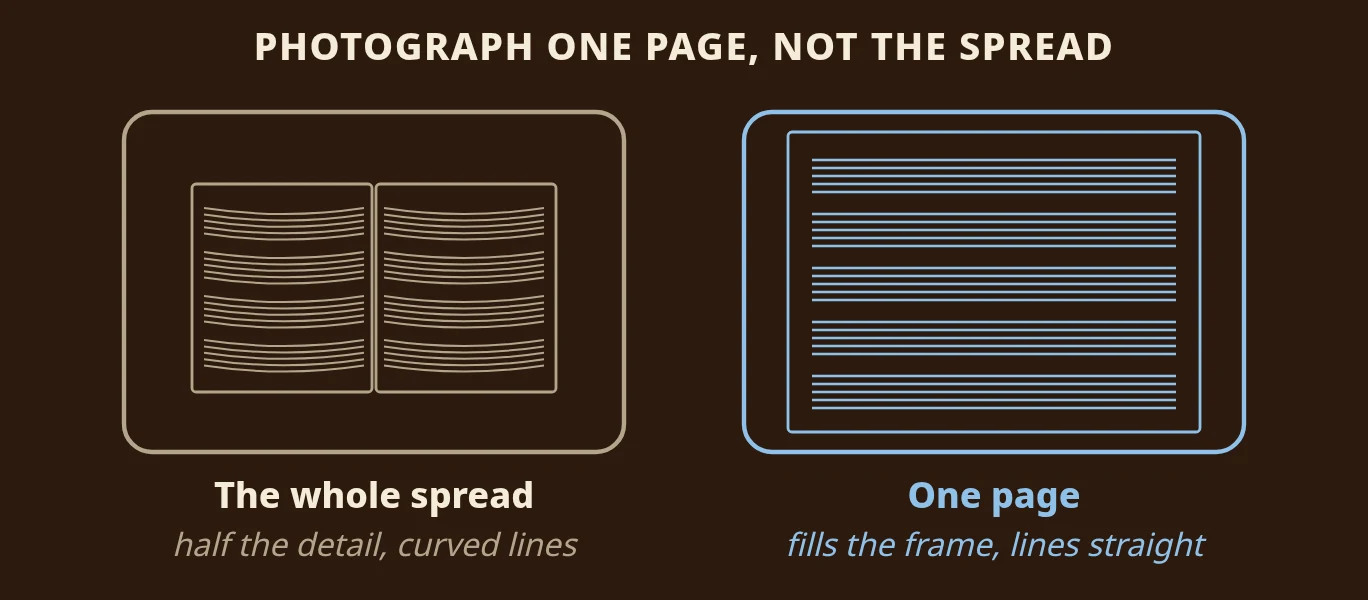
- Flatten the book. Press the page down near the spine, or hold it with a clip. A curved page is the number one cause of bad reads, because every staff line is supposed to be straight.
- Photograph one page at a time. A two-page spread halves the detail on each page and curls in the middle. Separate pages join into one continuous piece in the app anyway.
- Shoot square-on and close. Hold the phone parallel to the paper, centred over the page, with the staves filling the width of the frame.
- Check the braces first. When the score comes back, make sure each pair of staves plays as one piano. If the hands came back as separate instruments, rescan.
- Listen once, straight through. At the written tempo, a wrong pitch stands out, and a missed clef change sounds like a passage that jumped an octave.
- Then start working. Loop the four bars you cannot play yet, slow them down, and build up from there.
If you have the piece as a PDF, import it instead of photographing it: a PDF is already flat, square and evenly lit. For more photography habits, see our guide on how to scan sheet music.
Practise with both hands playing back
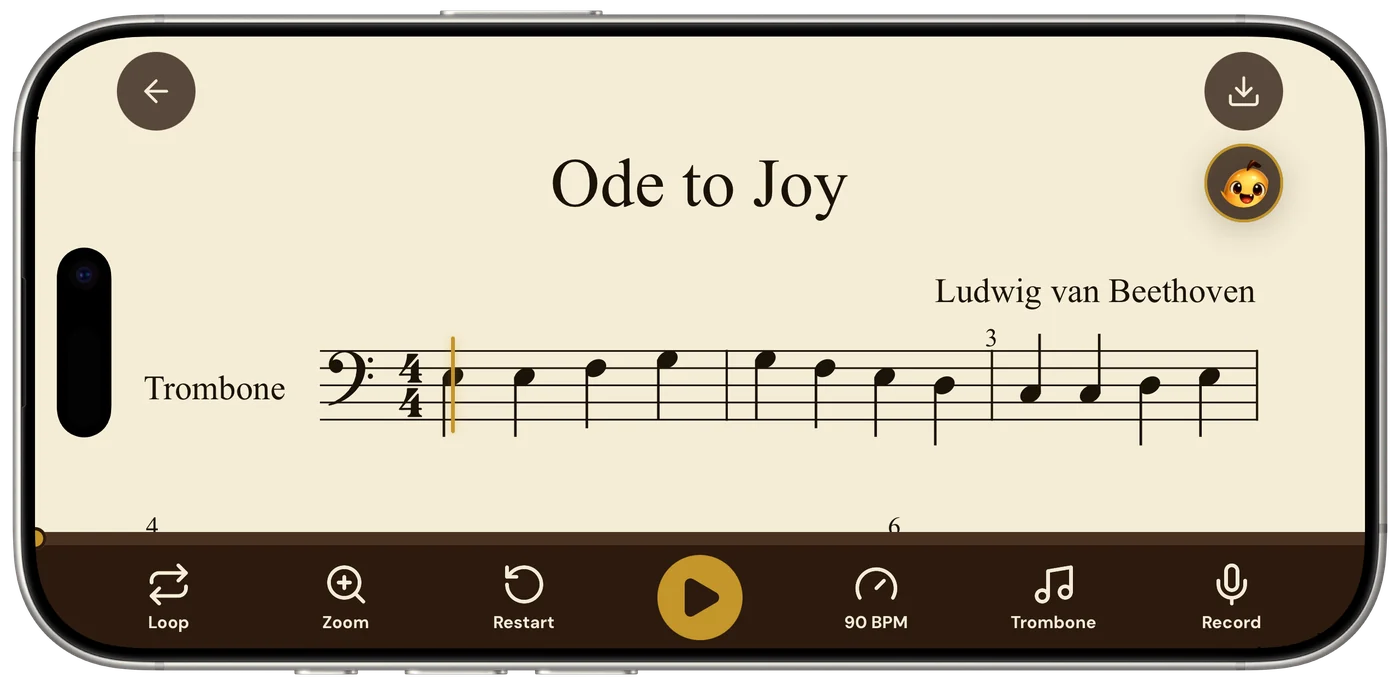
Hearing a page in your head before you play it takes years to learn. Until then, you learn a new piece partly blind, and every wrong note you repeat becomes a little more fixed. That is what we built Sheetly for. Take a photo of a printed piano page with your iPhone or iPad, and Sheetly plays both hands back with a playhead that follows the notes.
Four ways it helps at the piano:
- Hear it before you can play it. Listen to the bars you are about to learn, so you know what you are aiming for.
- Slow down properly. Almost nobody practises slowly enough. Hearing the passage played correctly at half speed shows you what "under control" sounds like.
- Loop the four bars that matter. Playing from the top ten times practises the easy opening ten times and the hard part once. Looping turns that around.
- Play one hand against the other. Play the right hand yourself while the playback carries both hands underneath you. It keeps steady time and never gets impatient.
You can also ask the built-in coach about the notes on that page. It has the actual notes of the piece you just scanned, so a question like "why does bar 12 keep falling apart?" gets an answer about your bar 12, and you can ask about left-hand fingering or which bars to drill tonight. It does not replace a teacher, whether you take lessons or teach yourself, but it is there at eleven at night when nobody else is.
One warning: use playback to check yourself, not as a replacement for reading. Read the bar first, both staves, then press play. If you stop looking at the page and copy the sound, you are learning by ear instead.
Questions
What is a grand staff?
A grand staff is two staves, usually treble above bass, joined at the left by a brace so they are read as one instrument. Piano and harp music are written on it, and organ music adds a third staff for the pedals.
Will a scanner read my piano exam book?
Graded exam pieces are printed, engraved music, which is the kind of page optical music recognition handles best. The usual obstacle is the binding rather than the notation, so press the page flat and photograph one page at a time.
Which hand plays which staff in piano music?
Usually the right hand plays the top staff and the left hand plays the bottom staff. Some editions mark exceptions with the letters r.h. and l.h. (or m.d. and m.s.) above the notes.
Can Sheetly play both hands of a piano piece?
Yes. Sheetly reads the two braced staves as one piano part, so both hands play back together, at any tempo, with a loop on any bar. Listen once all the way through to check the read before you practise from it.