Loop one bar until it stops falling apart
Playing from the top ten times gives the easy bars ten clean reps and the hard bar ten crashes. Loop flips that around.
Here is the most common practice session in the world: open the piece, start from bar 1, play until it falls apart somewhere around bar 12, sigh, go back to bar 1. Repeat ten times. Go and make tea.
Look at what that session actually rehearsed. Bars 1 to 11 got ten clean run-throughs. Bar 12, the one that is broken, got ten attempts, all of them wrong, each one ending in the same crash. You practised the easy bit ten times and you practised failing the hard bit ten times. Neither of those is the thing you needed.
The bar that breaks is the bar that needs the reps
Fingers learn whatever they repeat. If the only version of bar 12 they ever meet is the version that collapses, that is the version they will keep. The fix is boring and it works: stop playing the piece and start playing the bar. Only the bar. Over and over, until it stops falling apart.
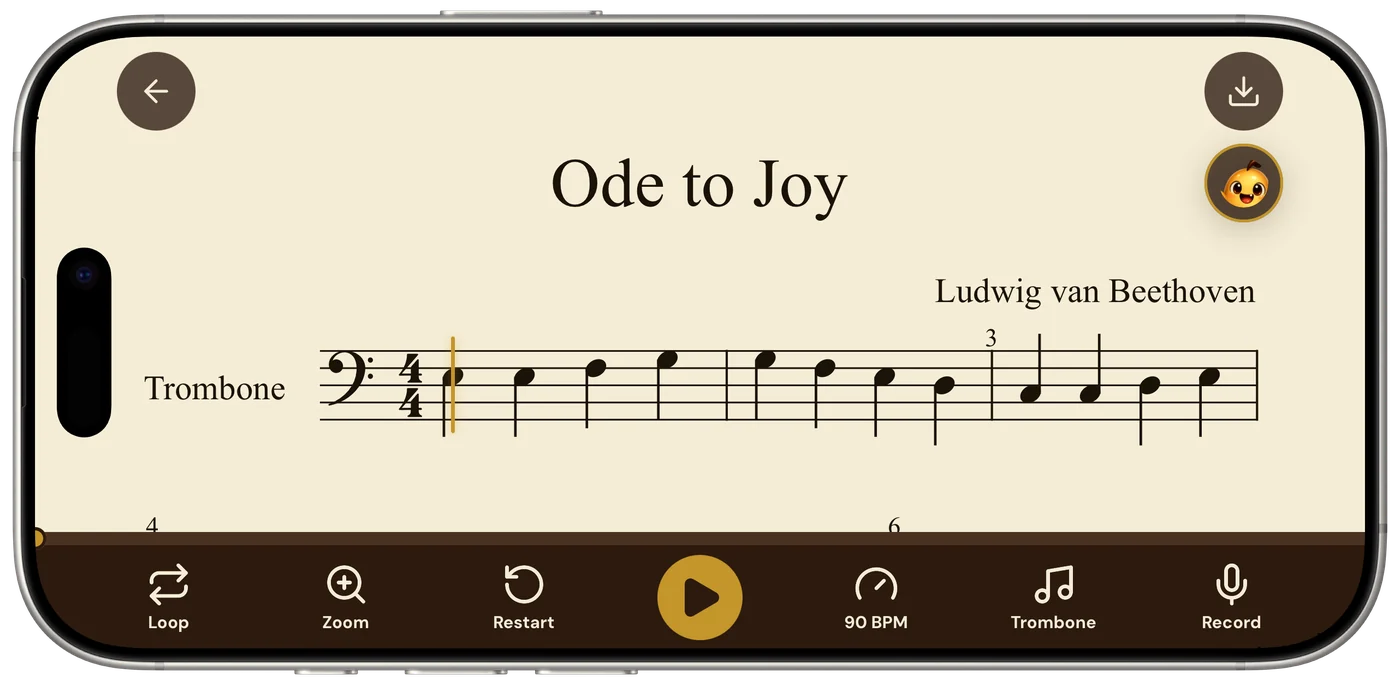
How Loop works in Sheetly
Open any scanned score in the player and you will find Loop in the bottom bar. Set the passage you want and press Play. Sheetly plays those bars, jumps back to the start of the loop, and plays them again. No stopping, no scrolling, no hunting for the right system on the page. The playhead just keeps coming round.
Because the loop runs at whatever tempo the 90 BPM control is set to, you can slow the circle down at the same time. A four-bar loop at a crawl is a small, polite thing that you can play along with twenty times without getting bored or tense.
A routine that holds up
- Find the crash. Play the piece once from the top. Note the first bar where it wobbles. That is your bar.
- Loop four bars around it. One or two bars before the problem, the problem, one bar after. Wide enough to hear it in context, narrow enough to get through it quickly.
- Slow it right down. Drop the tempo until you can play it cleanly, even if that feels silly. Slow and right beats fast and broken.
- Five clean reps in a row. Not five attempts: five clean ones. If rep four slips, the count goes back to zero. This is the part that actually builds the bar.
- Widen. Stretch the loop to eight bars, then the whole phrase, then the whole section. Nudge the tempo up a notch at each step.
If you cannot get five clean reps in a few minutes, the loop is too big or too fast. Shrink it to one bar and halve the tempo. A one-bar loop is never embarrassing; it is just where the work is.
Ten minutes of this does more for bar 12 than an hour of starting from the top. And when you do go back to bar 1, it is a different feeling: you are playing towards a bar you have already beaten.
Try it on your own part
Photograph the page, or import the PDF, and Sheetly turns it into a score that plays. Find the bar that keeps breaking, tap Loop, and give it the reps it was always asking for. Sheetly is on the App Store for iPhone and iPad.
Give bar 12 the reps.
Scan your part, tap Loop, and play the broken bar until it is not.

Free to download · iPhone and iPad · Android on the way

 Written by Love Ranmar, who makes Sheetly. hello@trysheetly.com
Questions
How do I loop one bar in Sheetly?
Open the score in the player, turn on Loop and choose the bar or bars you want. They repeat until you stop, so the hard bar gets the reps instead of the easy ones.
Can I slow a loop down as well?
Yes, and you usually should. The tempo control works inside a loop; find a speed where every note is right, then walk it back up.
How many clean repetitions are enough?
The routine in this article asks for five clean reps in a row before you move on. Five in a row proves it was not luck; one clean rep proves nothing.