Where to start
Reading sheet music means turning marks on a page into sounds in your head before you play them. Pitch runs up and down the page, time runs left to right, and everything else is detail. You can learn the whole system in an afternoon; reading it fluently takes months of doing it, which is why the method at the end of this page matters more than any single rule on it.
- Seven things to learn, in the order below: the staff and clefs, note names, rhythm values, time signatures, key signatures, dynamics, and a practice routine.
- Reading is a skill, not a fact. The rules take an afternoon; fluency takes repetition with feedback.
- The feedback loop that works: read a bar, play it, then hear the bar played correctly and compare. Sheetly gives you the last step for any printed page.
One thing to decide before you start: read first, then check. Hearing a piece before you read it will get you playing it sooner, and it will get you reading it never. So every time playback appears on this page, it appears after the reading, as the answer sheet. Hold to that and the tools below speed you up. Ignore it and they quietly replace the skill you were trying to learn.
1. The staff and the clefs
Music is written on a staff of five lines and four spaces. Higher on the staff means higher in pitch. A clef at the left-hand end tells you which pitches the lines stand for: the treble clef curls around the second line from the bottom and names it G; the bass clef’s two dots sit either side of the second line from the top and name it F.
Most single-line instruments use one clef. Violin, flute, trumpet and the right hand of the piano read treble; cello, bassoon, trombone and the left hand of the piano read bass. Piano music uses both at once, braced together into what is called the grand staff, with the treble staff on top. Read the two staves as one instrument, not two, and you have already understood something many scanning programs get wrong. That story is here.
Notes that sit above or below the staff get short extra lines of their own, called ledger lines. Middle C, the one nearest the lock on a piano, sits on a single ledger line just below the treble staff and just above the bass staff; it is the hinge the two clefs swing on.
2. Naming the notes
There are seven note names, A to G, and they repeat. On the treble staff the lines from bottom to top are E, G, B, D, F and the spaces are F, A, C, E. On the bass staff the lines are G, B, D, F, A and the spaces A, C, E, G. Every step up a line or space is the next letter.
The mnemonics are old and they work: Every Good Boy Deserves Fruit for the treble lines, FACE for the treble spaces, Good Boys Deserve Fruit Always for the bass lines, All Cows Eat Grass for the bass spaces. Use them for a fortnight and then stop using them, because fluent readers do not spell notes out, they recognise them, the way you recognise a word without sounding its letters.
The quickest way to get from spelling to recognising is to learn a few landmark notes cold, treble G on its line, middle C on its ledger line, bass F on its line, and read everything else as a distance from the nearest landmark. A note a third above G is B. You never needed the mnemonic.
3. Rhythm values and rests
The shape of a note tells you how long it lasts. A hollow note with no stem is a semibreve, four beats. A hollow note with a stem is a minim, two. A filled note with a stem is a crotchet, one. Add a flag or a beam and it is a quaver, half a beat; two flags, a semiquaver, a quarter. Each value is half the one before.
Two modifiers cover nearly everything else. A dot after a note adds half its value again, so a dotted minim is three beats and a dotted crotchet is one and a half. A tie, a curved line joining two notes of the same pitch, adds them together into one held sound, which is how a note lasts across a barline.
Rests are silences and come in the same lengths: a semibreve rest hangs below a line, a minim rest sits on one, a crotchet rest is the squiggle, a quaver rest the small flag. Rests are counted exactly as carefully as notes. Most beginner rhythm mistakes are rests that were skipped.
Count aloud. “One and two and three and four and” for a bar of quavers, with the numbers on the beats and the “ands” between. It feels childish for a week and then it becomes the thing that holds your playing together.
4. Time signatures
The two numbers after the clef are the time signature. The top number says how many beats are in each bar; the bottom says which note value counts as one beat, with 4 meaning a crotchet and 8 meaning a quaver. So 4/4 is four crotchet beats a bar, 3/4 is three, and 6/8 is six quavers, usually felt as two groups of three.
Bars are marked off by vertical barlines, and the first beat of each bar is a little stronger than the rest. That pulse is what makes 3/4 a waltz and 4/4 a march before a single note has been chosen. A C in place of numbers means 4/4; a C with a line through it means 2/2, two minim beats, and is usually played briskly.
Before you play a new piece, count a bar or two aloud in the written metre, then count the first line while following the notes with a finger. If the notes in a bar do not add up to the time signature, look for a dot or a tie you missed. They always add up.
5. Key signatures and accidentals
The sharps or flats printed between the clef and the time signature are the key signature, and they apply to every note of that name, in every octave, for the whole piece or until a new key signature appears. One sharp means every F is F sharp. Two flats mean every B and every E are flat. It is a standing instruction, not a one-off.
A sharp, flat or natural sign written in front of a note inside a bar is an accidental. It changes that note, and every repeat of it at the same pitch, until the end of that bar only. The next barline cancels it. A natural sign cancels a sharp or flat from the key signature for the rest of the bar in the same way.
You do not need to know which key a signature belongs to in order to play the notes, but it helps, and there is a shortcut: with sharps, the last sharp is one step below the key note, so one sharp, F sharp, is G major; with flats, the second-to-last flat is the key, so two flats, B flat and E flat, is B flat major. Every major key has a relative minor three steps down that shares the signature, which is why a piece with one sharp might be in E minor. The music tells you which; the signature does not.
6. Dynamics and articulation
Dynamics tell you how loud. They are Italian abbreviations under the staff: p for piano, soft; f for forte, loud; mp and mf for moderately soft and moderately loud; doubled letters for more so. A long wedge opening to the right is a crescendo, getting louder; closing to the right, a diminuendo. Tempo words at the top of the piece, Andante, Allegro, say how fast, and a metronome mark gives the exact beats per minute.
Articulation tells you how each note is shaped. A dot above or below a note means staccato, short and detached. A curved line over several notes of different pitches is a slur: play them joined, in one breath or bow, and do not confuse it with a tie, which joins notes of the same pitch. An accent, a small wedge, means lean on this one. A short horizontal line, tenuto, means give it its full length.
None of this changes which key you press. All of it changes whether the result sounds like music. Beginners read the notes and skip the dynamics; readers worth listening to do the opposite.
7. A method that checks itself
Reading improves through attempts with feedback, and most people practising alone have no feedback. The fix is to make every reading attempt a small test with an answer: read a bar, commit to it, then hear the bar played correctly and compare. Ten minutes of that a day beats an hour of playing through pieces you already half know.
- Pick one line of new musicNot a piece, a line. Something slightly easier than what you play, from a method book or a tune book. New, so you cannot lean on memory.
- Read it without the instrumentName the notes of the first bar, aloud if nobody is listening. Count the rhythm aloud. Clap it. You are building the picture in your head before your hands get involved.
- Play the bar, once, slowlyCommit to it. Do not stop and correct. Whatever came out is your reading of the bar.
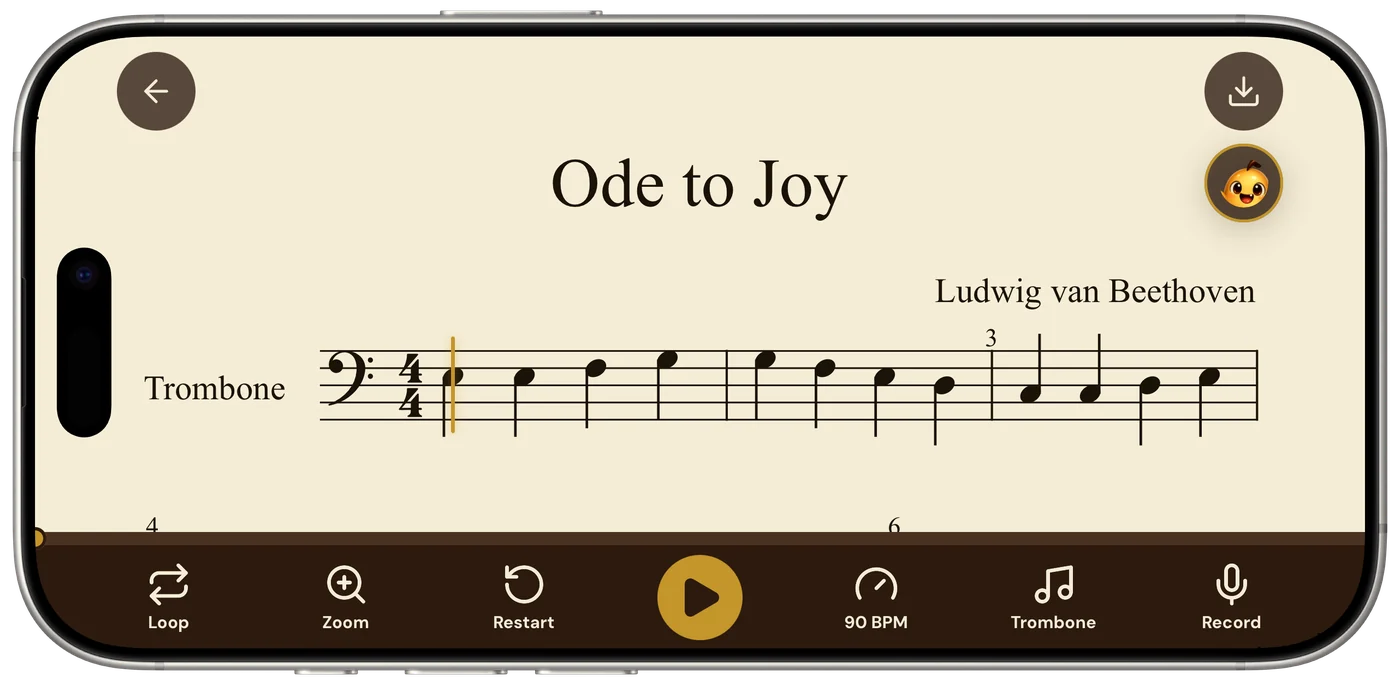
- Now hear it played correctlyThis is where Sheetly comes in. Photograph the line, press play on that bar, and listen. Was the third note a B or a D? Was the dotted crotchet long enough? The difference between what you played and what you heard is the lesson.
- Fix the difference, then move to the next barNot the next line. Reading is learned bar by bar, and the bars you got wrong are the only ones teaching you anything.
- Once a week, read a whole line coldAt a slow tempo, no stopping, then hear the whole line back. Note which kinds of mistake recur: a certain note you always misname, rests you skip, dotted rhythms. Next week’s lines should be full of those.
Playback is the answer sheet, not the textbook. If you notice you have started pressing play before you read, stop for a week and read without it. The aim is a page you can hear by looking at it, and that only grows in the gap between reading and checking.
When you get stuck
Tutorials answer general questions. Most of the questions you will actually have are about a specific bar in a specific piece: what that symbol is, why that bar does not seem to add up, how to count a rhythm you have never seen. Sheetly’s coach has read the actual notes of the page you photographed, so it can answer about your bar 7, by name.
Ask Sheetly: a coach that has read your score
Not a chatbot bolted onto a music app. The coach has the actual notes of the page you just photographed, so you can ask about your bar 12 and get an answer about what is written in it.
We know of no other sheet-music scanner that does this. Every other tool on this page hands you a transcription and stops.
 Free to download · iPhone and iPad
Questions
How long does it take to learn to read sheet music?
The rules of reading sheet music, the staff, clefs, note names, rhythm values and signatures, can be learned in an afternoon. Reading fluently, so that a page suggests its sound before you play it, usually takes a few months of short daily practice with feedback, and keeps improving for years.
What is the fastest way to learn to read sheet music?
Daily reading of new, slightly-too-easy material with an immediate check. Read a bar, play it, then hear it played correctly and compare. Learning landmark notes and reading by distance from them, rather than spelling every note with a mnemonic, is the other big accelerator.
Can an app teach me to read sheet music?
An app can give you the feedback a teacher would: what a bar is supposed to sound like. Sheetly plays any printed page you photograph, one bar at a time if you want, so you can check your reading against it, and its coach answers questions about the specific notes on the page. It does not replace the reading itself, and it is not a teacher.
What is the difference between a tie and a slur?
A tie is a curved line joining two notes of the same pitch, and it turns them into one longer note. A slur is a curved line over two or more notes of different pitches, and it means play them smoothly joined. They look alike; the pitches tell you which is which.
Do I need to learn both clefs?
If you play piano, yes, because piano music uses the treble and bass clefs together on a grand staff. Most single-line instruments use one clef, treble for violin, flute and trumpet, bass for cello, bassoon and trombone, and you can start with the one your instrument reads.