
Why piano is the hard case
A flute part is a line of notes. Piano music is two staves braced into one instrument, several voices moving independently, notes that cross from one hand to the other mid-beam, and chords stacked six deep. Every one of those is a place a scanner can go wrong.
Reading a page of piano music means solving problems a single-line part never poses:
- Grouping the staves. Two staves on a page might be a piano, or a flute and a bassoon. Get the brace wrong and the piece comes back as two unrelated instruments playing simultaneously.
- Two clefs at once. The left hand is usually in bass clef and the right in treble, but not always. Composers move the left hand into treble whenever it suits them, and a missed clef change transposes an entire passage.
- Voices within a hand. A single staff can carry a melody and an inner line with different rhythms, written with opposing stems. Collapsing them into one voice destroys the rhythm.
- Cross-staff writing. Notes beamed across the brace genuinely belong to the other hand. The page shows it with a beam; the data has to record it.
- Ledger lines. Piano ranges far above and below both staves, and counting four ledger lines correctly in a photograph taken at a slight angle is harder than it sounds.
This is why a scanner that handles a violin part beautifully can still make a mess of a Chopin nocturne, and why grand-staff performance is worth checking specifically before you settle on a tool.
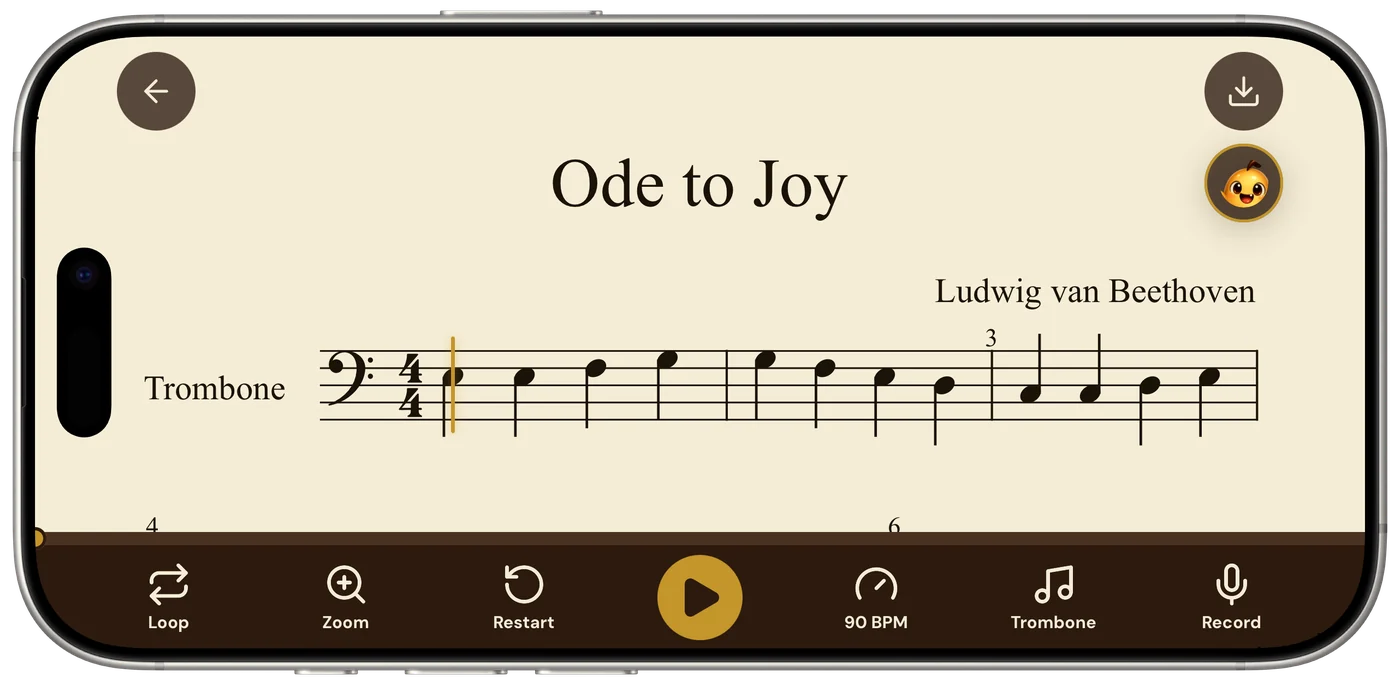
The Sheetly player on an iPhone. Every page you scan opens like this, ready to play, loop and slow down.
Scanning a piano page
- Flatten the bookPiano repertoire lives in bound volumes and bound volumes do not lie flat. Press the page down near the spine, or use a clip. Curvature is the number one cause of bad reads.
- One page per photographNot the open spread. A spread halves your resolution and guarantees curl at the centre, and the two pages will stitch into one continuous piece anyway.
- Shoot square-on, close inPhone parallel to the paper, centred on the page, staves filling the width. The full set of habits is here.
- Check the braces firstWhen the score comes back, look at whether the two staves are joined. If the left and right hands arrived as separate instruments, rescan. That is a grouping error, and it will make everything downstream wrong.
- Listen once, straight throughAt the written tempo. Wrong pitches announce themselves in the ear. A missed clef change will sound like a passage that suddenly moved to the wrong octave.
- Then start workingLoop the four bars you cannot do. Halve the tempo. Play one hand while it plays the other.
What it is actually good for
Scanning a piano page is not really about the scan. It is about the four things that become possible once the page has a play button.
Hearing it before you can play it
The gap between reading music and hearing music in your head takes years to close. Until it does, a piece you have never heard is a piece you are learning blind, and every wrong note you practise gets a little more permanent. Hearing the page first removes the guesswork.
Slowing down properly
Everyone is told to practise slowly and almost nobody does it slowly enough. A metronome tells you the tempo; a score playing correctly at half speed shows you what the passage sounds like when it is under control, which is a far more persuasive teacher.
Looping the four bars that matter
Most of the difficulty in most pieces lives in a handful of bars. Playing the piece from the top ten times means practising the easy opening ten times and the hard bit once. Looping inverts that.
Hands separately, then together
Let it play the left hand while you play the right. It keeps time better than you do, it does not get impatient, and it makes the moment of combining the hands a great deal less alarming.
Playback is a tool for checking yourself, not a substitute for reading. If you find you have stopped looking at the page and started copying the sound, you have quietly switched from learning to read into learning by ear. Read first; check second.
Asking about the piece
Once a score has been read, it can be asked about. This is the part that is genuinely new: the coach in Sheetly has the actual notes of the piece you just scanned, so questions can be specific rather than general.
“Why does bar 12 keep collapsing?” is a different question from “how do I play dotted rhythms?”, and it gets a different answer, one that refers to what is written in your bar 12. So is “what fingering should the left hand use here?”, or “which four bars should I drill tonight?”.
It is not a teacher and does not replace one. It is closer to having someone knowledgeable sitting next to the piano at eleven at night when your actual teacher is asleep.
Ask Sheetly: a coach that has read your score
Not a chatbot bolted onto a music app. The coach has the actual notes of the page you just photographed, so you can ask about your bar 12 and get an answer about what is written in it.
We know of no other sheet-music scanner that does this. Every other tool on this page hands you a transcription and stops.
 Free to download · iPhone and iPad
Questions
Can an app scan piano sheet music with both hands?
Yes. Grand-staff piano music is read as one instrument with two staves, so the left and right hands come back together and play as a whole. Keeping the two staves correctly braced is one of the harder parts of the problem, which is why some scanners handle single-line instruments far better than they handle piano.
Can I hear just the left hand?
Playing hands separately is one of the oldest and best piano practice methods, and hearing one hand correctly before combining is exactly the use case scanning is good for. Sheetly plays back the score you scanned and lets you loop and slow any passage while you play the other hand yourself.
Will it read my grade exam book?
Graded exam repertoire is printed, engraved music, which is the case optical music recognition handles best. The practical obstacle is usually the binding rather than the notation: exam books do not lie flat, so press the page down or photograph one page at a time.
What about very dense piano writing?
Thick chords, dense ledger lines, cross-staff beaming and late-Romantic textures are the genuinely hard cases for every scanner. A simpler Classical or Baroque texture will read more reliably than a page of Liszt. Listening once before you rely on it is always the right move.
Does it help with sight-reading?
Indirectly, and be careful here. Hearing a piece before you read it can shortcut the reading if you let it. Used well it is a useful feedback loop: read first, then check yourself against the playback. Used lazily, it becomes learning by ear with the page as decoration.