
Who this is for
This page is for adults who can read some music but cannot yet hear a page in their head: people who started late, people coming back after twenty years, and people working through a method book on their own with a lesson a fortnight or no lesson at all. The best sheet music app for that learner is one that plays their page, at their tempo, and answers their questions about it.
- Adult beginners practise alone most of the time, and the thing they lack is feedback, not information.
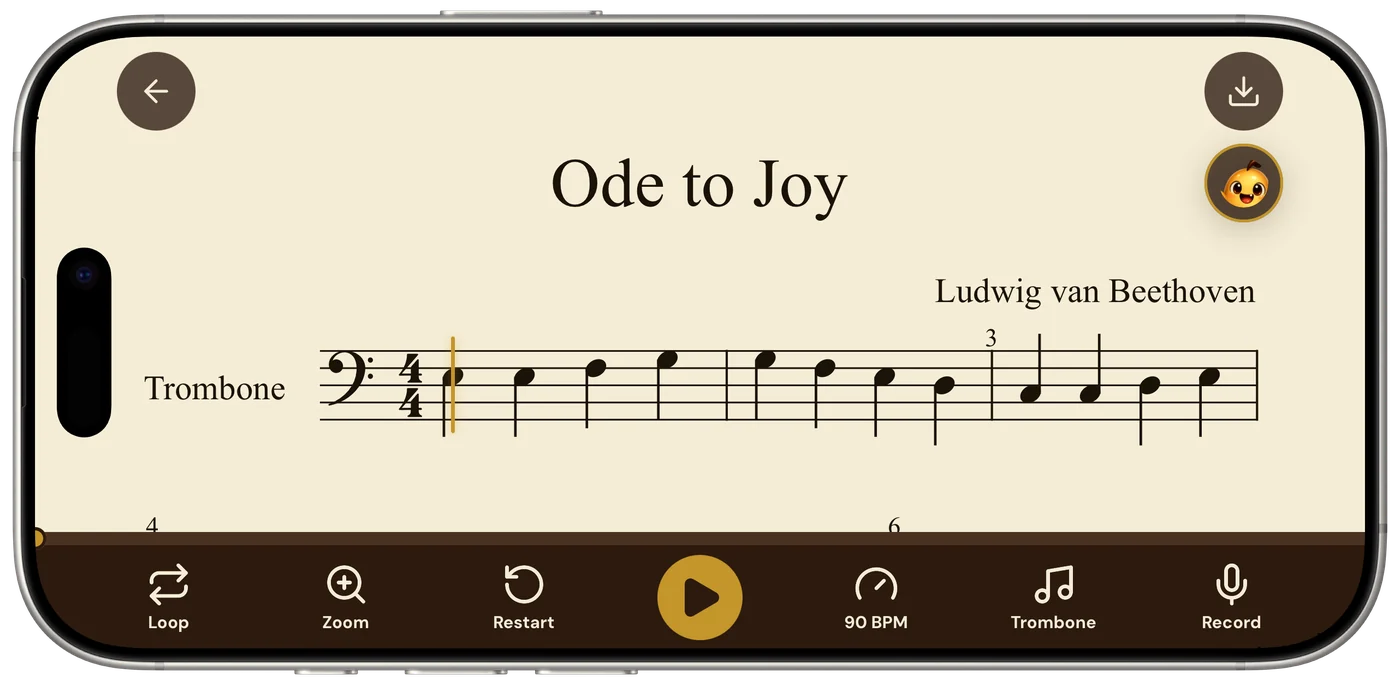
- Sheetly photographs the page in your book and plays it, so you can hear what you are reading, slow it down, loop it, record yourself against it and ask a coach about it.
- It is not a teacher, it does not listen to you play in real time, and it reads printed music rather than handwriting.
- The routine below takes four short sessions a week and uses each tool for one job.
Adults learn music with advantages children do not have: patience, an understanding of why, the ability to practise deliberately rather than just repeatedly. They also carry disadvantages: less time, more self-consciousness, a tendency to intellectualise a physical skill, and, above all, no one listening. A child has a teacher weekly and a parent nagging daily. An adult has a book, an instrument, and Tuesday evening.
Most apps aimed at beginners solve the wrong problem. They supply content, a curriculum of pieces someone else chose, and the adult beginner already has content: it is sitting on the stand. What they lack is the part a teacher provides between lessons, which is hearing what the page is supposed to sound like and knowing what to work on.
The gap between reading and hearing
Experienced musicians look at a page and hear it. Beginners look at a page and decode it, one note at a time, with no idea what the result should sound like until they have played it, and no way of knowing whether what they played was right. That gap between reading and hearing is the central difficulty of learning music as an adult, and it takes years to close unaided.
The gap has practical consequences that anyone who has practised alone will recognise:
- You learn mistakes. A misread note, practised fifty times because nothing told you it was wrong, is now a learned note, and unlearning costs more than learning did.
- You cannot tell rhythm errors from difficulty. A bar that sounds wrong might be a misread dotted rhythm or might just be hard. Without hearing it correctly you cannot know which.
- You practise the easy parts. Starting from the top every time means the opening gets twenty repetitions and the hard bar in the middle gets two.
- You cannot hear yourself. Your sense of your own tempo and evenness is flattering, and there is no one to say so.
Every one of those is a feedback problem, and every one of them has a recording-shaped solution, except that the recording has to be of your page, your edition, your bar, at your speed. That is what a scanner attached to a player provides.
What Sheetly does for a learner
Sheetly photographs a page of printed music, reads it, and gives you a score that plays. For an adult beginner that means the book on the stand now has an answer sheet: press play on the bar you just read, and hear whether you had it right. Around that one idea sit four tools, each solving one of the problems above.
Hear the page first, or check it after
Photograph the page and press play. It plays at the written tempo, on piano, organ, flute or another instrument. The honest advice is to read a bar first and then check, so the reading skill grows; but on a piece you simply want to learn, hearing it first is fine and quicker. A reading method that uses playback as the check is here.
Slow it down until it holds
Set any tempo. Most adult beginners practise too fast because the slow version sounds so unlike music; a score playing correctly at half speed shows you that the slow version is the music, just patient, which is a surprisingly persuasive thing to hear.
Loop the four bars that matter
Select the bars that fall apart and let them repeat while you play along. This inverts the practise-the-easy-bits problem: the hard bar now gets twenty repetitions and the opening gets two, which is the right way round.
Record a take and listen back
Record yourself, then hear your take against the score. This is the nearest thing to a teacher saying “you are rushing the quavers”, and it works because it is not you saying it.
Ask about the piece
The coach has read the actual notes on your page and answers by bar number. More on using it well below.
How well it reads a page matters, so here is the number rather than the adjective: on Sheetly’s own 31-piece benchmark, scored by strict F1, where a note counts only when pitch, onset and duration are all correct, it scored 96% on clean scores and 95% on the same pieces degraded to simulate a phone photograph. A method book is printed, clearly engraved music, which is the easy case. How to photograph a page so it reads cleanly is here.
What it will not do
Sheetly is not a teacher, and it does not listen to you while you play. It will not tell you your wrist is tense, it cannot hear a wrong note as you play it, and it will not choose what you should learn next. It reads printed and engraved music, not handwriting or guitar tablature, and it needs a connection to scan a page and to ask the coach.
Some of that is worth dwelling on, because the apps that promise real-time listening set expectations this one does not try to meet. Sheetly’s feedback is deliberate and after the fact: you play, you record, you listen back, you compare. It is the feedback loop of a good practice room, not of a lesson. For an adult who practises alone, that turns out to be most of what is missing.
Nothing on this page replaces a person who can watch your hands. What Sheetly does is make the thirteen days between lessons productive: you arrive having heard the piece, having looped the bar you were told to work on, and with a recording of how it went. Teachers like that student.
A weekly routine
Four sessions of twenty to thirty minutes beat one long Sunday. Each session below uses the tools for one job, and the whole week works on one page of your book, not a piece. Adult beginners who progress are the ones who finish pages.
- Day one: read and hearPhotograph the new page. Read the first line without the instrument, naming notes and counting aloud, then press play on the line and compare. Repeat for each line. Finish by hearing the whole page at the written tempo, once. Do not play it through yet.
- Day two: find the hard barsPlay the page slowly, straight through, and note the bars that collapse. There will be three or four. Ask the coach what is going on in each one and what fingering or counting to use. Loop each at a tempo where it holds, for five minutes each.
- Day three: loop and raiseLoop the same bars, starting at yesterday’s tempo and raising it a few clicks each time it holds together three times running. Then play from two bars before each hard bar into it and out the other side, so the join is practised too.
- Day four: record and listenPlay the page at the fastest tempo that is still clean, and record the take. Listen to it against the score. Write down the two things that were worst. Those become next week’s day-two bars, along with the next page.
Switching the playback instrument is a small trick that earns its place in this routine. Hearing the page on organ instead of piano exposes held notes you have been cutting short; hearing it on harp makes an uneven rhythm obvious. Same notes, new ears.
The coach, used well
The coach in Sheetly has read the score you photographed, so the useful questions are specific ones: about a bar, a symbol, a fingering, what to practise tonight. General questions about music theory get general answers anywhere; the thing this coach can do that a search cannot is answer about your bar 9.
Ask Sheetly: a coach that has read your score
Not a chatbot bolted onto a music app. The coach has the actual notes of the page you just photographed, so you can ask about your bar 12 and get an answer about what is written in it.
We know of no other sheet-music scanner that does this. Every other tool on this page hands you a transcription and stops.
 Free to download · iPhone and iPad
Questions
What is the best sheet music app for adult beginners?
For an adult beginner working from a book, the most useful sheet music app is one that plays the page in the book: Sheetly photographs printed sheet music and plays it back with tempo control, looping, take recording and a coach that has read the score. Apps that supply their own curriculum solve a different problem.
Can I learn to play an instrument as an adult using an app?
An app cannot watch your hands, so a teacher, even occasionally, is still the best investment. An app like Sheetly makes the time between lessons productive by giving you what a teacher provides in the room: what the page should sound like, which bars to work on, and honest feedback from a recording of yourself.
Does Sheetly listen to me play and correct me?
No. Sheetly does not listen in real time. You record a take and then hear it against the correctly-played score, which is deliberate, after-the-fact feedback. Its coach answers questions about the notes on the page; it does not hear what you played.
Will it work with my method book?
Yes. Method books and graded exam books are printed, clearly engraved music, which is the case optical music recognition reads best. Flatten the page near the spine and photograph one page at a time rather than the open spread.
Is Sheetly free?
Sheetly is free to download on iPhone and iPad, with a Pro subscription for the full set of features. Android is on the way.