
The short version
For iPhone and iPad, if you photograph printed music to learn and practise it, Sheetly is the better choice. Pick Sheet Music Scanner if you want the cheapest, longest-established way to simply hear a page played: it has been on the App Store for years, holds a 4.5 rating from 6.4K ratings, plays on 30+ instruments and exports audio files. Sheetly’s case is everything after the scan: a published accuracy benchmark, a loop on one bar, a recorder for your own take, MusicXML export with Pro, and a coach that has read the notes of your score.
- Sheet Music Scanner is a cheap, long-established app that photographs a page, plays it on 30+ instruments at 50–330 bpm, and exports MIDI, MusicXML, audio and PDF.
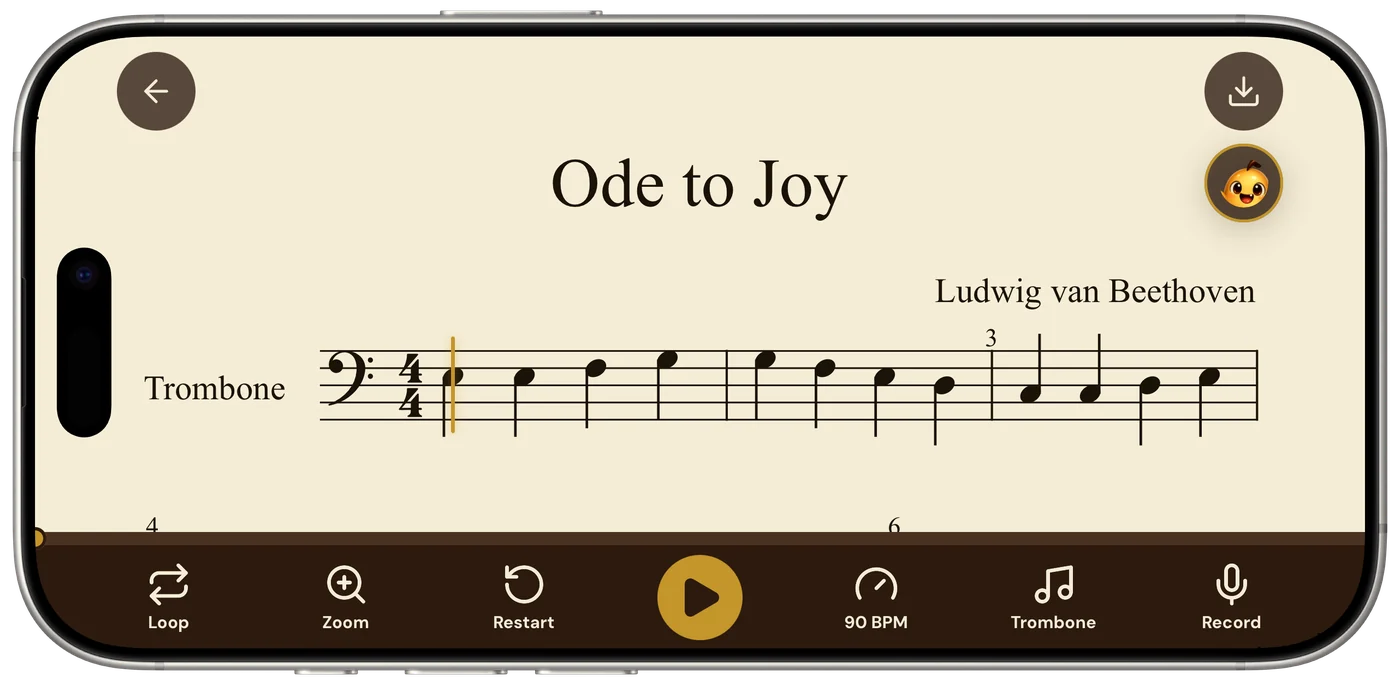
- Sheetly photographs a page, plays it, loops a bar, records your take, exports PDF, MIDI and MusicXML with Pro, and includes a coach that has read the notes of the page.
- Sheetly publishes its accuracy benchmark: 96% strict F1 on clean scores and 95% on phone photographs on a 31-piece suite. Sheet Music Scanner has not been measured in that harness.
- Sheet Music Scanner’s listing says codas, percussion notation, dynamics, double sharps and flats and grace notes are unsupported. Sheetly reads printed notation only, not handwriting or tab.
We make Sheetly. Every claim about another product is taken from that product’s own materials, and we say plainly where it is better. We publish numbers only where we have measured something, and we have not measured Sheet Music Scanner.
These two apps are closer than most pairs on this site. Both are phone apps. Both start from a photograph or a PDF. Both hand you a play button. The difference is how much happens after that button. Sheetly is built for one job: turning the printed music you already own into something you can hear, ask about and practise, on an iPhone or iPad. Sheet Music Scanner stops at “hear”, and does that cheaply and well.
Where Sheet Music Scanner is better
Sheet Music Scanner is better if you want the cheapest and most established way to hear a page. It has a 4.5 App Store rating from 6.4K ratings, a one-off in-app purchase that has historically been $3.99, 30+ playback instruments, a 50–330 bpm tempo range, and audio export in M4A, AAC, MP3 and WAV. Sheetly has none of the audio formats and costs more.
It has been around a long time
Sheet Music Scanner, originally by David Zemsky and now published by App Sub 1 LLC, is one of the original scan-and-play apps. A 4.5 rating across 6.4K ratings is a large base of people who got what they paid for. That track record is worth something, and we are a newer product.
It is cheap
Free to download with an in-app purchase that has historically been a $3.99 one-off. If your whole need is “play this page so I know how it goes”, that is very hard to argue with, and we will not try.
Thirty-plus instruments and transposing pitch
Sheet Music Scanner plays back on more than 30 instruments and handles transposing-instrument pitch, so a clarinet or horn part sounds at the written pitch for that instrument. Sheetly offers piano, organ, violin, flute, trumpet and the other instruments on its list, plus a drum kit; the list is shorter.
Audio export
Sheet Music Scanner exports M4A, AAC, MP3 and WAV alongside MIDI, MusicXML and PDF. Sheetly exports PDF, MIDI and MusicXML, not audio files. If you want a backing track as an audio file for a student or a choir, that is a real difference in their favour.
Android
Sheet Music Scanner has an Android “Pro” version. Sheetly is iPhone and iPad today.
Where Sheetly is better
Sheetly is better once hearing the page is not enough. Sheetly publishes its accuracy benchmark with the method and the public test set, loops a single bar or passage, records your own take against the score, includes a coach that has read the notes of the page, and exports MusicXML with Pro. Sheet Music Scanner documents none of the loop, record or coach features.
The accuracy is published
Sheetly publishes its accuracy benchmark with the method, the dated run and the public test set: 96% strict F1 on clean scores and 95% on phone photographs on a 31-piece suite, and 90% mean / 99% median on 60 systems cut from real scanned pages in the public OLiMPiC set, against Audiveris 5.11.0 at 88% / 50% and 58% / 65%. Strict F1 means a note counts only when pitch, onset and duration are all correct. We have not run the closed commercial apps through the same harness, so we publish no number for them. The method is here. Sheet Music Scanner’s own listing is also candid about limits: codas, percussion notation, dynamics, double sharps and flats and grace notes are listed as unsupported, and earlier versions also listed repeat signs and tuplets. We note that neutrally; every recogniser has limits, and Sheetly reads printed notation only.
Loop one bar
Photograph it, hear it, understand it, practise it. The practising part is a loop: pick the bar or passage that keeps collapsing and let it repeat at a tempo you can manage while you work on it. Sheet Music Scanner documents tapping a measure to play from anywhere, which is a quick way back to a passage, but we could not find a repeating loop described. How looping works in Sheetly.
Record your take
Sheetly records your own playing against the score so you can hear the two side by side. It does not grade you; it lets you hear yourself. We could not find recording documented in Sheet Music Scanner’s materials.
The coach
Sheetly is the only iPhone and iPad app we know of where the AI coach has read the actual notes of the page you photographed, so a question about bar 12 gets an answer about your bar 12. Ask what a marking means, how a rhythm subdivides, what fingering to try, or what to drill tonight. Sheet Music Scanner has no coach; it hands you the playback and stops.
Ask Sheetly: a coach that has read your score
Not a chatbot bolted onto a music app. The coach has the actual notes of the page you just photographed, so you can ask about your bar 12 and get an answer about what is written in it.
We know of no other sheet-music scanner that does this. The coach reads the page; it does not listen to you play.
PDF, MIDI and MusicXML export
Sheetly exports PDF, MIDI and MusicXML with Pro, so the page can go into MuseScore, Dorico or Sibelius. Sheet Music Scanner also exports MusicXML, plus audio; the difference is not the format but what the app lets you do before you export.
Feature by feature
| After the scan, can you… | Sheetly | Sheet Music Scanner |
|---|---|---|
| Hear it played back | Yes | Yes |
| Change the tempo | Yes, any tempo | Yes, 50–330 bpm |
| Play from any measure | Yes | Yes, tap the measure |
| Loop one difficult bar | Yes | Not documented |
| Record your own take against it | Yes | Not documented |
| Ask questions about your score | Yes | No |
| Playback instruments | Piano, organ, strings, winds, brass and more | 30+, with transposing pitch |
| Export MusicXML / MIDI / PDF | Yes, with Pro | Yes |
| Export audio (M4A, MP3, WAV) | No | Yes |
| Published accuracy benchmark | Yes | Not documented |
| Documented notation limits | Printed only; no handwriting, tab or shape notes | No codas, percussion, dynamics, double sharps/flats, grace notes |
| Price | Free download, Pro subscription | Free download, one-off IAP (historically $3.99) |
| Runs on | iPhone, iPad | iOS, Android (Pro) |
Read the price row and the audio row as what they are: two things Sheet Music Scanner does better than we do. If a $3.99 one-off and an MP3 out are what you need, the rest of the table does not matter much.
Which one should you get?
Get Sheet Music Scanner if you want the cheapest way to hear a page of printed music played, on an instrument of your choice, and perhaps save it as an audio file. Get Sheetly if you want to practise and understand the page: loop the hard bar, record your take, ask the coach what is written, and export MusicXML with Pro. There is a published accuracy number behind the scan.
- You just want to know how the piece goes. Sheet Music Scanner. It is cheap and it has done this for years.
- You need a backing track as an MP3 or WAV. Sheet Music Scanner.
- You play a transposing instrument and want it to sound right. Sheet Music Scanner documents transposing pitch; we do not claim it.
- You keep getting one bar wrong. Sheetly. Loop it, slow it, ask about it.
- You want to hear your own playing against the score. Sheetly.
- You want to know how accurate the scan is before you trust it. Sheetly, because the number is published with the method.
From the music stand to a play button.
Photograph the page, hear both hands at a tempo you can follow, loop the bars that need work, and ask the coach what to drill. Free to download on iPhone and iPad.

Free to download · iPhone and iPad · Android on the way

Questions
Is Sheetly better than Sheet Music Scanner?
Sheetly is better for practising and understanding a page of printed music on an iPhone or iPad: it loops a bar, records your take, includes a coach that has read the notes of your score, exports MusicXML with Pro and publishes its accuracy benchmark. Sheet Music Scanner is better if you want the cheapest, longest-established way to hear a page played, with 30+ instruments and audio export.
Does Sheet Music Scanner loop a bar?
We could not find a loop documented in Sheet Music Scanner’s materials. Its listing describes tapping a measure to play from anywhere and a tempo range of 50 to 330 bpm, which gets you back to a passage quickly, but not a repeating loop. Sheetly loops a single bar or any passage you choose, at any tempo, so the bar that keeps collapsing plays on repeat while you work on it.
Which is more accurate, Sheetly or Sheet Music Scanner?
Sheetly publishes its accuracy benchmark with the method, the dated run and the public test set: 96% strict F1 on clean scores and 95% on phone photographs on a 31-piece suite, and 90% mean / 99% median on 60 systems cut from real scanned pages in the public OLiMPiC set, against Audiveris 5.11.0 at 88% / 50% and 58% / 65%. Strict F1 means a note counts only when pitch, onset and duration are all correct. We have not run the closed commercial apps through the same harness, so we publish no number for them. Sheet Music Scanner has not been measured by us and we claim no number for it.
Does Sheet Music Scanner have an AI coach?
No. Sheet Music Scanner scans a page and plays it back; its materials describe no coach or question-answering about the score. Sheetly is the only iPhone and iPad app we know of where the AI coach has read the actual notes of the page you photographed, so a question about bar 12 gets an answer about your bar 12. Sheetly’s coach explains markings, rhythms and fingerings by bar number; it does not listen to you play.
Is Sheetly free?
Sheetly is free to download on iPhone and iPad: after your first pages, the free tier scans one page a month. Pro, at US$11.99 a month or US$39.99 a year, removes the limits and adds PDF, MIDI and MusicXML export. Sheet Music Scanner is free to download with an in-app purchase, historically a $3.99 one-off, which is why it is the cheapest way to hear a page played; Sheetly costs more and does more with the page afterwards.