
The short version
For iPhone and iPad, if you photograph printed music to learn and practise it, Sheetly is the better choice. Pick Halbestunde if you are on Android or want to work in a browser, if you need to transpose a piece into another key, or if you want a gallery of ready-made songs to play from. Halbestunde is the more mature product with the larger user base; Sheetly is the one that publishes how accurate it is and lets you ask a coach about the bar you are stuck on.
- Sheetly is better for an iPhone or iPad player who wants to photograph a page, hear it, loop the hard bars, record a take and ask a coach that has read the notes.
- Halbestunde is better for anyone on Android or the web, anyone who needs transposition, and anyone who wants a built-in song gallery.
- Sheetly publishes its accuracy benchmark with the method, the dated run, the public test set, and the raw files, so the figures can be recomputed by a stranger in twenty-five seconds. Halbestunde’s site states 99% scanning accuracy, and we could not find a method, dataset or definition behind that number.
- Sheetly exports PDF, MIDI and MusicXML with Pro, at US$11.99 a month or US$39.99 a year. Halbestunde’s own materials list MusicXML, MIDI and PDF export too, with paid tiers from $6.99 a month and a $79.99 lifetime option.
We make Sheetly. Every claim about another product is taken from that product’s own materials, and we say plainly where it is better. Where we have measured something we show the method; where we have not, we publish no number.
Of the phone scanners in the wider comparison, Halbestunde is the one most people will put next to Sheetly, because the pitch sounds the same: point the camera at a page, hear it in seconds. The two apps then diverge. Halbestunde grows outwards: more platforms, more instruments, a song gallery, transposition. Sheetly grows inwards, towards the moment after the page plays. Sheetly is built for one job: turning the printed music you already own into something you can hear, ask about and practise, on an iPhone or iPad.
Where Halbestunde is better
Halbestunde is better if you need it on Android or in a browser, if you need to transpose, if you want a lifetime purchase instead of a subscription, or if you want a gallery of songs to start from. It is also the more established app, with a 4.3 rating from about 1.4K US reviews. Those are real advantages and we list them first.
Android and the web
Halbestunde runs on iOS, Android and as a web app at app.halbestunde.com. Sheetly is on iPhone and iPad, with Android on the way. If your phone is an Android phone, or you want to open a scanned score on a laptop, Halbestunde is the one of the two that exists there today, and we would point you to it.
Transposition
Halbestunde’s own materials list transposing keys alongside 24 instrument and voice options. A singer who needs the song a tone lower, or a clarinettist reading from a piano part, gets that in Halbestunde. Transposition is not a headline feature of Sheetly, so if changing key is part of your weekly routine, weigh that heavily.
A song gallery and a virtual piano
Halbestunde ships with a gallery of hundreds of songs and a virtual piano, so there is something to play the first time you open it without photographing anything. Sheetly starts from your own printed music; if you do not have a page in front of you, there is less to do.
A lifetime option and a mature product
Halbestunde’s listing shows Virtuoso at $6.99 a month or $39.99 a year, Maestro at $12.99 a month or $59.99 a year, and Lifetime Pro at $79.99. A one-off purchase is something many players prefer, and Sheetly does not offer one. Halbestunde has also been in the category longer, with a larger user base, recognition of lyrics and symbols, and a documented multi-page flow (“tap Next and add pages”). None of that is experimental.
Where Sheetly is better
Sheetly is better at showing its accuracy and at what happens after the page has been read. It publishes a reproducible benchmark rather than a headline number, it includes a coach that has read the actual notes of your scanned page, it loops a bar and records your take, and with Pro it exports PDF, MIDI and MusicXML. Photograph it, hear it, understand it, practise it.
An accuracy number you can check
Sheetly publishes its accuracy benchmark with the method, the dated run and the public test set: 96% strict F1 on clean scores and 95% on phone photographs on a 31-piece suite, and 90% mean / 99% median on 60 systems cut from real scanned pages in the public OLiMPiC set, against Audiveris 5.11.0 at 88% / 50% and 58% / 65%. Strict F1 means a note counts only when pitch, onset and duration are all correct. We have not run the closed commercial apps through the same harness, so we publish no number for them. The full method is on the benchmark page. The point is not that 95% is a big number; it is that you can see exactly what it means and what it was measured on.
A coach that has read the page
Sheetly is the only iPhone and iPad app we know of where the AI coach has read the actual notes of the page you photographed, so a question about bar 12 gets an answer about your bar 12. We could not find any question-answering about the score in Halbestunde’s materials. The coach does not listen to you play; it answers about fingering, rhythm, what a marking means and what to drill, by bar number.
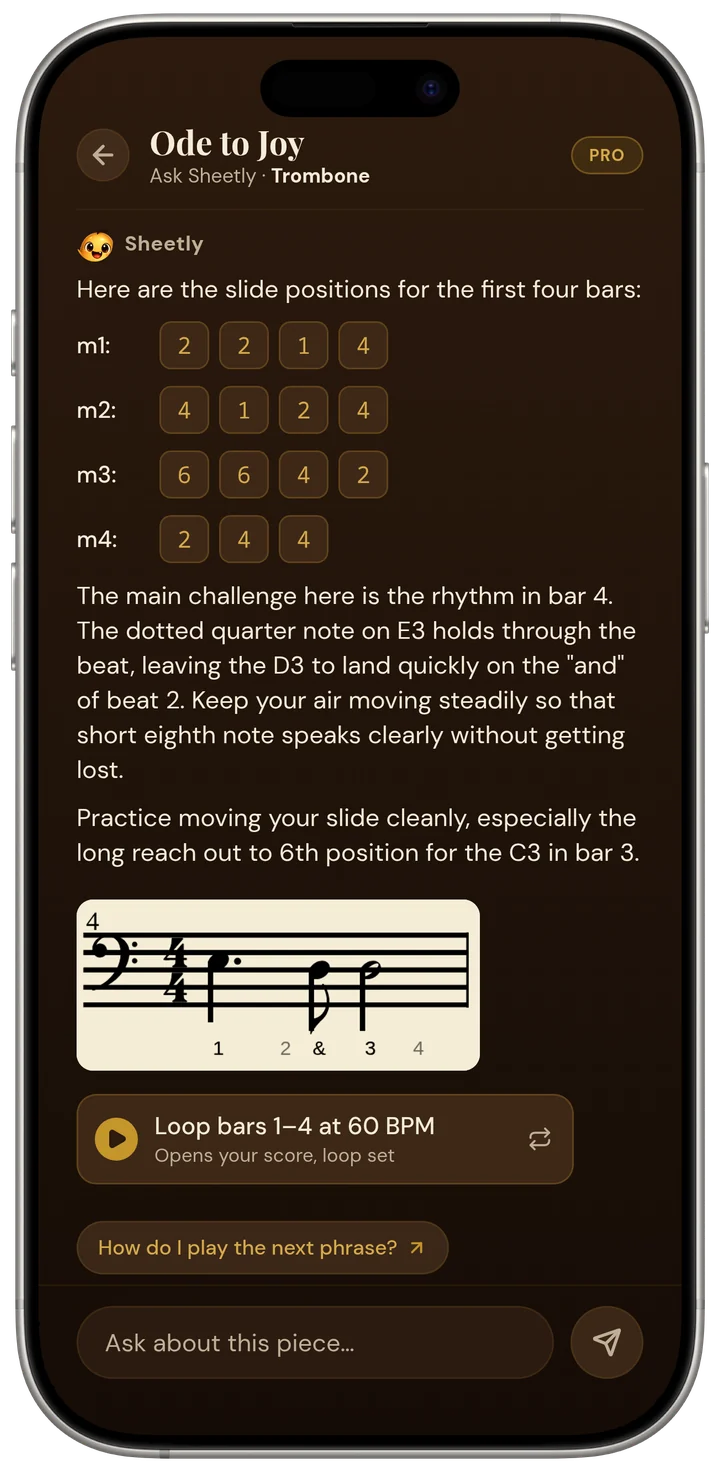
Ask Sheetly: a coach that has read your score
Not a chatbot bolted onto a music app. The coach has the actual notes of the page you just photographed, so you can ask about your bar 12 and get an answer about what is written in it.
We know of no other sheet-music scanner that does this. Every other tool on this page hands you a transcription and stops.
Loop, slow down, record
Both apps loop and both record. Halbestunde lists loop sections, tempo control and recording yourself as audio. Sheetly loops a single bar or any passage at any tempo, on piano, organ, flute, trumpet and other instruments, and records your own take against the score. We are not claiming a feature Halbestunde lacks here; we are claiming a tighter circle. The loop, the take and the coach sit on the same score, so the bar you cannot play is the bar you loop, the bar you record, and the bar you ask about.
PDF, MIDI and MusicXML export
Sheetly exports PDF, MIDI and MusicXML with Pro. Halbestunde lists the same three formats; we could not find which of its tiers include export, so check the plan you would actually be on before comparing prices.
99% of what, measured how?
Halbestunde’s site headline is “Scan and Play Any Sheet Music in Seconds. 99% Scanning Accuracy.” We are not saying that number is false. We are saying we could not find, anywhere in Halbestunde’s materials, what it counts, what it was measured on, or when. Without those three things a percentage cannot be compared with anything, including ours.
Accuracy in music recognition depends entirely on the definition. Count symbols found and a page with every notehead in the right place but the wrong durations can score in the high nineties. Count notes where pitch, onset and duration are all correct, which is the strict F1 we use, and the same page scores far lower. Measure on clean PDFs and the number goes up; measure on phone photographs with shadow and page curl and it comes down. Halbestunde’s own photo tips ask for even light, no shadows, portrait orientation and a camera angle “as close to zero as possible”, which is sensible advice and also a hint that the input matters a great deal.
So the fair comparison is not 99% against 95%. It is a number with a published method against a number without one. If Halbestunde publishes its test set and definition, we would be glad to run both tools on the same pages and put the result on the benchmark page. Until then, we publish no number for Halbestunde and draw no conclusion about it.
Feature by feature
The table is compiled from each product’s own published feature list. “Not advertised” means we could not find the feature documented, not that it is definitely absent. Products change; check the current version before you buy.
| After the scan, can you… | Sheetly | Halbestunde |
|---|---|---|
| Hear it played back | Yes | Yes |
| Change the tempo | Yes | Yes |
| Loop one difficult bar | Yes | Yes, loop sections |
| Record your own take against it | Yes | Yes, audio |
| Ask questions about your score | Yes | Not advertised |
| Transpose to another key | Not a headline feature | Yes |
| Export MusicXML / MIDI / PDF | Yes, with Pro | Yes |
| Built-in song gallery | No | Hundreds of songs |
| Published accuracy method | Yes, with public test set | Not found |
| Correct mistakes in an editor | No | Not advertised |
| Read handwriting | No | “Challenging at this point in time” |
| Runs on | iPhone, iPad | iOS, Android, web |
Three rows go against us and we would rather say so than bury them: transposition, the song gallery, and platforms. If any of those is the thing you need, the rest of the table does not matter much.
Which one should you get?
Get Halbestunde if you are on Android or want to work in a browser, if you transpose regularly, or if you want a lifetime purchase and a song gallery. Get Sheetly if you are on iPhone or iPad and the point of the scan is to learn the piece: hear it, loop the hard bars, record a take, and ask a coach that has read the notes what to do about bar 12.
- Android phone, or you want it on a laptop. Halbestunde. Sheetly is not there yet.
- You need the piece in a different key. Halbestunde.
- You want to open the app and play something today, without a page in front of you. Halbestunde, for the gallery.
- You want to know what an accuracy number actually means before you trust it. Sheetly, because the method and test set are published.
- You are stuck on a bar and want to ask why. Sheetly. Nothing else in the category answers about your bar.
Scan it, then actually practise it.
Photograph the page you are working on, loop the bars that keep collapsing, record a take, and ask the coach what to drill tonight. Free to download on iPhone and iPad.

Free to download · iPhone and iPad · Android on the way

Questions
Is Sheetly better than Halbestunde?
For iPhone and iPad, if you photograph printed music to learn and practise it, Sheetly is the better choice: it loops a bar, records your take, exports with Pro, publishes a reproducible accuracy benchmark, and its coach has read the notes of your page. Halbestunde is the better choice if you are on Android or the web, need transposition, or want a ready-made song gallery.
Which is more accurate, Sheetly or Halbestunde?
Sheetly cannot say which is more accurate, because the two claims are not comparable. Sheetly publishes 96% strict F1 on clean scores and 95% on phone photographs, with the method, the dated run and the public test set. Halbestunde’s site says 99% scanning accuracy, and we could not find a method, dataset or definition behind that number. Sheetly has not run Halbestunde through its harness and publishes no number for it.
Does Halbestunde have an AI coach?
We could not find an AI coach or any question-answering about the score in Halbestunde’s own materials. Halbestunde scans, plays back, loops, transposes and records audio. Sheetly includes Ask Sheetly, a coach that has read the actual notes of the page you photographed and answers by bar number about fingering, rhythm, markings and what to drill. Sheetly’s coach does not listen to you play.
Is Halbestunde on iPhone?
Yes. Halbestunde is on iOS, Android and the web, and the App Store listing shows a 4.3 rating from about 1.4K US ratings. Sheetly is on iPhone and iPad only, with Android on the way. On an iPhone you can choose either; on Android or in a browser, Halbestunde is the one of the two that exists today.
Which is cheaper, Sheetly or Halbestunde?
Both are free to download with in-app purchases. Halbestunde’s App Store listing shows Virtuoso at $6.99 a month or $39.99 a year, Maestro at $12.99 a month or $59.99 a year, and a Lifetime Pro purchase at $79.99. Sheetly is free to download with a Pro subscription; the current price is shown in the app. If a one-off lifetime purchase matters to you, Halbestunde offers one and Sheetly does not.
Can Halbestunde and Sheetly loop a bar and record a take?
Both can. Halbestunde’s own materials list looping sections, tempo control and recording yourself as audio. Sheetly loops a single bar or any passage at any tempo and records your own take against the score. The difference is what comes after: in Sheetly you can ask the coach about the bar you just looped, and the answer is about the notes written in that bar.