How to Count Sixteenth Notes: The 1 e & a Method, Step by Step
Wondering how to count sixteenth notes? In this guide, we show you how to split a beat into four even slices, the six patterns you will meet most often, and a slow method that keeps them from rushing, with a picture for every step.

Have you ever turned the page and found a row of notes with two beams, packed so tightly together that you are not sure where one beat ends and the next begins? Sixteenth notes are where rhythm starts to feel fast, and it is very common to rush them, smudge them or lose the beat in the middle of a run.
The good news is that sixteenth notes follow a simple, reliable system. Every beat is split into four equal slices, and each slice gets its own syllable: "1 e and a". Every sixteenth note rhythm you will ever meet is just those four slices, with some notes held over or left out. Once you can say the slices evenly, you can count anything.
In this guide, we show you how to count sixteenth notes step by step: what they look like, how the 1 e and a system works, the six patterns that cover almost every beat, how to count a whole measure, how to count 16th notes in 6/8, and a slow practice method that keeps them even. Each step has a picture, and at the end we share an easy way to check yourself as you practice.
How to count sixteenth notes
Step 1: Know what a sixteenth note is
A sixteenth note (a semiquaver in British English) looks like an eighth note with two flags instead of one. When several sixteenth notes sit together, their flags are joined into two thick lines called beams. One beam means eighth notes. Two beams mean sixteenth notes.
In 2/4, 3/4 and 4/4 time, where the quarter note gets the beat, four sixteenth notes fill one beat, and sixteen of them fill a whole measure of 4/4.
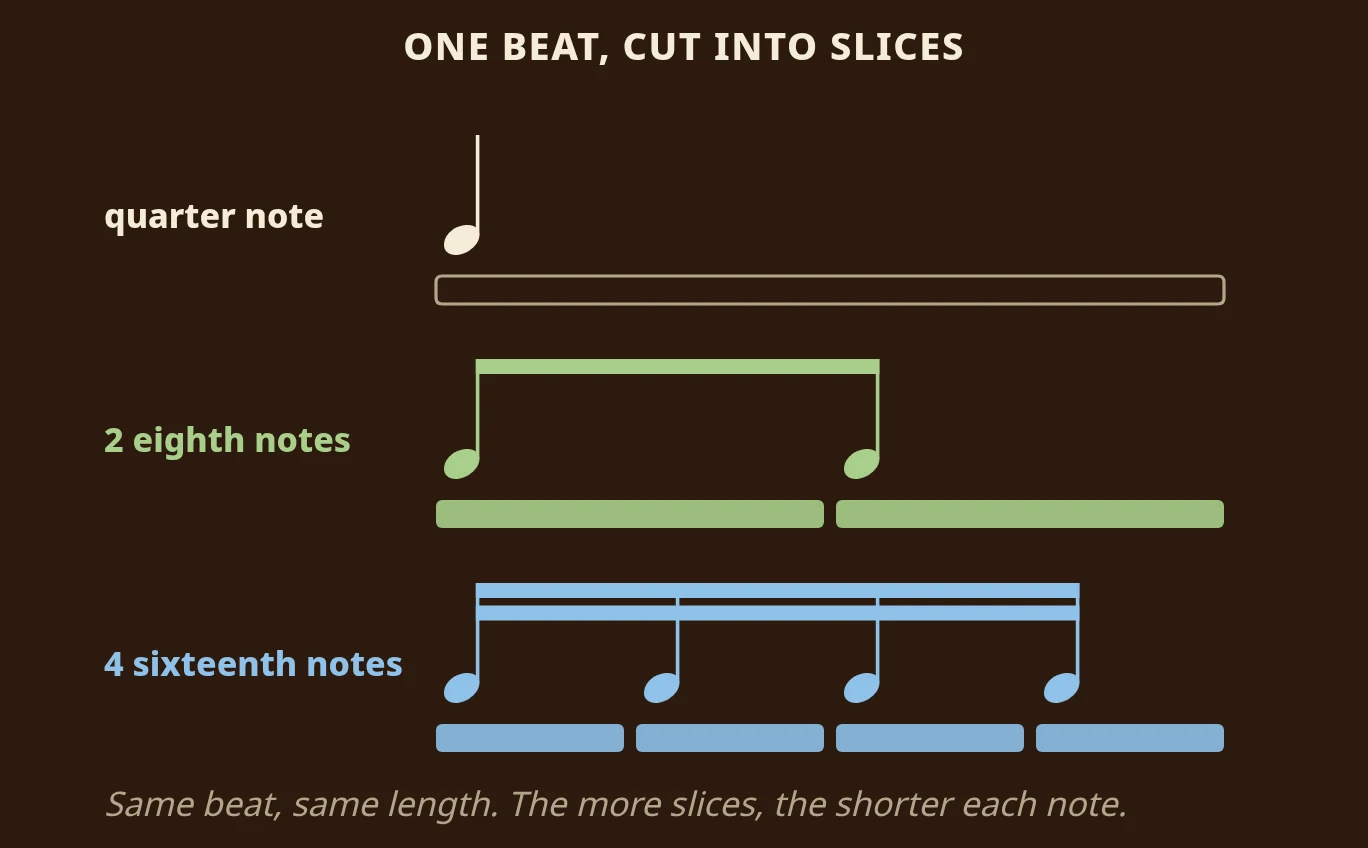
Picture one beat as a box cut into four equal slices. A sixteenth note fills one slice. An eighth note fills two. A dotted eighth fills three. A quarter note fills the whole box. Every rhythm in this guide is just a different way of filling those four slices.
Step 2: Learn the 1 e & a syllables
The syllables name the slices. The first is the beat number. Then come "e", "and" (written &) and "a". Say them "one ee and uh". The number is always on the beat, "and" is exactly halfway through it, and "e" and "a" sit in between.
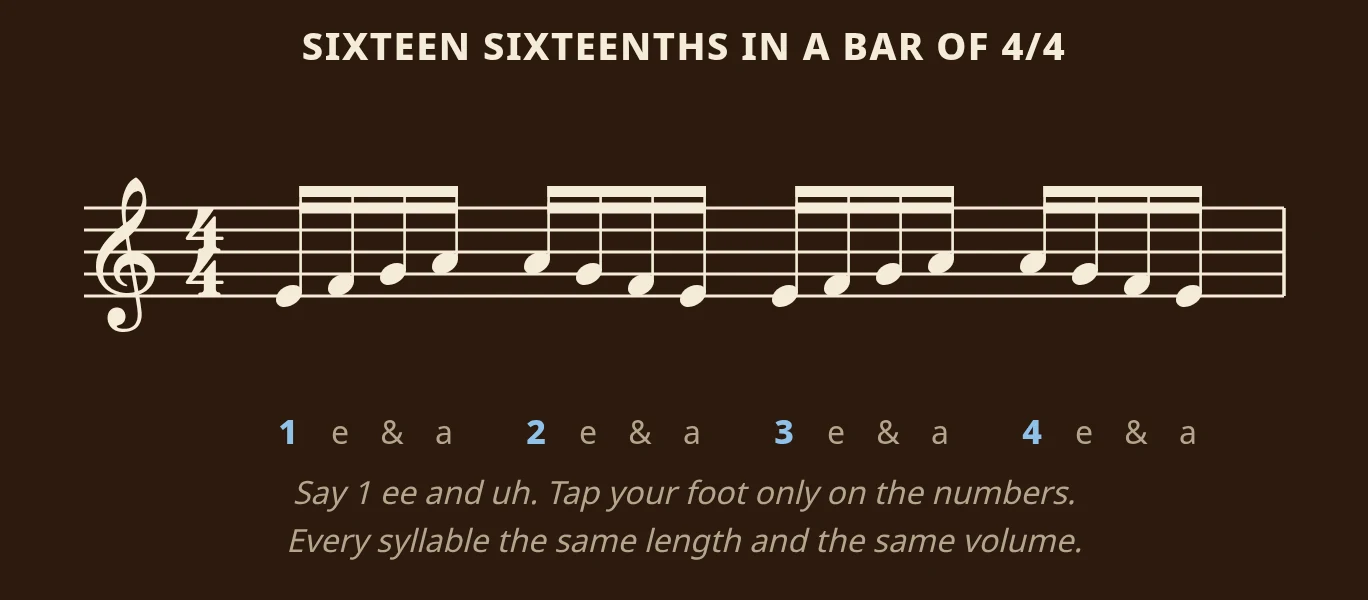
Try this now. Tap your foot on the numbers only, slowly, and say all sixteen syllables of a 4/4 measure: "1 e and a, 2 e and a, 3 e and a, 4 e and a". Every syllable should be the same length and the same volume, with four even syllables between each tap.
Some teachers use "1 ee and da", or the syllables "ta ka di mi". The words do not matter, as long as the four slices stay even. Use whatever your teacher or band director uses, so you can count together.
Step 3: Learn the six patterns that cover almost every beat
Real music rarely has four sixteenth notes on every beat. Instead, you will see a handful of patterns over and over again. Learn these six, and you can read almost any sixteenth note rhythm. A syllable in brackets is counted, but not played.
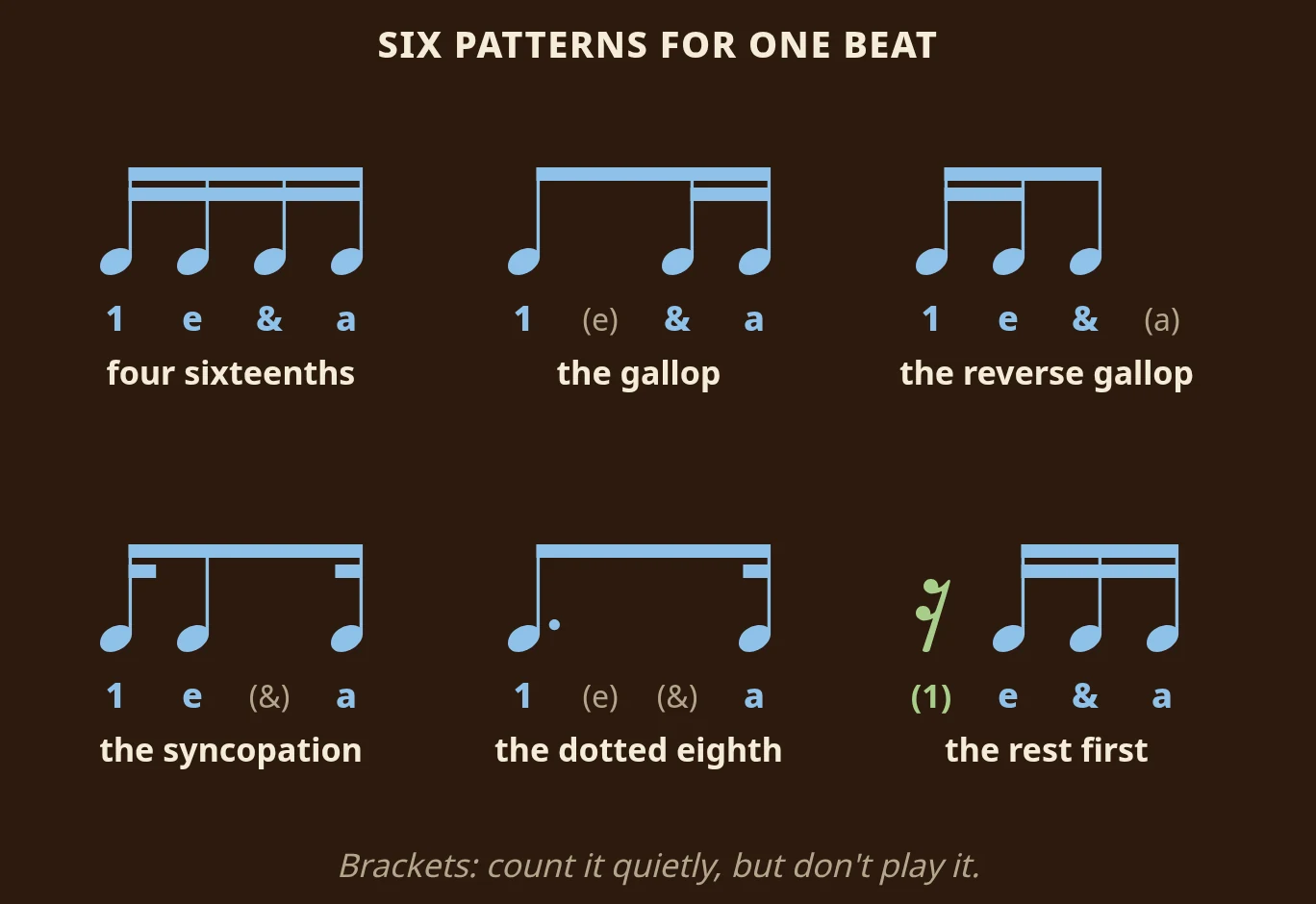
- Four sixteenths: "1 e and a". A note on every syllable.
- The gallop (an eighth note and two sixteenths): "1 (e) and a". The eighth note holds through "e".
- The reverse gallop (two sixteenths and an eighth): "1 e and (a)". The eighth note starts on "and" and holds through "a".
- The syncopation (sixteenth, eighth, sixteenth): "1 e (and) a". The eighth note starts on "e" and holds through "and", so the last note lands on "a". This is the one most people rush.
- The dotted eighth (dotted eighth and sixteenth): "1 (e and) a". The long note takes three slices and the short one lands on "a". Our guide to dotted notes and ties explains the dot itself.
- The rest first (a sixteenth rest and three sixteenths): "(1) e and a". Silence on the beat, then three notes. This is common in band parts, and it is very easy to come in early.
Here is a tip for spotting them. Look at the beams. Where there are two beams, the notes are sixteenths. Where there is only one beam, that note is an eighth, worth two slices. A short stub of a second beam marks a single sixteenth.
Step 4: Count a whole measure slice by slice
Now let's put some patterns together. Here is a 4/4 measure with four sixteenths on beat 1, a gallop on beat 2, a quarter note on beat 3 and a reverse gallop on beat 4.
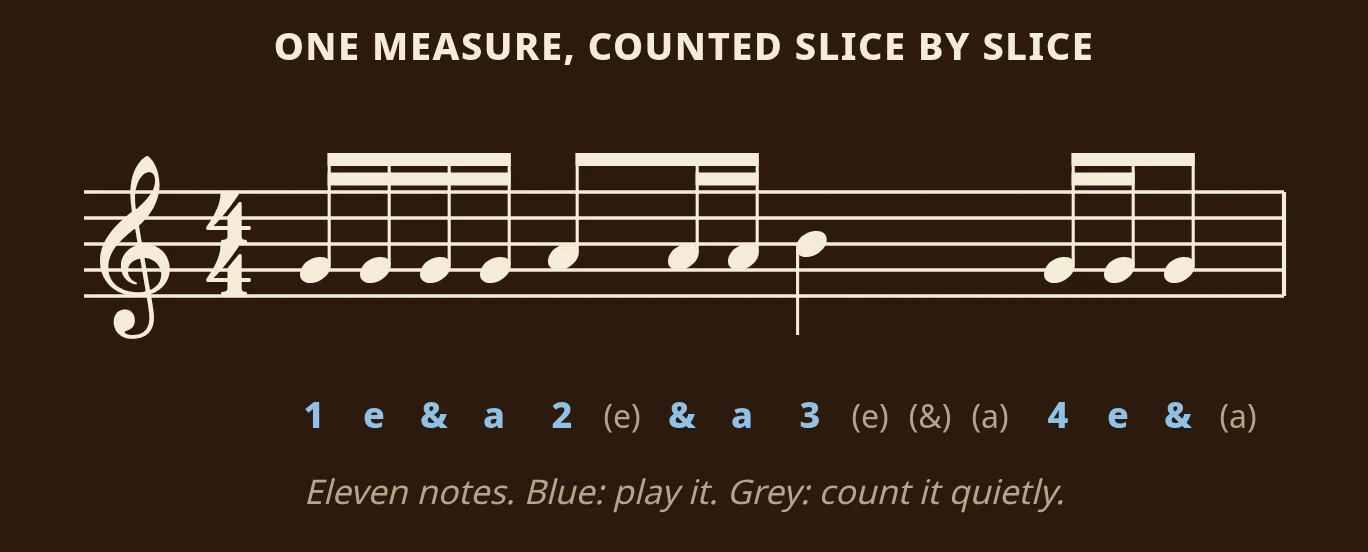
Count every slice, and play only on the blue ones: "1 e and a, 2 (e) and a, 3 (e and a), 4 e and (a)". That is eleven notes in total.
Whispering the syllables in brackets is the secret. It keeps every slice the same size, even the empty ones, which is exactly where most people speed up. The quarter note on beat 3 is a good example: it is easy to cut it short and rush into beat 4. Saying "(e and a)" quietly holds the space open.
Step 5: Count sixteenth rests and other time signatures
Silence gets the same treatment as sound. A sixteenth rest looks like an eighth rest with two little flags instead of one, and it lasts one slice. You still say its syllable, just quietly, and you do not play. A dotted eighth rest lasts three slices, so a dotted eighth rest followed by a sixteenth note is counted "(1 e and) a", with the note landing right on the "a".
Rests at the start of a beat are the ones to watch. Because nothing happens on the number, it is easy to forget to count it and come in early. Always say the number to yourself, even when it is silent.
When the beat is not a quarter note
Everything above assumes the quarter note gets the beat, as it does in 2/4, 3/4 and 4/4. In other time signatures the slices change size, but the idea stays the same. In cut time (2/2), the half note gets the beat, so eight sixteenth notes fill one beat. In 6/8, the beat is a dotted quarter, so six sixteenth notes fill one beat. That one needs its own way of counting, so it gets the next step.
Step 6: Count 16th notes in 6/8
In 6/8 time, every measure holds six eighth notes, grouped in two sets of three. That grouping is the reason "1 e and a" does not work here. In 4/4, each beat splits into four sixteenths. In 6/8, each group of three eighths splits into six sixteenths, so a counting system built on fours will cut across the groups.
The simplest fix is to give every eighth note its own number, from 1 to 6, and put "and" on the sixteenth in between. A full measure of sixteenth notes in 6/8 is counted "1 and 2 and 3 and, 4 and 5 and 6 and": twelve even syllables, with the numbers on the eighth notes.
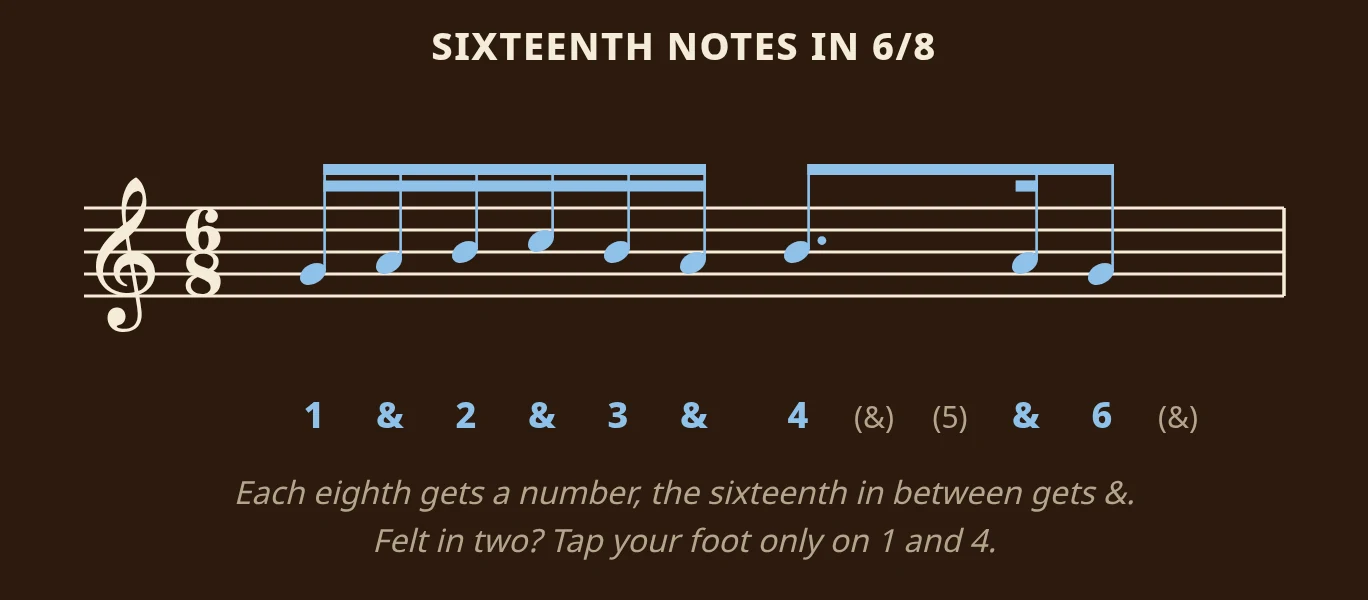
In the measure above, the first half is six sixteenth notes beamed together, counted "1 and 2 and 3 and". The second half is a dotted eighth, a sixteenth and an eighth. The dotted eighth lasts three sixteenths, so it starts on "4" and holds through "and 5". The sixteenth lands on the "and" after 5, and the eighth note takes "6 and". Counted out, that is "4 (and 5) and 6 (and)". This long, short, long shape is one of the most common rhythms in 6/8, so it is worth learning by ear.
When 6/8 is fast
At a quick tempo, six numbers per measure become too many to say, and the music feels like two big beats instead of six small ones. Keep the same count in your head, but tap your foot only on 1 and 4, the start of each group of three. Each tap now carries six sixteenth notes. Some teachers use syllables instead, such as "du da di" for the three eighths in a beat, with "ta" added between them for sixteenths: "du ta da ta di ta". Use whatever your teacher or band director uses.
The most common mistake is to read six beamed sixteenths as if they were four and rush them into the space of a 4/4 beat. Look at the beams: in 6/8, a full group of sixteenths has six notes under one set of beams, not four. To practice, set a metronome to a slow eighth note pulse and say "1 and 2 and 3 and, 4 and 5 and 6 and" for two measures before you play. Once that is even, set the metronome to click only on 1 and 4 and count the same syllables. Our guide to reading 6/8 time explains how the 6/8 beat itself works.
Step 7: Avoid the four reasons sixteenths come out uneven
- The gallop turns into a triplet. The eighth, sixteenth, sixteenth pattern comes out as three equal notes. The eighth is twice as long as each sixteenth, so keep the "(e)" in your count. Our guide to reading triplets shows how a real triplet differs.
- Groups of four rush. Four quick notes tend to bunch up. Say all four syllables at the same volume, with a metronome clicking on the beat.
- The beat drifts after a long run. A full measure of sixteenths can pull you a slice ahead. Tap only on the numbers: the next number has to land exactly on the tap.
- A rest on the beat gets skipped. With a sixteenth rest on beat 1, the first note belongs on "e". Say the "1" first, then play.
Step 8: Practice them even first and fast last
Sixteenth notes are short, so it is tempting to practice them fast. But speed hides mistakes. The quickest way to play them fast is to play them evenly at a slow speed first. Here is a five-minute method:
- Set a slow beat. Put a metronome on 60 beats per minute. Each syllable is now a quarter of a second, slow enough to be exact.
- Speak the grid. Count "1 e and a" for two full measures without playing, every syllable the same length and volume.
- Speak the rhythm. Say the played syllables out loud and whisper the held ones.
- Clap it. Clap only the played syllables while you whisper the rest.
- Play it. Play the rhythm on one note first, then on the real notes.
- Speed up last. Three clean times in a row earns you 4 to 6 more beats per minute.
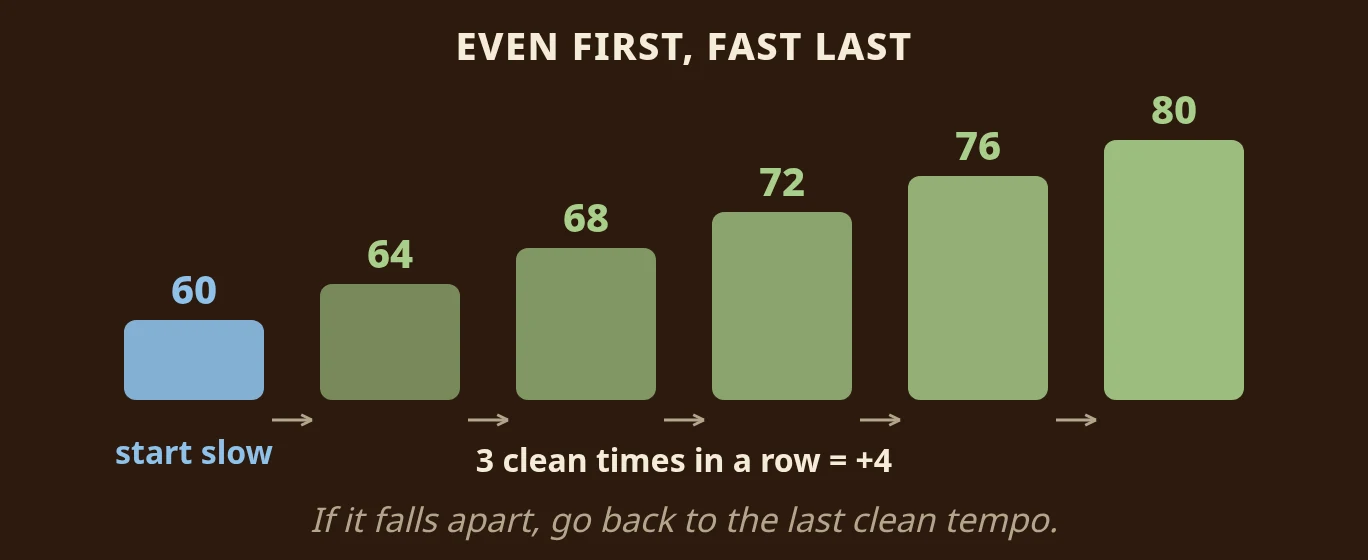
If it falls apart at the new speed, do not push through. Go back to the last tempo where it was clean, play it three more times, and try again. Over a week of short sessions, you will climb the ladder without ever practicing a mistake.
Step 9: Practice with a way to check yourself
Counting tells you where each note goes. Hearing tells you whether you got it right. With sixteenth notes, a rhythm that is a little uneven can feel perfectly fine while you play it, so it helps to hear the measure played exactly and count along.
That is what Sheetly is for. Take a photo of the page with your iPhone or iPad, loop the measure you are working on, and slow it down until you can say "1 e and a" along with the playhead. Then bring the tempo back up step by step, just like the ladder above. If a rhythm still makes no sense, ask the built-in coach about that measure. It has read the notes on your page, so it counts your measure, not a textbook one.
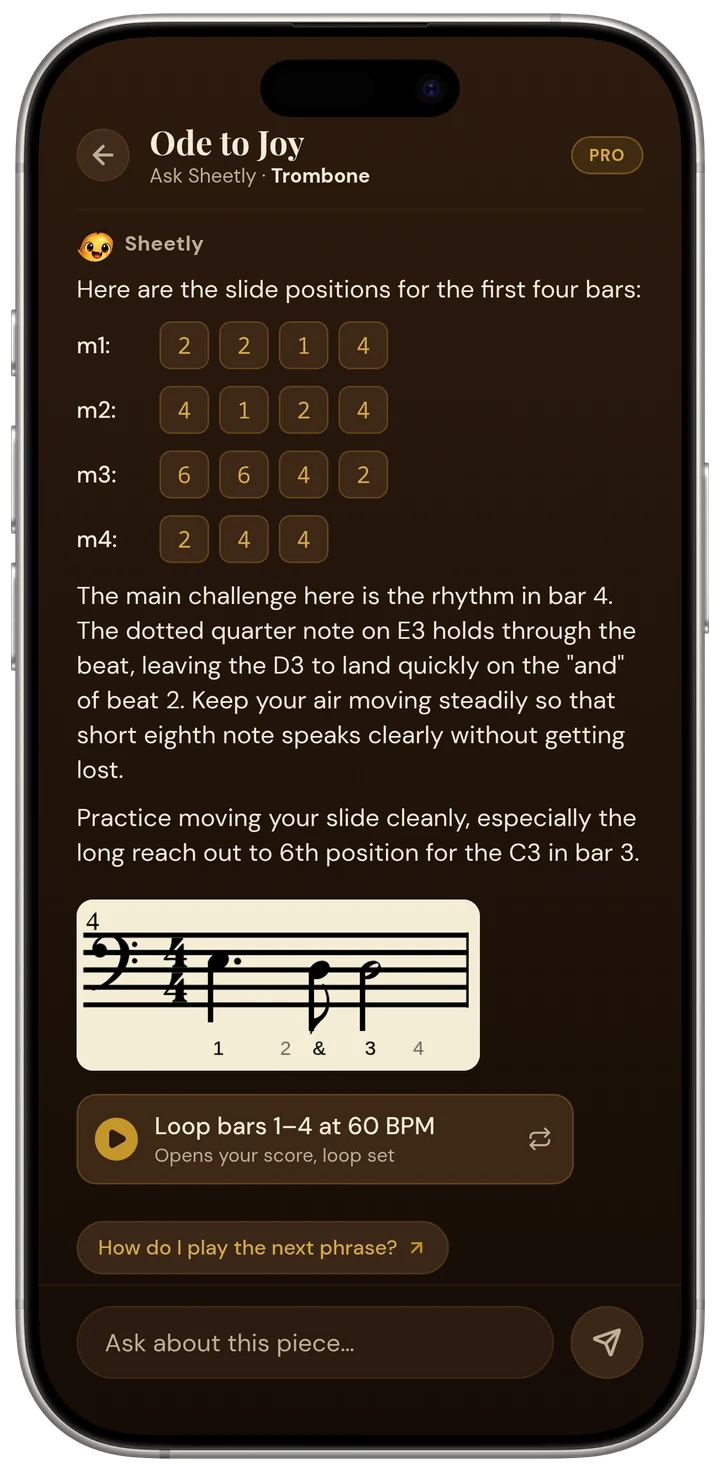
Count it, clap it, then press play and compare. When your syllables and the playhead line up at every speed, the rhythm is yours.
Questions
How many sixteenth notes are in a beat?
Four, in 2/4, 3/4 and 4/4 time, where the quarter note gets the beat. A full measure of 4/4 holds sixteen sixteenth notes.
How many sixteenth notes fill a beat in cut time or 6/8?
In cut time (2/2), where the half note gets the beat, eight sixteenth notes fill a beat. In 6/8, where the dotted quarter is the beat, six sixteenth notes fill a beat, and a full measure of 16th notes in 6/8 is counted "1 and 2 and 3 and, 4 and 5 and 6 and".
What does a sixteenth rest look like?
A sixteenth rest looks like an eighth rest with two flags instead of one. It is one syllable of silence: counted, but not played.
How do you say 1 e and a?
Say it "one ee and uh", with all four syllables the same length. The number lands on the beat and "and" lands exactly halfway through it.