6/8 Time Signature: How to Read and Count 6/8 Time
Wondering how to read 6/8 time? In this guide, we explain what the two numbers mean, why 6/8 feels like two beats and not six, how it differs from 3/4, and how to count its most common rhythms, with a picture for every step.

Have you ever opened a piece of music, seen 6/8 at the start, and wondered whether you are meant to count to six in every bar? Or maybe you counted to six, and the tune came out sounding heavy and slow, nothing like the lively jig or gentle lullaby it was supposed to be.
You are not alone. 6/8 is one of the most misunderstood time signatures, because the numbers say one thing and the music feels like another. The numbers say six eighth notes per bar. The music, most of the time, feels like two big swaying beats, each one split into three. Once you feel that, 6/8 becomes one of the most natural rhythms there is: it is the rhythm of rocking a cradle, rowing a boat or dancing a jig.
In this guide, we show you how to read 6/8 time step by step: what the numbers mean, how to count it, how it differs from 3/4, which note lengths you will meet, and how to read a real tune in 6/8. Each step has a picture, and at the end we share a short drill and an easy way to check your counting as you practice.
How to read 6/8 time
Step 1: Know what the two numbers mean
A time signature is the pair of numbers at the start of the music. In most time signatures, the top number tells you how many beats are in each bar and the bottom number tells you which note gets one beat. 6/8 bends that rule a little.
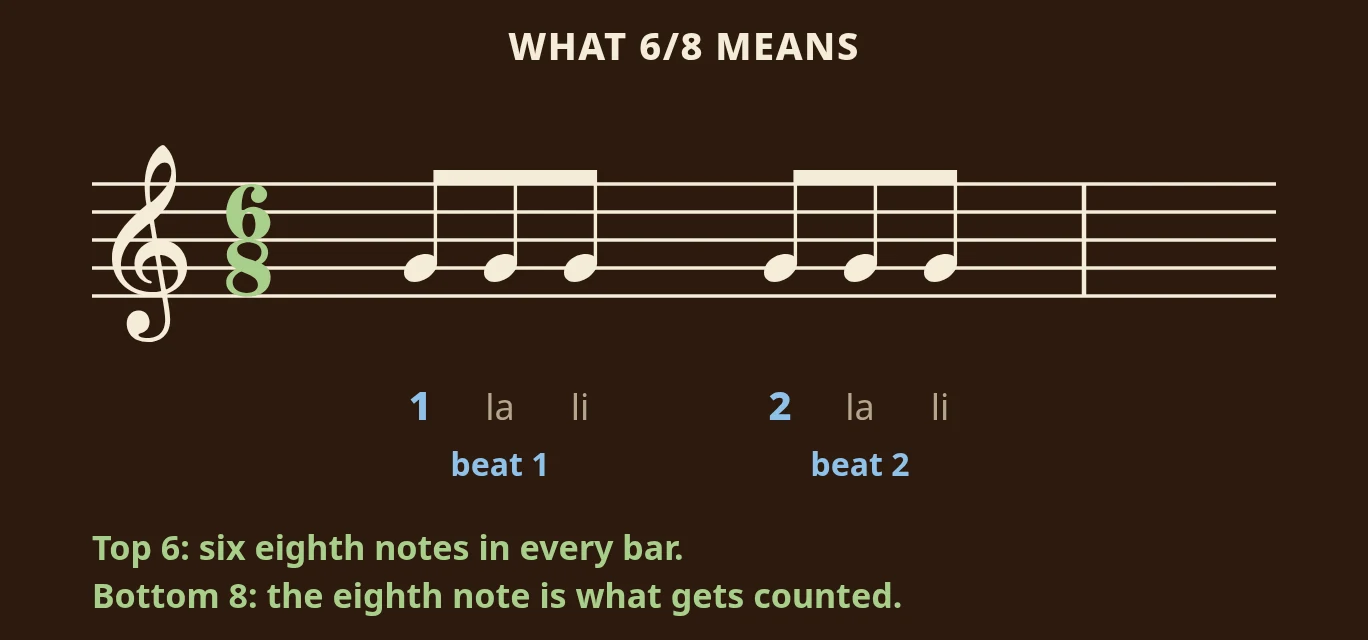
In 6/8, the top number 6 tells you there are six eighth notes in every bar. The bottom number 8 tells you that the eighth note is the unit being counted. So far, so simple. But at most speeds, nobody actually feels six separate beats. The six eighth notes fall into two groups of three, and you feel two strong pulses per bar: one at the start of each group.
Simple time and compound time
Time signatures like 2/4, 3/4 and 4/4 are called simple time, because each beat splits naturally into two. Time signatures like 6/8 are called compound time, because each beat splits into three. 6/8 is "compound duple": two beats, each made of three eighth notes.
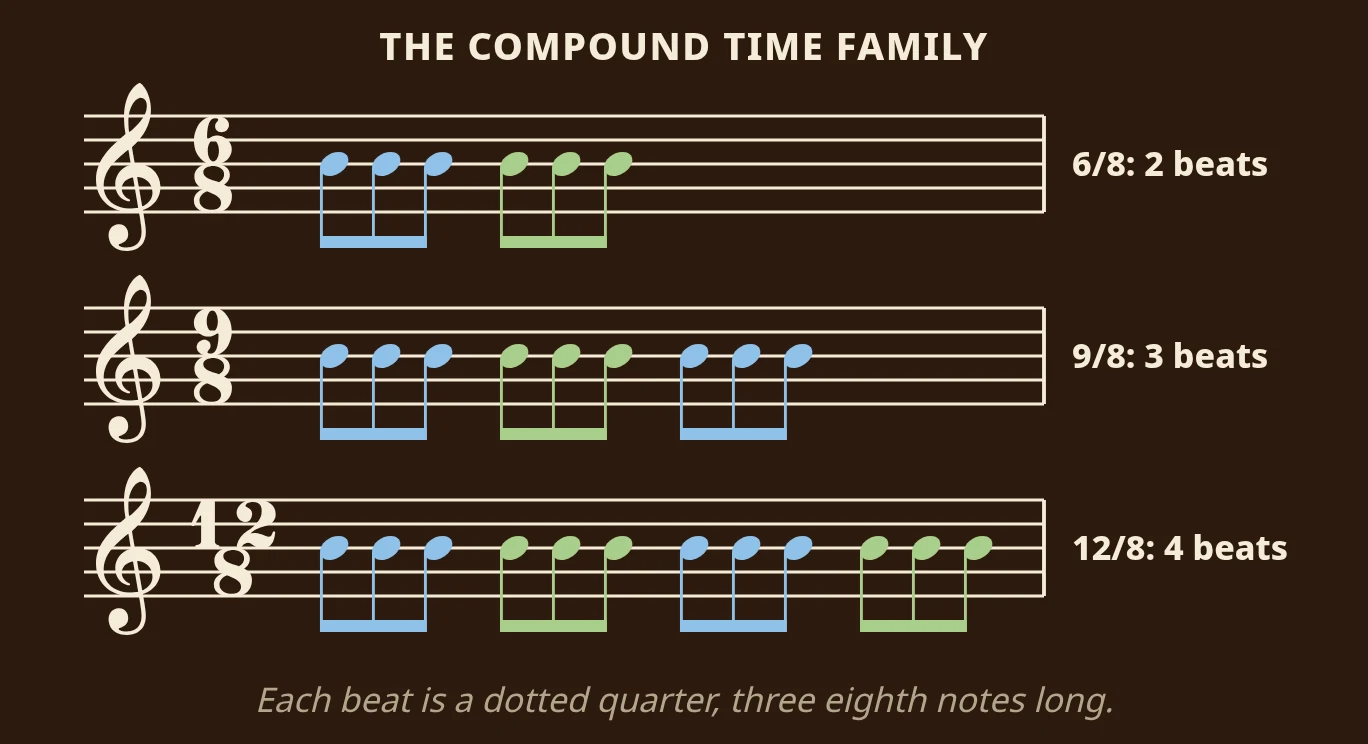
6/8 has two relatives that work the same way. 9/8 has three beats of three, and 12/8 has four beats of three, which is why a slow blues shuffle is often written in 12/8. In all three, each beat is one dotted quarter note long.
Step 2: Count it as two groups of three
The easiest way to count 6/8 is to give every eighth note a syllable and lean on the first one of each group: "1 la li 2 la li". Some teachers say "1 and a 2 and a" or "1 trip let 2 trip let". The words do not matter. What matters is the shape: two strong syllables, each followed by two light ones.
Try it now. Tap your knee twice per bar at a walking pace, and say "1 la li 2 la li" against the taps, so that "1" and "2" land on your taps. That swaying, rocking feeling is 6/8.
In slow music, like a lullaby or a slow air, you may feel all six eighth notes as separate pulses, and that is fine. Even then, the first and fourth eighth notes carry the weight. The pulse is two, and the six is how you divide it.
Tempo markings in 6/8
When a 6/8 piece has a metronome marking, it usually counts the dotted quarter note: a small dotted quarter followed by a number, such as 60. That means 60 big beats per minute, two per bar, with three eighth notes inside each one. If you set a metronome, set it to the big beat, not to every eighth note, and let the "la li" fit in between the clicks. When a marking shows a plain eighth note instead, the composer usually wants a slower piece that you feel in six.
Step 3: Don't confuse 6/8 with 3/4
Here is where many readers get stuck. A bar of 6/8 and a bar of 3/4 hold exactly the same amount of music: six eighth notes. The difference is how those eighth notes are grouped.
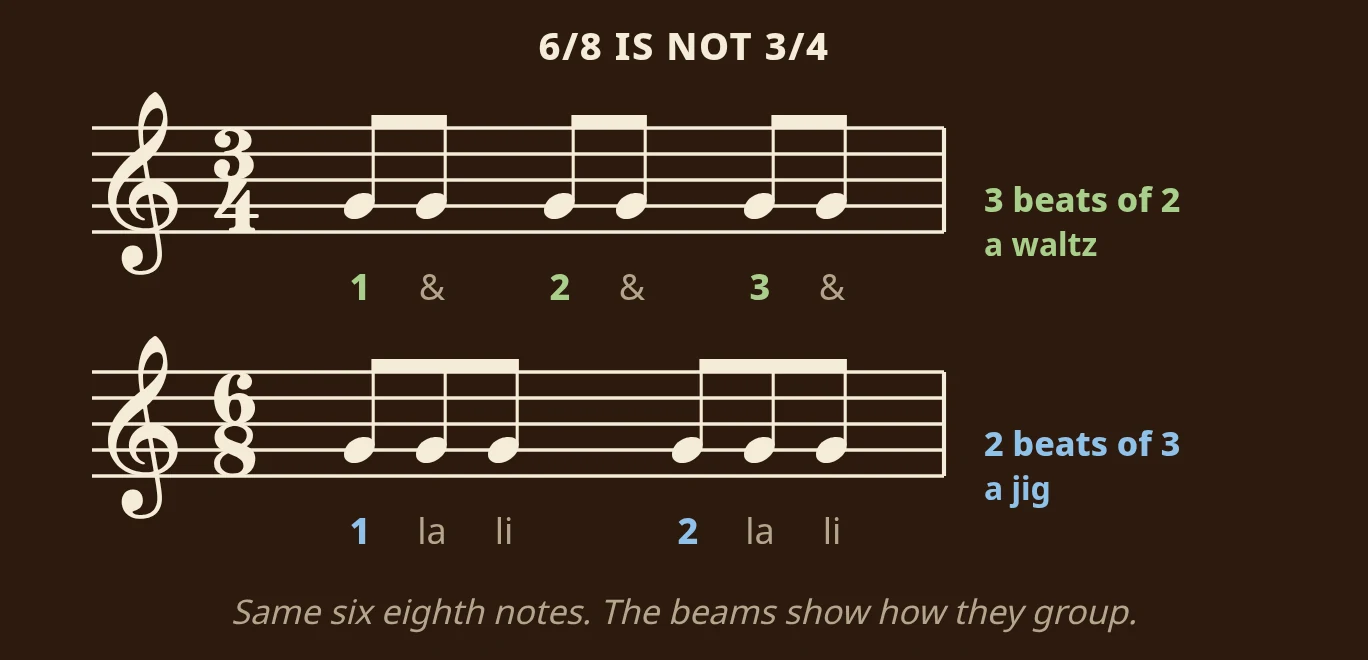
3/4 has three quarter note beats, each split into two: "1 and 2 and 3 and". That is the oom-pah-pah of a waltz. 6/8 has two dotted quarter note beats, each split into three: "1 la li 2 la li". That is the lilt of a jig.
The beams give it away. In 3/4, eighth notes are beamed in pairs, three pairs to a bar. In 6/8, they are beamed in threes, two groups to a bar, and never across the middle of the bar. If you are ever unsure where the beats are, look at the beams.
Common mistake: accenting eighth notes one, three and five, which gives the bar three even bumps like a waltz. Accent only the first note of each beamed group of three.
Step 4: Learn how long each note lasts in 6/8
Because 6/8 counts in eighth notes, it helps to think of every note length in eighths.
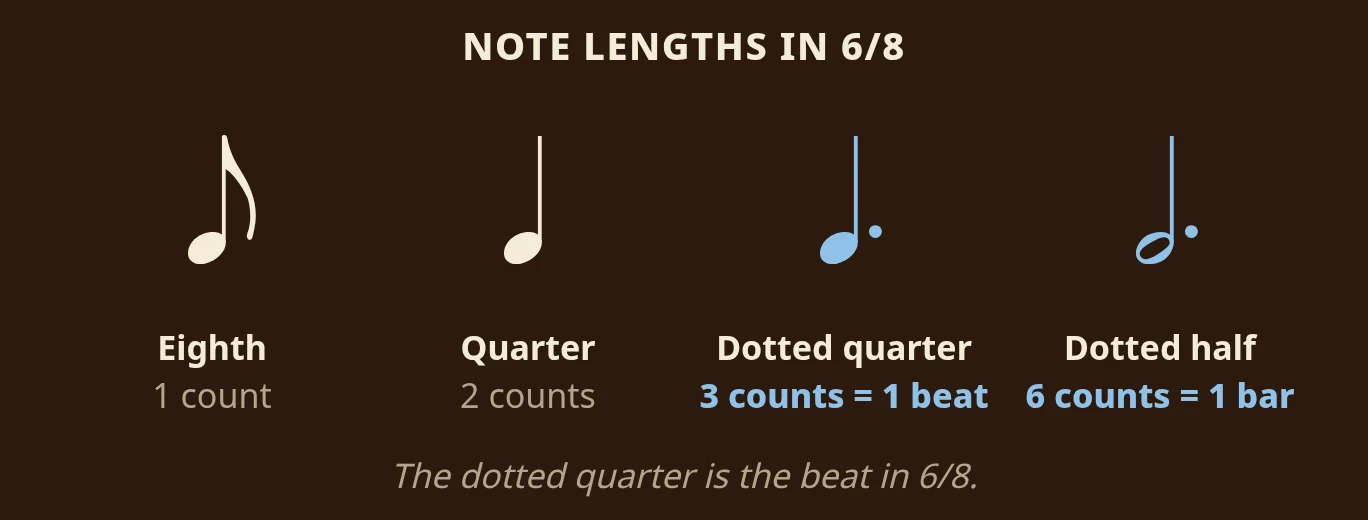
- An eighth note gets one syllable.
- A quarter note gets two syllables, usually the first two of a group.
- A dotted quarter note gets all three syllables: one whole beat.
- A dotted half note gets all six syllables: the whole bar.
The dotted quarter is the key. In 4/4, a dotted quarter is an awkward one and a half beats. In 6/8, it is exactly one beat. Players who come from 4/4 often cut it short out of habit, so give it its full three syllables: "1 la li".
The jig rhythm
The most common rhythm in 6/8 is a quarter note followed by an eighth note, twice: long, short, long, short.
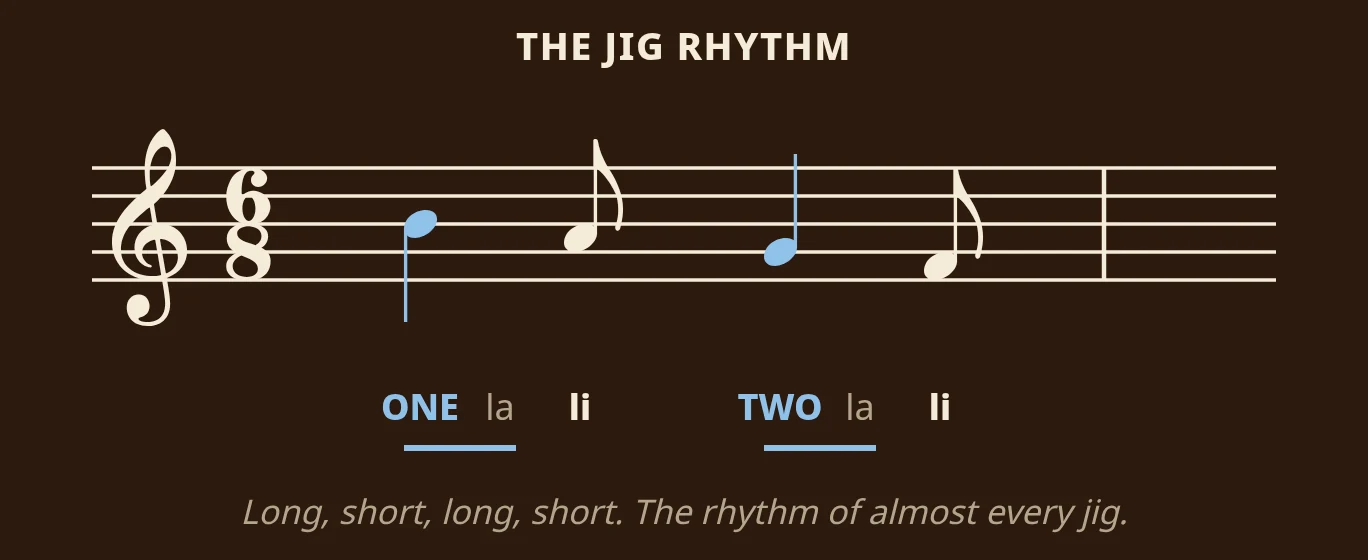
Count it "ONE la li TWO la li", holding the first syllable of each group through "la" and playing the short note on "li". You will hear this rhythm in almost every jig and in many 6/8 marches. Tap two beats per bar and say "ONE-la li, TWO-la li" until it feels like a gentle gallop.
Step 5: Read a real tune in 6/8
Let's put it all together with a song almost everyone knows: Row, Row, Row Your Boat. It is very often written in 6/8, and it is a perfect example of two big beats per bar.
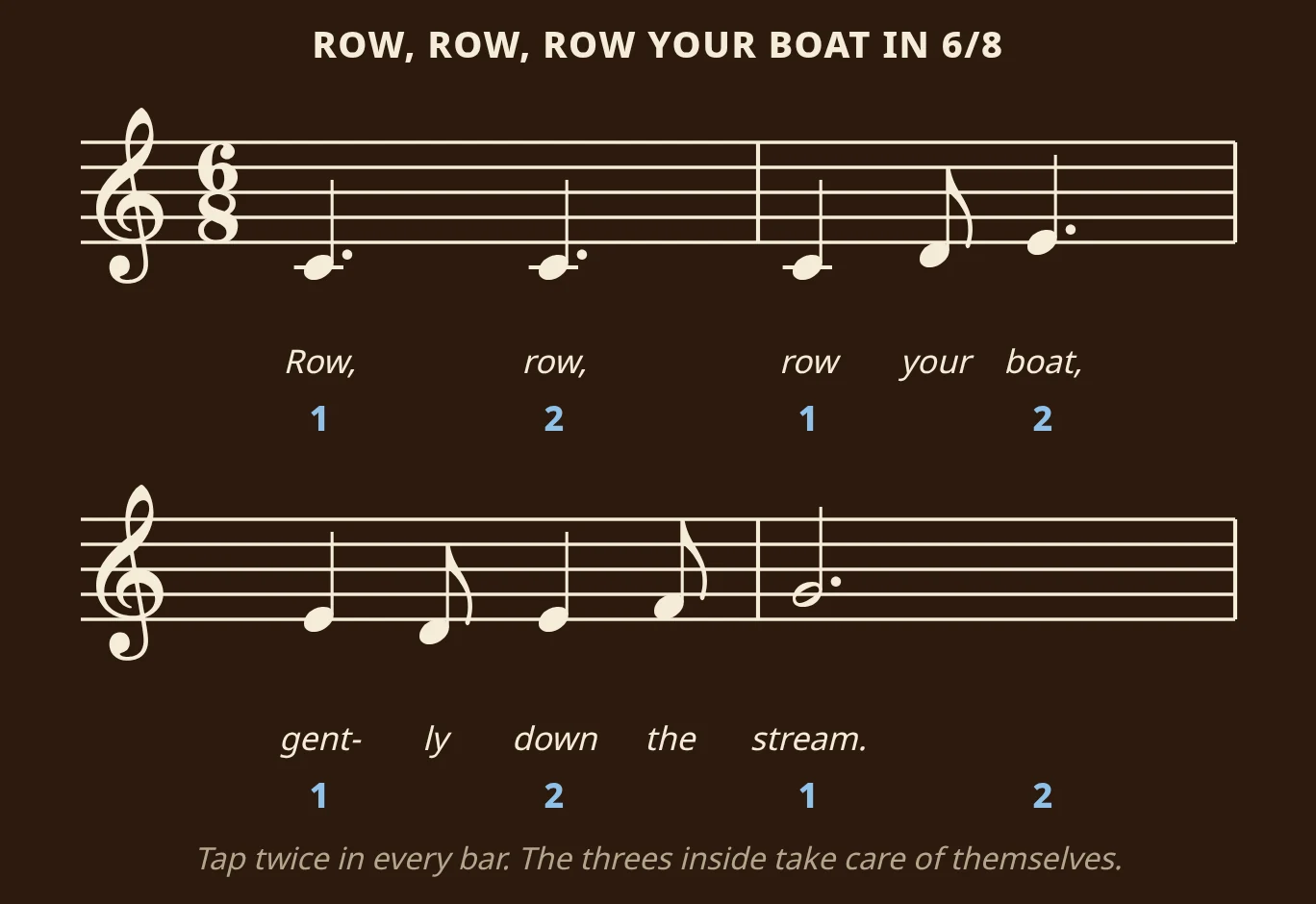
Bar 1, "Row, row", is two dotted quarter notes: one on each beat. Bar 2, "row your boat", is a quarter note and an eighth note on beat 1 (the long-short jig rhythm), then a dotted quarter on beat 2. Bar 3, "gently down the", is the long-short pattern twice. Bar 4, "stream", is a dotted half note that fills the whole bar.
Check the sums as you go. In bar 2, a quarter (two eighths) plus an eighth (one) is one beat of three, and the dotted quarter is another three: six in total. If a 6/8 bar ever does not come to six eighth notes, look again for a dot, a tie or a rest you missed.
Now sing it while tapping twice per bar. It should feel like rowing: two long pulls per bar, not a count to six. Other well-known music often written in 6/8 includes Greensleeves, Silent Night and the Irish jig.
Step 6: Avoid the three common 6/8 mistakes
- Counting six slow beats. Six even, heavy beats turn a lively jig into something slow and plodding, and you lose the swing that makes it 6/8. Tap two beats per bar and say the six syllables inside them.
- Playing it like 3/4. Accents on eighth notes one, three and five give three bumps instead of two sways. Look at the beams: three eighth notes under one beam are one beat.
- Clipping the dotted quarter. In 6/8 it is a whole beat. Give it all three syllables.
A two-minute daily drill
- Tap two, say six. Tap your knee at a walking pace and say "1 la li 2 la li" against the taps (30 seconds).
- Long, short. Keep tapping and change to "ONE-la li, TWO-la li", holding the first syllable for two eighth notes. That is the jig rhythm (30 seconds).
- Clap a tune. Clap the rhythm of Row, Row, Row Your Boat or any 6/8 piece while your foot keeps tapping in two. If you lose the two, stop and start again from the taps (1 minute).
Step 7: Practice with a way to check yourself
The hardest part of 6/8 is the feel, and feel is something you learn by hearing it. If you only ever hear your own counting, it is easy to drift into a waltz or a slow count of six without noticing.
That is where Sheetly helps. Take a photo of a printed page in 6/8 with your iPhone or iPad, and Sheetly plays it back with a playhead that follows the notes. Listen for the two big pulses in every bar, then play along. Slow it down while you learn the rhythm and bring the tempo back up when the sway feels natural, loop a tricky bar, or ask the built-in coach how to count a bar that puzzles you.
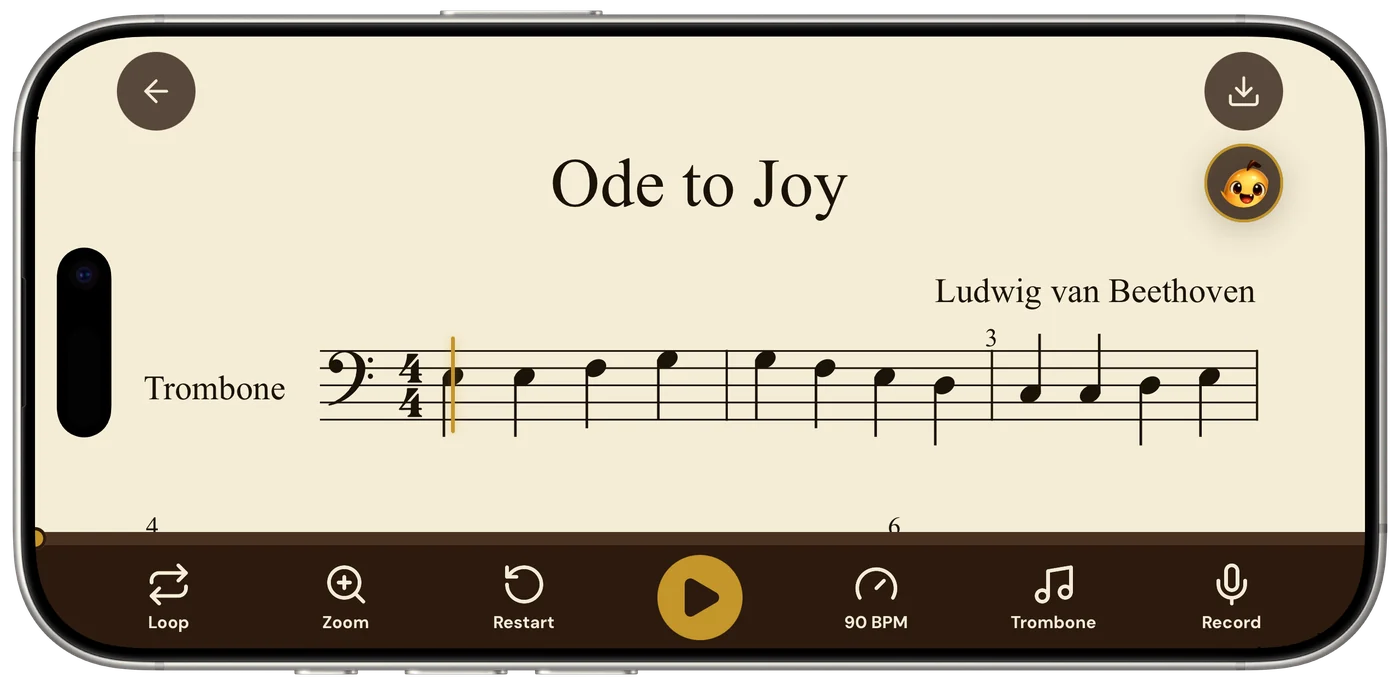
Clap the bar first, then press play and compare. When your clapping and the playback sway together, you are reading 6/8.
Questions
How many beats are in a bar of 6/8?
Six eighth notes, but at most tempos you feel two beats, each one a dotted quarter note split into three eighth notes. In very slow music you may count all six.
What is the difference between 6/8 and 3/4?
Both hold six eighth notes per bar. 3/4 groups them in three pairs (1 and 2 and 3 and), like a waltz. 6/8 groups them in two threes (1 la li 2 la li), like a jig. The beams show you which grouping is meant.
Is 6/8 the same as 2/4 with triplets?
In sound, yes. A bar of 2/4 filled with eighth note triplets has two beats, each divided into three, just like 6/8. Composers write 6/8 when the whole piece moves in threes, and save triplets for the occasional bar in 2/4.
What is a duplet in 6/8?
A duplet is two equal eighth notes marked with a small 2, played in the time of one dotted quarter beat that would normally hold three. Count it "1 and" inside the beat. It makes a 6/8 tune sound briefly square.