
How to help when you don’t read music
You do not need to read music to help your child practice. Your job is not to correct notes. It is to make practice happen at the same time each day, give each session a small, specific goal (“measures 9 to 16, slowly, three times without a mistake”), and listen for a few minutes at the end. Those three things do more than any amount of “go practice”.
- A fixed daily time works better than a long session once a week.
- A goal for each session works better than a number of minutes.
- You can hear a steady beat, effort and progress without reading a note.
- To check the notes themselves, use the method book’s recordings or an app that plays the page.
Set up the routine
- Same time, every day. Attach it to something that already happens, like right after school or before screen time.
- Short sessions. For beginners, many teachers suggest 15 to 20 minutes, growing as they get older. Five focused minutes count for more than thirty distracted ones.
- A place for it. Music stand up, pencil on the stand, instrument easy to reach. Less setup means fewer arguments.
- Goals, not minutes. A timer teaches clock-watching. “Play the scale three times without a mistake” has a finish line.
A 20-minute session for a beginner
- Warm up, 3 minutesLong tones or a scale. On piano, a five-finger exercise.
- The assignment, 7 minutesWhatever the teacher or director asked for this week. Check the assignment sheet or practice log.
- The hard spot, 7 minutesThe two to four measures that keep breaking, slowly, until they are right three times in a row.
- Something fun, 3 minutesA favorite piece or a song they chose. Ending on something they like makes tomorrow easier to start.
Questions that help
You can ask all of these without reading music:
- “What did your teacher ask you to work on this week?”
- “Which measures are the hard ones? Show me where.”
- “Can you play just that part slowly for me?”
- “How do you know if that was right?”
- “What sounds better than yesterday?”
Measure numbers make this easier. Most band and orchestra parts print the number of the first measure at the start of each line, so you can point at measure 12 even if you cannot read the notes in it. And asking your child to teach you one thing, like a note name or what a symbol means, is good practice for them: explaining something is a quick way to find out whether you really know it.
How to check a piece by ear
Without reading music you can still hear three things: whether the beat is steady, whether the music stops and restarts, and whether it is better than last week. To check the notes themselves, you need to know how the piece should sound:
- The method book’s recordings. Most band and string method books come with recordings or online play-along tracks. Check the cover and the first pages.
- A recording of the piece. Search the title and composer. Pieces for school concerts often have publisher recordings online.
- An app that plays the page. Photograph the sheet music and the app plays it back.
That last one is what Sheetly does. Photograph the page your child is stuck on, press play, and you both hear how measure 12 should sound, at any tempo. Your child can also ask the coach about that page by measure number and get an answer for their instrument: slide positions on trombone, valves on trumpet, the string and finger on violin.
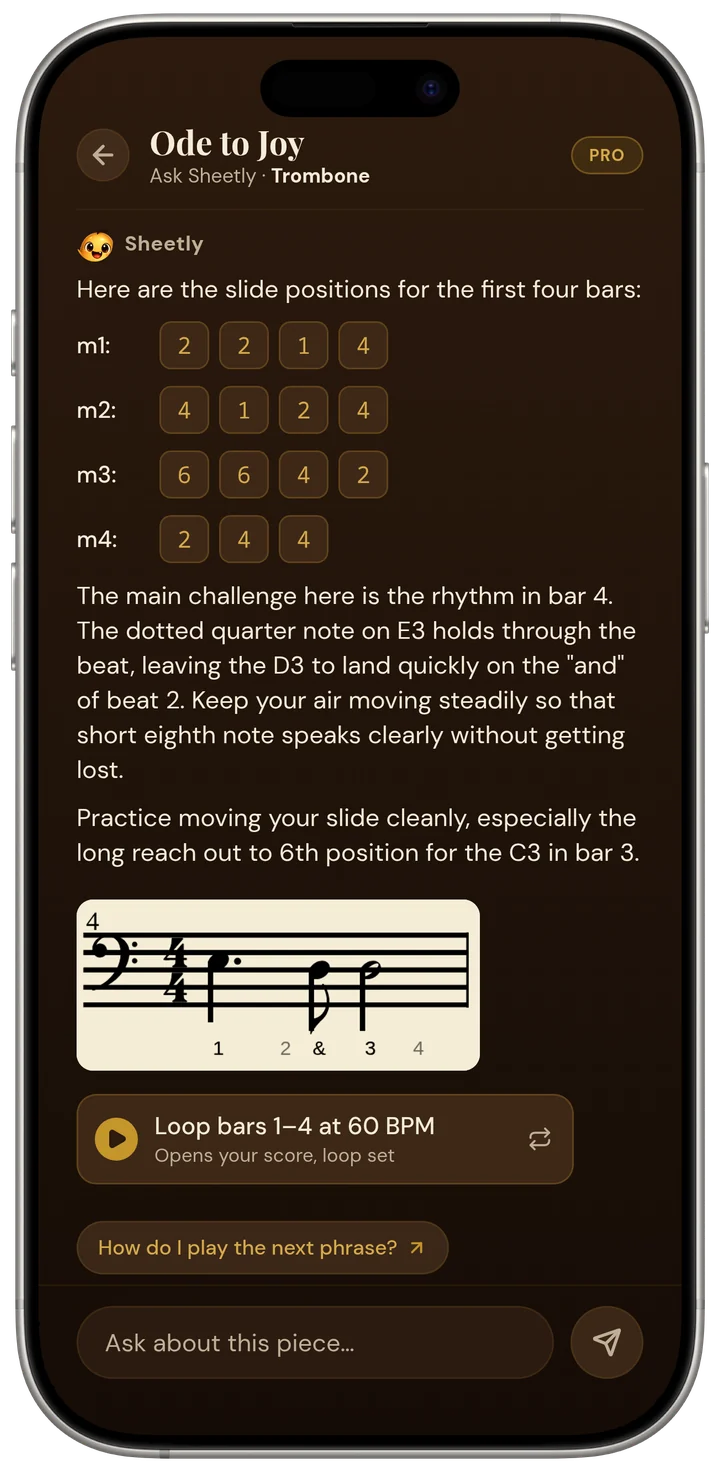
Sheetly is free to download. Your first pages scan free while you set it up, then one page a month, with three coach questions on every score. Pro removes the limits for US$11.99 a month or US$39.99 a year, and the yearly plan starts with a 14-day free trial.
Hear what the page should sound like.
Photograph your child’s music, press play, and loop the hard measures at any tempo. Free to download on iPhone and iPad.

Free to download · iPhone and iPad · Android on the way

What to avoid
- Correcting notes you are not sure about. A wrong correction is worse than none. Ask “how do you know?” instead.
- Practice as punishment. It teaches that music is a chore.
- Comparisons. Not with siblings, not with classmates.
- Praising talent instead of work. “That hard part is much smoother than on Monday” is worth more than “you’re so musical”.
Questions
How long should a child practice an instrument each day?
Many teachers suggest 15 to 20 minutes a day for beginners, growing to 30 minutes or more as students get older and the music gets harder. Practicing most days matters more than the length of any one session, and a clear goal for each session matters more than the minutes.
Can I help my child practice if I can’t read music?
Yes. Parents who do not read music can set a daily routine, give each session a specific goal, ask their child to show and explain the hard measures, and listen for a steady beat and progress. To check the notes, use the method book’s recordings or an app that plays the sheet music from a photo.
How do I get my child to practice without a fight?
Make it the same time every day, keep sessions short, give a goal instead of a number of minutes, and end with something they enjoy. Let them choose some of the music. A session with a clear finish line and a fun ending is much easier to start than an open-ended half hour.
Is there an app that shows how my child’s sheet music should sound?
Yes. Sheetly, for iPhone and iPad, reads a photo of printed sheet music and plays it back at any tempo, with a coach that answers questions about that exact page. It is free to download, with one page a month free after the first pages. Pro is US$11.99 a month or US$39.99 a year, and the yearly plan starts with a 14-day free trial.