
The short version
Simply Piano is a lesson app. It teaches from its own song library and listens to you play through the microphone to check the notes. It does not scan your own printed music into a playable score, and its feedback is about your playing rather than a conversation about the notation. Sheetly does the opposite: it photographs the printed page you already have, plays it, and has a coach that has read those notes. If you want a guided course, keep Simply Piano. If you have your own music and a teacher, try Sheetly.
- Keep Simply Piano if you are learning from zero without a teacher and want a structured course that hears you play and tells you whether you hit the note.
- Try Sheetly if the music you practise is printed: a method book, pieces from a teacher, an exam syllabus, a hymnal. Sheetly reads that page and plays it.
- Sheetly is, as far as we know, the only sheet-music app where you photograph your own printed page and then ask an AI coach questions about that score by bar number. It does not listen to you play and it does not replace a teacher.
We make Sheetly. We have not measured Simply Piano and make no claims about it beyond what its own materials describe. Where Simply Piano is the better tool we say so.
The “Simply Piano alternative” search usually comes from someone who has outgrown a song library: they now have a teacher, or a method book, or a piece for an exam, and the app cannot see any of it.
What Simply Piano is for
Simply Piano teaches piano from its own library of songs and exercises, and listens through the microphone to check whether you played the right notes. That is its whole design: content it controls, so it can judge what it hears. It does not scan the printed music you already own into a playable score, and its feedback is about your playing, not a chat about what is written in the notation.
For a beginner with no teacher, that loop (play, be heard, be corrected) is genuinely useful, and nothing on this page does it. Sheetly does not listen to you play. If the thing you value most is an app telling you that the F sharp was an F, keep Simply Piano, or look at Flowkey or Yousician, which work the same way.
The shape stops fitting when your music comes from outside the app. A teacher assigns a piece from a book. An exam board publishes a syllabus. A choir hands out a photocopy. None of that is in a lesson app’s library, and the app has no camera path to get it there.
Simply Piano and Sheetly side by side
Simply Piano listens to you play its own songs and corrects you; Sheetly reads your own printed page, plays it and lets you ask a coach about it. They are almost mirror images. Only Simply Piano listens through the microphone; only Sheetly scans a page into notes and has a coach that has read the score.
| Sheetly | Simply Piano | |
|---|---|---|
| Reads your printed page into playable notes | Yes: photograph or PDF, server-side recognition | No: teaches from its own song library |
| Plays the score back | Yes, any tempo, loop a bar or passage, piano and other sounds | Plays its own lesson content |
| Listens to you play | No | Yes: checks notes through the microphone |
| AI coach about your score | Yes, has read the notes; answers by bar number | Feedback is about your playing, not a chat about the notation |
| Library and PDF reading | Your own scanned and imported scores | Its own song library |
| Platform | iPhone and iPad; Android on the way | See its own materials |
What Sheetly does with your page
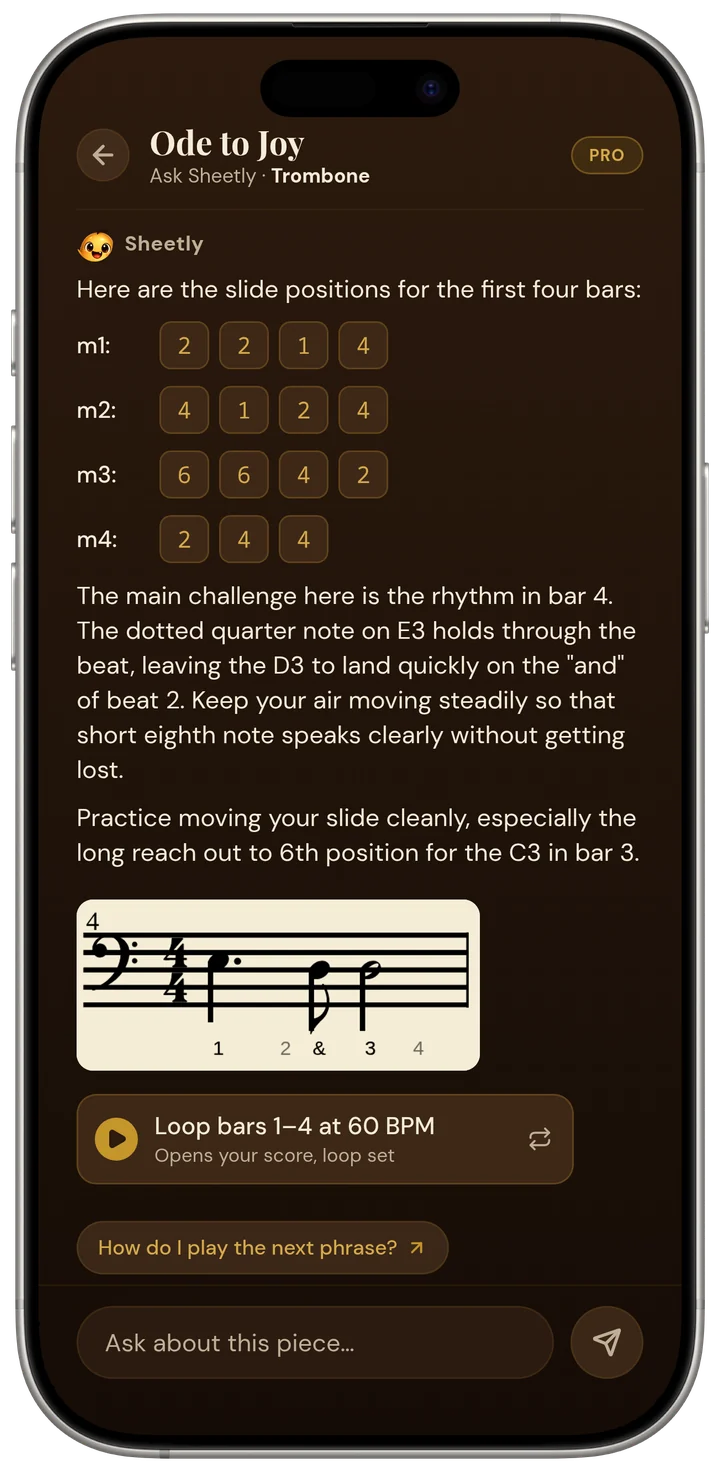
Sheetly photographs a printed page or imports a PDF, reads the engraved notation on a server, and gives you a score that plays. Set any tempo, loop one bar or a whole passage, pick piano, organ, flute, trumpet or another sound, record your own take against the score, and export PDF, MIDI or MusicXML. The coach has read the actual notes of the scanned piece and answers by bar number.
The reading accuracy is measured. On Sheetly’s own 31-piece benchmark the strict F1 (pitch, onset and duration all correct) was 96% on clean renders and 95% on simulated phone photographs; on the public OLiMPiC suite of 60 systems cut from real scanned pages, 90% mean with usable output for all 60. Method on the benchmark page. Lesson apps and closed products were not measured.
Ask Sheetly: a coach that has read your score
Not a chatbot bolted onto a music app. The coach has the actual notes of the page you just photographed, so you can ask about your bar 12 and get an answer about what is written in it.
The coach answers from the page you photographed. It does not hear you play; your teacher does that.
And what it does not do
Sheetly does not listen to you play through the microphone and does not mark your notes right or wrong. It reads printed, engraved notation only: not handwriting, not guitar tab, not shape notes. There is no correction editor; a misread note means a better photograph and a rescan. It needs a connection to scan and to ask the coach; scanned scores play back offline.
Which one should you use?
Keep Simply Piano if you are learning without a teacher and want a course that listens to you and corrects the notes; Sheetly does not do that. Use Sheetly if your music is printed and you want to hear it, loop the hard bars, record a take and ask a coach what is written in bar 12.
- Complete beginner, no teacher, no music of your own. Simply Piano, or a similar lesson app.
- You want the app to hear you and mark notes. Simply Piano.
- You have a teacher and a book. Sheetly: the page is already chosen; you need to hear it and practise it.
- Exam pieces, choir parts, photocopies. Sheetly.
- You want to ask what to drill tonight in this piece. Sheetly.
Your music, not a song library.
Photograph the page your teacher gave you, hear it at your tempo, loop the bars that need work, and ask the coach what to drill. Free to download on iPhone and iPad.

Free to download · iPhone and iPad · Android on the way

Questions
Can Sheetly replace Simply Piano?
Not if what you want is an app that listens to you play and marks the notes; Sheetly does not listen through the microphone. Sheetly replaces Simply Piano only for the person whose music is printed and who wants that page to play, loop and be explained by a coach.
Does Simply Piano scan my own sheet music?
Not as far as its own materials describe. Simply Piano teaches from its own song library and listens to you play it. Sheetly photographs your own printed page or imports a PDF and reads the notation into a playable score.
Does Sheetly listen to me play and correct me?
No. Sheetly plays the scanned score, loops passages at any tempo, and records your own take so you can hear it against the score, but it does not judge your notes. The Sheetly coach answers questions about what is written on your page, by bar number. A teacher hears you; Sheetly does not.
Can a beginner use Sheetly?
Yes, if the beginner has printed music to work from: a method book, a teacher’s pieces, a hymnal. Sheetly is free to download on iPhone and iPad with a Pro subscription, and needs a connection to scan and to ask the coach; scanned scores play offline.