
The short version
For iPhone and iPad, if you photograph printed music to hear it, understand it and practise it, Sheetly is the better choice. Pick MusPal if you are a violinist who wants a machine to listen to you play and grade your intonation, rhythm and posture. That is MusPal’s real strength, and Sheetly does not do it. Sheetly’s coach does not listen to you play. It reads the page, plays it at any tempo, loops a bar, records your take, exports PDF, MIDI and MusicXML, and explains what is written by bar number.
- MusPal records a violinist playing and gives feedback on pitch, rhythm and posture, with progress reports, lesson notes and badges. MusPal does not explain what is written on the page, as far as its materials show.
- Sheetly photographs a printed page for any instrument, plays it back, loops a bar, records a take and includes a coach that has read the notes of the page. Sheetly does not listen to you play.
- Sheetly publishes its accuracy benchmark: 96% strict F1 on clean scores and 95% on phone photographs on a 31-piece suite. MusPal has not been measured in that harness.
- MusPal Gold costs HK$338 a month; Sheetly is free to download, and Pro, with MusicXML export, is US$11.99 a month.
We make Sheetly. Every claim about another product is taken from that product’s own materials, and we say plainly where it is better. We publish numbers only where we have measured something, and we have not measured MusPal.
This is a comparison between two apps that both say “practice” and mean different things by it. MusPal means: play, be heard, be corrected. Sheetly means: understand the page before you are judged on playing it. Sheetly is built for one job: turning the printed music you already own into something you can hear, ask about and practise, on an iPhone or iPad. MusPal is built for a different job, and a violinist might reasonably want both.
Where MusPal is better
MusPal is better if you want to be listened to. Its own materials describe recording you playing and giving real-time feedback on pitch, rhythm and posture, with corrections pinpointed within a minute, progress reports, lesson notes, badges and leaderboards. Sheetly does none of that. If automatic grading of your intonation is the thing you want, MusPal is the right category of app and Sheetly is not.
It listens to your playing
This is the whole difference and we will not soften it. MusPal’s pitch is that it hears a violinist play and tells them what was out of tune, what was late and what their posture was doing. Sheetly’s coach never hears you. You can record your own take in Sheetly and listen to it against the score, but the judgement is yours, not the app’s. A student who has no teacher in the room and wants a machine to say “that F sharp was flat” should look at MusPal.
It is built for violin
MusPal describes itself as revolutionising violin practice, and posture feedback only makes sense for an instrument where posture is part of the technique being taught. A focused tool for one instrument can go deeper on that instrument than a general one. If you play violin and the feedback it advertises matches what your teacher nags you about, that focus is an advantage rather than a limit.
It tracks progress
Progress reports, lesson notes, badges and leaderboards are documented in MusPal’s materials. Sheetly has no equivalent scoring or ranking layer. If the motivation of a streak or a leaderboard keeps you practising, MusPal has it and Sheetly does not.
Android
MusPal runs on iOS and Android. Sheetly is iPhone and iPad today.
Where Sheetly is better
Sheetly is better if the problem is the page rather than the performance. Sheetly reads the printed music you own, for any instrument, plays it at any tempo, loops the bar that keeps collapsing, records your take, exports PDF, MIDI and MusicXML with Pro, and includes a coach that has read the notes and explains what is written. It costs a fraction of MusPal’s Gold plan.
It reads the page you own, for any instrument
Photograph it, hear it, understand it, practise it. Sheetly works from a photograph of a printed page or an imported PDF, recognises the notation on a server in a few seconds, and gives you a playable score. It does not care whether the page is a violin part, a piano grand staff, a flute line or a choral score; printed notation is printed notation. MusPal’s scanning is described as a “Sheet-Music Target Breakdown” in service of violin feedback, and we could not find piano or other instruments documented.
The accuracy is published
Sheetly publishes its accuracy benchmark with the method, the dated run and the public test set: 96% strict F1 on clean scores and 95% on phone photographs on a 31-piece suite, and 90% mean / 99% median on 60 systems cut from real scanned pages in the public OLiMPiC set, against Audiveris 5.11.0 at 88% / 50% and 58% / 65%. Strict F1 means a note counts only when pitch, onset and duration are all correct. We have not run the closed commercial apps through the same harness, so we publish no number for them. The method is here.
Loop, slow down, record
Once the page is read, Sheetly gives you the practice tools: playback on piano, violin, organ, flute and other instruments at any tempo, a loop on exactly the bars you choose, and a recorder so you can hear your own take against the score. The judging is still yours, but you get to hear what the page is supposed to sound like before you attempt it, which is the step a grading app skips.
The coach explains what is written
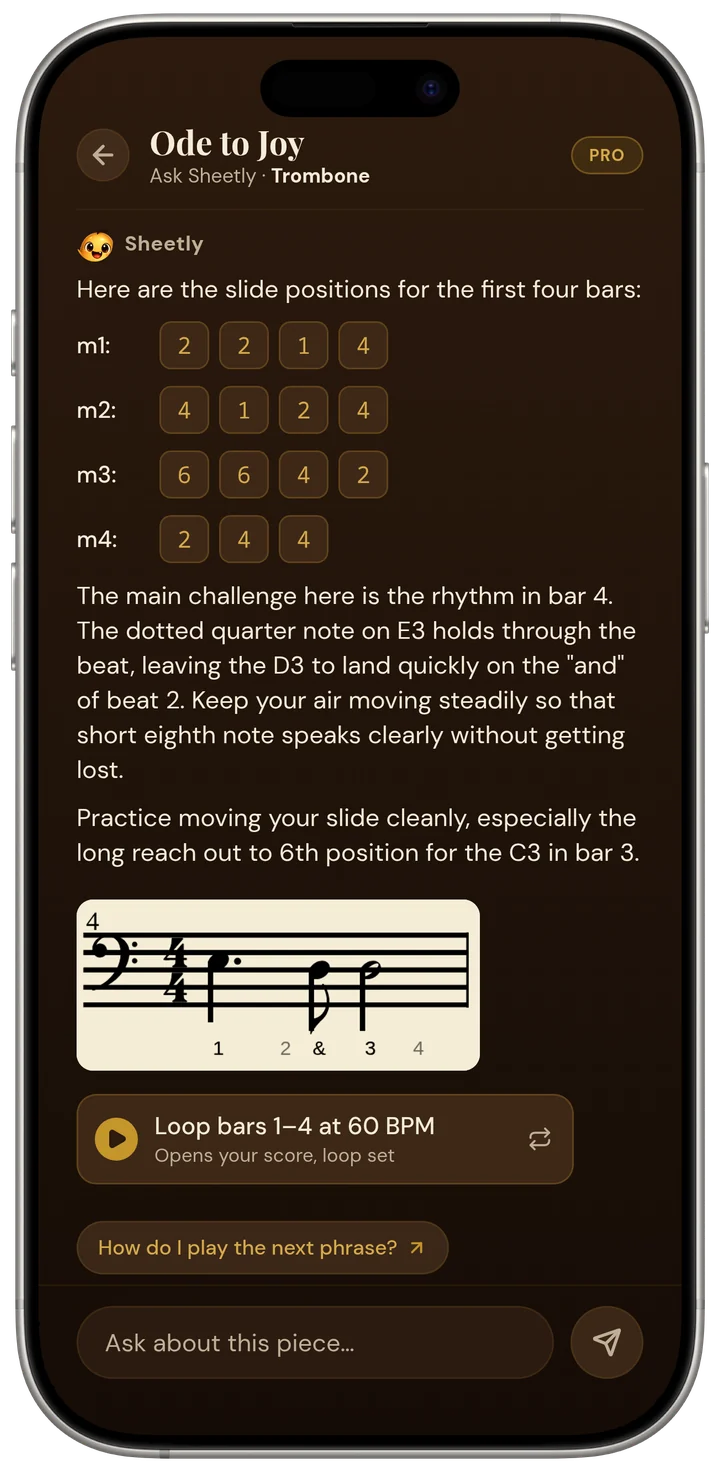
Sheetly is the only iPhone and iPad app we know of where the AI coach has read the actual notes of the page you photographed, so a question about bar 12 gets an answer about your bar 12. Ask what a marking means, how to finger a passage, how a rhythm subdivides, or what to drill tonight. MusPal tells you what went wrong after you played; Sheetly tells you what the page is asking for before you play. Understand the page before you are judged on playing it.
Ask Sheetly: a coach that has read your score
Not a chatbot bolted onto a music app. The coach has the actual notes of the page you just photographed, so you can ask about your bar 12 and get an answer about what is written in it.
The coach reads the page. It does not listen to you play, and we do not claim otherwise.
PDF, MIDI and MusicXML export
Sheetly exports PDF, MIDI and MusicXML with Pro, so the page you photographed can go into MuseScore, Dorico or a DAW. We could not find file export documented in MusPal’s materials.
Price
MusPal’s Gold plan is HK$338 a month or HK$2,888 a year for 25 scans and 25 reports; Platinum is HK$388 a month or HK$3,388 a year. Sheetly is free to download with a Pro subscription. You are paying for different things, but the gap is large enough to matter.
Feature by feature
| Can you… | Sheetly | MusPal |
|---|---|---|
| Photograph a printed page and hear it played | Yes, any instrument | Scans sheet music for violin feedback |
| Change the tempo | Yes | Not documented |
| Loop one difficult bar | Yes | Not documented |
| Record your own take | Yes, to listen back | Yes, for analysis |
| Get feedback on pitch, rhythm, posture | No | Yes |
| Ask what is written in your bar | Yes | Not documented |
| Progress reports, badges, leaderboards | No | Yes |
| Export MusicXML / MIDI / PDF | Yes, with Pro | Not documented |
| Published accuracy benchmark | Yes | Not documented |
| Instruments | Any printed notation | Violin-focused |
| Price | Free download, Pro subscription | Free tier; Gold HK$338/mo; Platinum HK$388/mo |
| Runs on | iPhone, iPad | iOS, Android |
Read the feedback row as what it is: the one thing MusPal does that we do not. If being graded on intonation is the point, the rest of the table does not matter much.
Which one should you get?
Get MusPal if you play violin and want a machine to listen to you and grade intonation, rhythm and posture. Get Sheetly if you want to hear, understand and practise printed music on an iPhone or iPad, on any instrument, with a coach that explains what is on the page, at a fraction of the price.
- You are a violinist who wants intonation graded. MusPal. The listening is the product.
- You play piano, flute, guitar from notation, or anything else. Sheetly. We could not find other instruments documented for MusPal.
- You keep getting a bar wrong and do not know what it is asking for. Sheetly. Ask the coach about that bar.
- You want to hear the piece tonight and loop the hard bars. Sheetly.
- You want a leaderboard and a streak. MusPal.
- You want both. They do not compete for the same slot. Understand the page in Sheetly, then get graded on it in MusPal.
From the music stand to a play button.
Photograph the page, hear it at a tempo you can follow, loop the bars that need work, and ask the coach what is written. Free to download on iPhone and iPad.

Free to download · iPhone and iPad · Android on the way

Questions
Is Sheetly better than MusPal?
Sheetly is better for hearing, understanding and practising printed music on an iPhone or iPad, on any instrument. MusPal is better if you are a violinist who wants a machine to listen to your playing and grade intonation, rhythm and posture. Sheetly does not listen to you play; MusPal does not, as far as its materials show, explain what is written in a bar. Pick by the job.
Does Sheetly listen to you play?
No. Sheetly does not listen to you play and does not grade your pitch, rhythm or posture. Sheetly reads the printed page you photograph, plays it back at any tempo, loops a bar, records your own take so you can hear it against the score, and answers questions about what is written by bar number. If you want automatic performance feedback, MusPal is built for that and Sheetly is not.
Does MusPal work for piano?
MusPal’s own materials centre on violin: its site describes the app as revolutionising violin practice, and the feedback it advertises covers pitch, rhythm and posture. We could not find piano documented as a supported instrument, so we do not claim either way. Sheetly reads printed notation for any instrument, including piano grand staff, and plays it back on piano, violin, organ, flute and other sounds.
Which is cheaper, Sheetly or MusPal?
Sheetly is much cheaper. MusPal prices in Hong Kong dollars: Gold is HK$338 a month or HK$2,888 a year, Platinum is HK$388 a month or HK$3,388 a year, and the free tier allows 3 scans and 3 AI reports a month. Sheetly is free to download, and Pro, which adds PDF, MIDI and MusicXML export, costs US$11.99 a month or US$39.99 a year.
Can MusPal explain what is written in a bar?
We could not find that documented. MusPal’s materials describe feedback on your playing: pitch, rhythm, posture, corrections within a minute, progress reports and lesson notes. Explaining a marking, a rhythm or a fingering from the page itself is what Sheetly’s coach does: Ask Sheetly has read the notes of the scanned score and answers by bar number, without listening to you play.