How to Help Your Child Practice an Instrument (Even If You Don't Read Music)
Wondering how to help your child practice an instrument when you don't read music yourself? In this guide, we share a simple daily routine, five questions you can ask without reading a note, and easy ways to check the notes.

Has your child just started band, orchestra or music lessons, and you are wondering how to help at home? Maybe you never learned to read music yourself, and the page of dots on the music stand looks like a foreign language. You want to support them, but you are not sure whether that squeak was a wrong note, or whether twenty minutes of noodling counts as practice.
Here is the good news: you do not need to read music to help your child practice. The most useful things a parent can do have nothing to do with notes. You can make practice happen at the same time every day, help your child set a small, clear goal for each session, and listen for a few minutes at the end. Those three habits make more difference than anything else.
In this guide, we share how to help your child practice an instrument step by step: setting up a routine, a simple 20-minute session plan, five questions you can ask without reading a note, how to check the notes when you want to, and a few habits to avoid. Each part is short and practical, so you can start tonight.
Set up a routine: same time, short sessions, clear goals
- Same time, every day. Attach practice to something that already happens, like right after school or just before screen time. A fixed daily time beats a long session once a week.
- Short sessions. Many teachers suggest 15 to 20 minutes a day for beginners, growing to 30 minutes or more as children get older. Five focused minutes count for more than thirty distracted ones.
- A place for it. Music stand up, a pencil on the stand, instrument within reach. Less setup means fewer arguments.
- Goals, not minutes. A timer teaches clock-watching. A goal like "play measures 9 to 16 slowly, three times without a mistake" has a finish line, and finishing feels good.
A 20-minute session in four parts
If your child is not sure how to fill their practice time, this simple shape works for most beginners on any instrument.
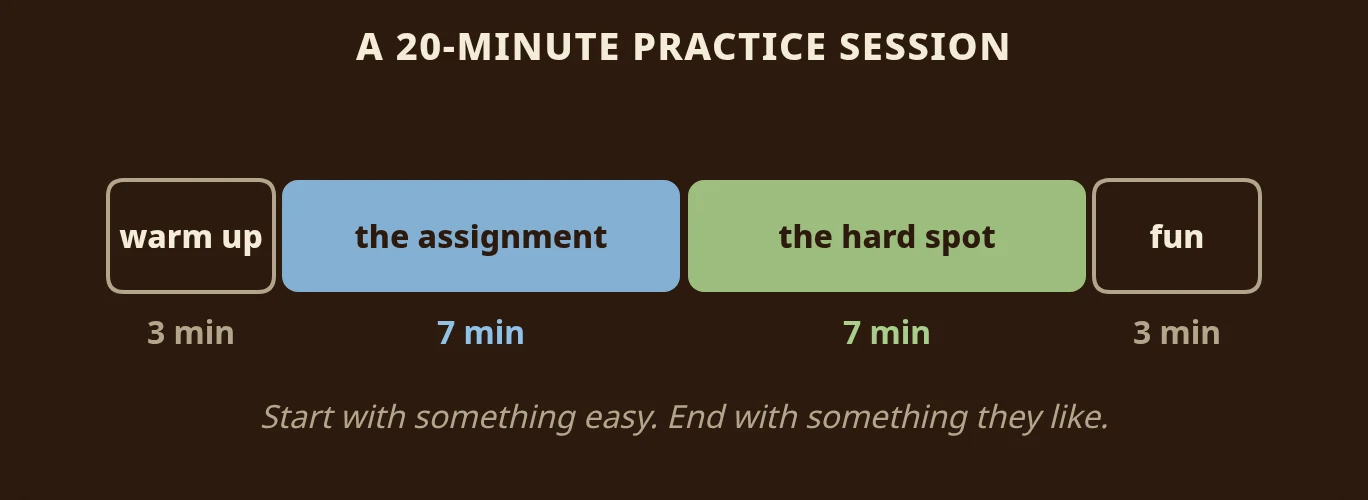
- Warm up (3 minutes). Long tones on a wind or brass instrument (single notes held steadily), a scale, or a five-finger exercise on the piano.
- The assignment (7 minutes). Whatever the teacher or director set this week, from the assignment sheet or practice log.
- The hard spot (7 minutes). The two to four measures that keep going wrong, played slowly until they are right three times in a row.
- Something fun (3 minutes). A favorite piece or a song they chose. Ending on something they enjoy makes tomorrow's practice easier to start.
The hard spot is where real progress happens, and it is also the part children most like to skip. Your gentle reminder, "did you do the hard bit?", is one of the most helpful things you can say.
Five questions you can ask without reading music
You do not need to know what a note is called to ask good questions. These five help your child think about their own practice:
- "What did your teacher ask you to work on this week?"
- "Which measures are the hard ones? Show me where."
- "Can you play just that part slowly for me?"
- "How do you know if that was right?"
- "What sounds better than yesterday?"
How to find a measure without reading a note
Music is divided into measures (also called bars) by thin vertical lines. Most band and orchestra parts print a small number at the start of each line: the number of the first measure on that line. That means you can find measure 12 by counting, without reading any of the notes.
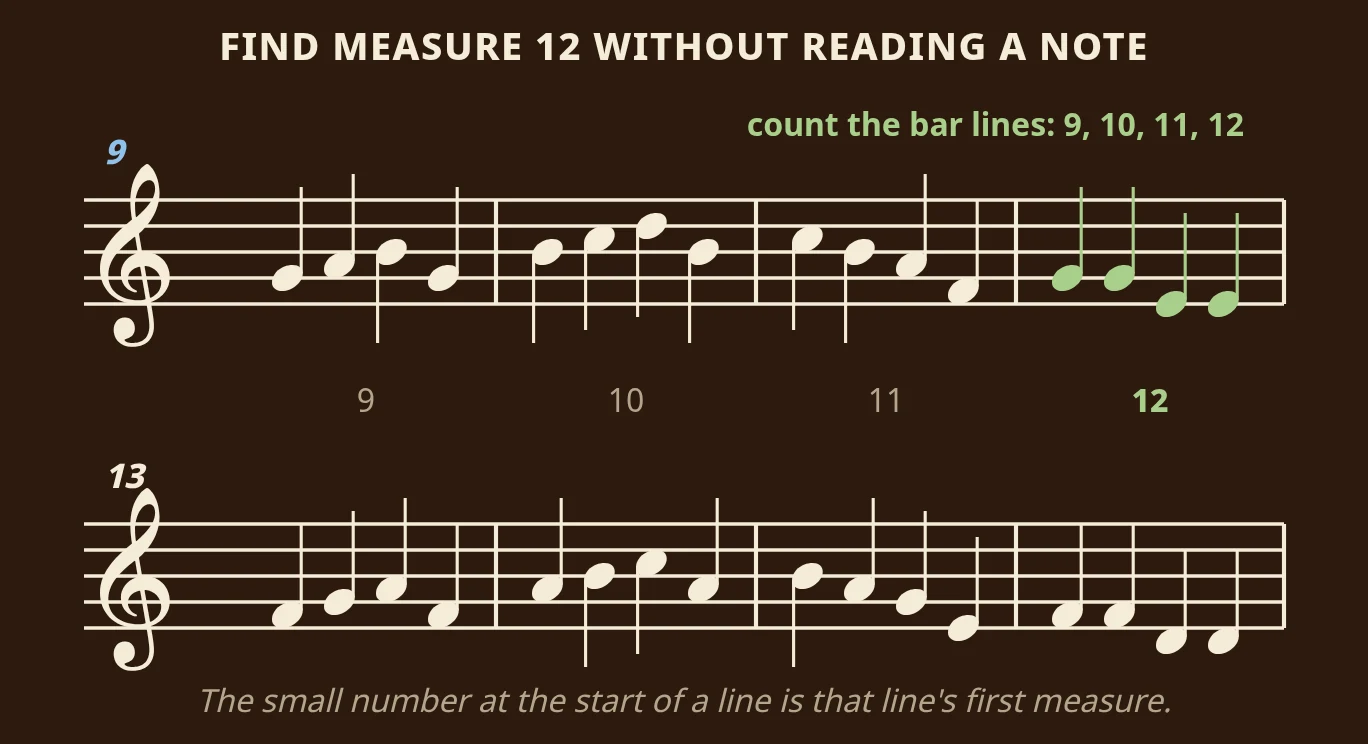
In the picture, the first line starts at measure 9. Count the spaces between the bar lines, 9, 10, 11, and the fourth one is measure 12. Now you can say "let's hear measure 12 again" like a pro.
Ask them to teach you
Ask your child to teach you one thing: the name of a note, what a symbol means, or how to hold the instrument. Explaining something is a quick way to find out whether you really know it, and children usually love being the teacher. If you want to learn alongside them, our guide on how to read sheet music is a friendly place to start.
How to check: the beat by ear, the notes by recording
Even without reading music, you can hear a lot. You can tell whether the beat is steady, whether the music keeps stopping and restarting, and whether it sounds better than last week. Those are exactly the things that matter most for a beginner.
To check the notes themselves, you need to know how the piece should sound. There are three easy ways:
- The method book's recordings. Most band and string method books come with recordings or online play-along tracks.
- A recording of the piece. Search the title and composer. School concert pieces often have publisher recordings online.
- An app that plays the page. Take a photo of the sheet music and the app plays it back.
For band kids who struggle with long rests and come in early, our guide on counting multi-measure rests is worth reading together.
Four habits that backfire
- Correcting notes you are not sure about. A wrong correction is worse than none. Ask "how do you know?" instead.
- Practice as punishment. It teaches that music is a chore.
- Comparisons. Not with siblings, and not with classmates.
- Praising talent instead of work. "That hard part is much smoother than on Monday" is worth far more than "you're so musical".
Hear what the page should sound like
The hardest moment for a parent who does not read music is when your child is stuck and you cannot tell what the problem is. Sheetly is built for exactly that moment.
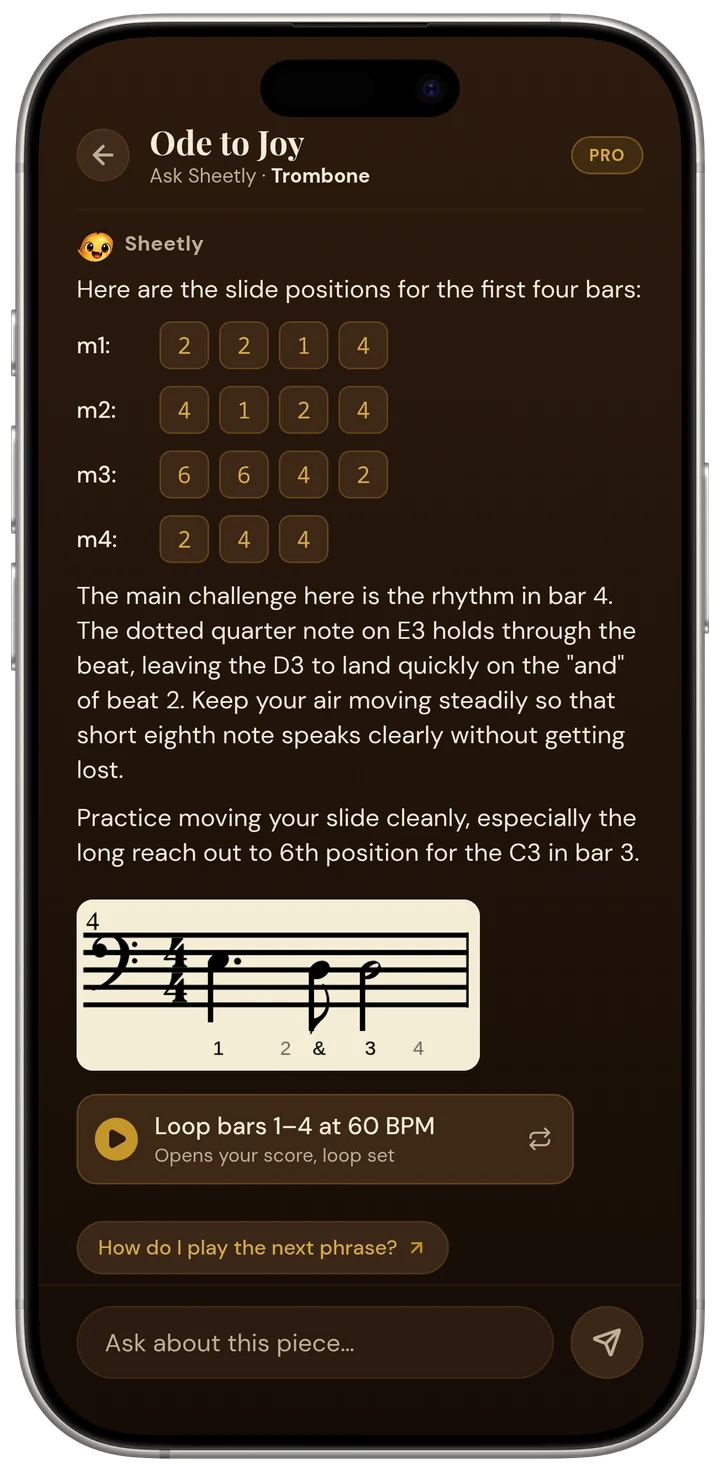
Take a photo of the page your child is stuck on with your iPhone or iPad, press play, and you both hear how measure 12 should sound, with a playhead that follows the notes. Slow it down, loop the hard measures, and let your child play along. Your child can also ask the built-in coach about any measure on the page and get an answer for their instrument: slide positions on trombone, valves on trumpet, the string and finger on violin.
You still do the most important job: making practice happen and listening with interest. Sheetly just fills in the part you could not do before, knowing how the page is meant to sound.
Questions
How long should my child practice each day?
Many teachers suggest 15 to 20 minutes a day for beginners, growing to 30 minutes or more as children get older. A short, focused session every day does more than a long one once a week. Your child's teacher can give the best guide.
Can I help if I don't read music?
Yes. The most helpful things a parent does are making practice happen at a regular time, helping set a clear goal for each session, and listening at the end. You can hear a steady beat and progress without reading a note.
What are long tones?
Long tones are single notes held steadily for several beats. They are a standard warm-up on wind and brass instruments for building an even, steady sound.
What is a five-finger exercise on piano?
A five-finger exercise keeps each finger of one hand over its own key, for example C to G, and plays patterns within those five notes to build evenness and finger independence.