Ask Sheetly About Bar Twelve: How to Get Help With the Exact Bar You Are Stuck On
Stuck on one bar and not sure how to ask for help? In this guide, we show you how to find and name the exact spot, how to ask a question that gets a useful answer, and what happened when someone asked Sheetly about Ode to Joy.

You are practising, everything is going fine, and then you reach the same bar and stop. Maybe you are not sure of a note, maybe the rhythm feels wrong, maybe your fingers simply cannot get there in time. You want to ask someone, but "the tricky bit in the middle" is hard to explain. Asking about bar twelve, by its number, is much easier, and it is exactly what Ask Sheetly is built for.
Good teachers never say "the middle bit". They say "bar twelve, beat two". A bar number and a beat point to one exact spot on the page, so the answer can be about that spot and nothing else. Learning to name the place you are stuck is a small skill, and it makes every question you ask more useful, whether you ask a teacher, a friend in your section or an app.
In this guide, we show you how to find any bar number, how to name the beat, how to ask a clear question, and a real example of a question about Ode to Joy and the answer that came back. There is a picture for each step.
Why bar numbers matter
Ask a general chat assistant how to play the start of Ode to Joy and you will get something reasonable but vague, along the lines of "the melody starts on the third note of the scale, so if you are in C major, start on E". It does not know your edition. It does not know your part is in bass clef, which key the arranger chose, or that you play trombone. It is answering from its memory of a famous tune.
The same is true for a school band arrangement, a photocopied chorale or your own part from a ring binder: the bar you are stuck on is in your copy, not in anybody's memory. So the first step is always the same. Point at the exact bar.
How to ask about the bar you are stuck on
Step 1: Find the bar number
Most printed music has a small number above the start of each line. That is the bar number (or measure number) of the first bar on that line. To find any other bar, find the nearest number before it and count forward.
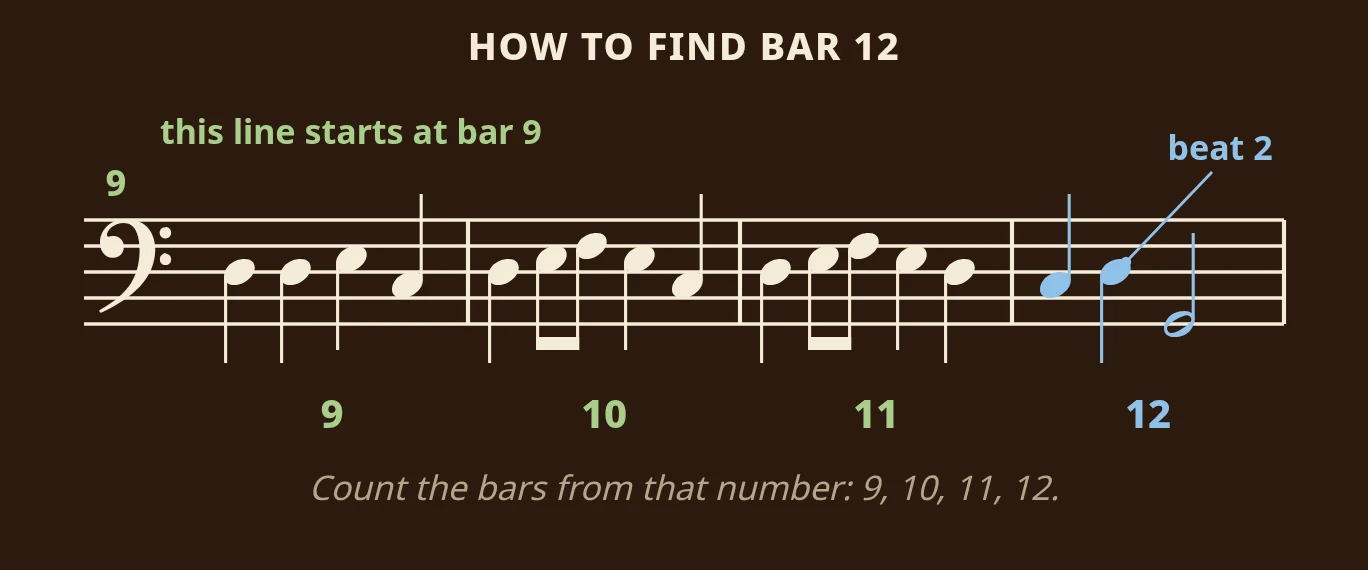
In the example above, the line starts at bar 9. Count each bar line you cross: 9, 10, 11, 12. The bar you are stuck on is the fourth bar of that line.
Some parts, especially band and orchestra parts, also have numbers in boxes every few bars. Those are often bar numbers too, placed at the start of a new section so the conductor can say "from 27". Letters in boxes (A, B, C) are rehearsal marks, not bar numbers, so do not count them.
Watch out for pickup bars and long rests
Two things trip people up when counting. First, if the piece starts with a short incomplete bar (a pickup bar, also called an anacrusis), that bar is usually not counted. Bar 1 is the first full bar. Second, a multi-bar rest, a thick bar with a number above it, counts as that many bars. A rest marked 8 is eight bars, not one.
Step 2: Name the beat
Once you have the bar, count the beats inside it to find the exact note. In 4/4 time there are four beats in each bar. If the note you are stuck on is the second one you would count, it is on beat 2. If it falls between two beats, it is on an "and": "the and of beat 2". Now you can say "bar 12, beat 2", and anyone with the same music will be looking at the same note.
Step 3: Say what goes wrong
A bar number tells someone where to look. What goes wrong tells them what to look for. Try to describe it in one short sentence:
- "I don't know the fingering for the high note in bar 12."
- "I can't tell how to count the rhythm on beat 2."
- "I can't get from the C to the G in time."
- "I run out of breath before the end of bar 12."
Each of those has a different answer, and none of them can be answered from "bar 12 is hard".
Step 4: Ask one question at a time
Ask how to play it, how to count it, or what to practise, but ask one of those at a time. A single clear question gets a single clear answer. When you understand that, ask the next one.
A real question about Ode to Joy
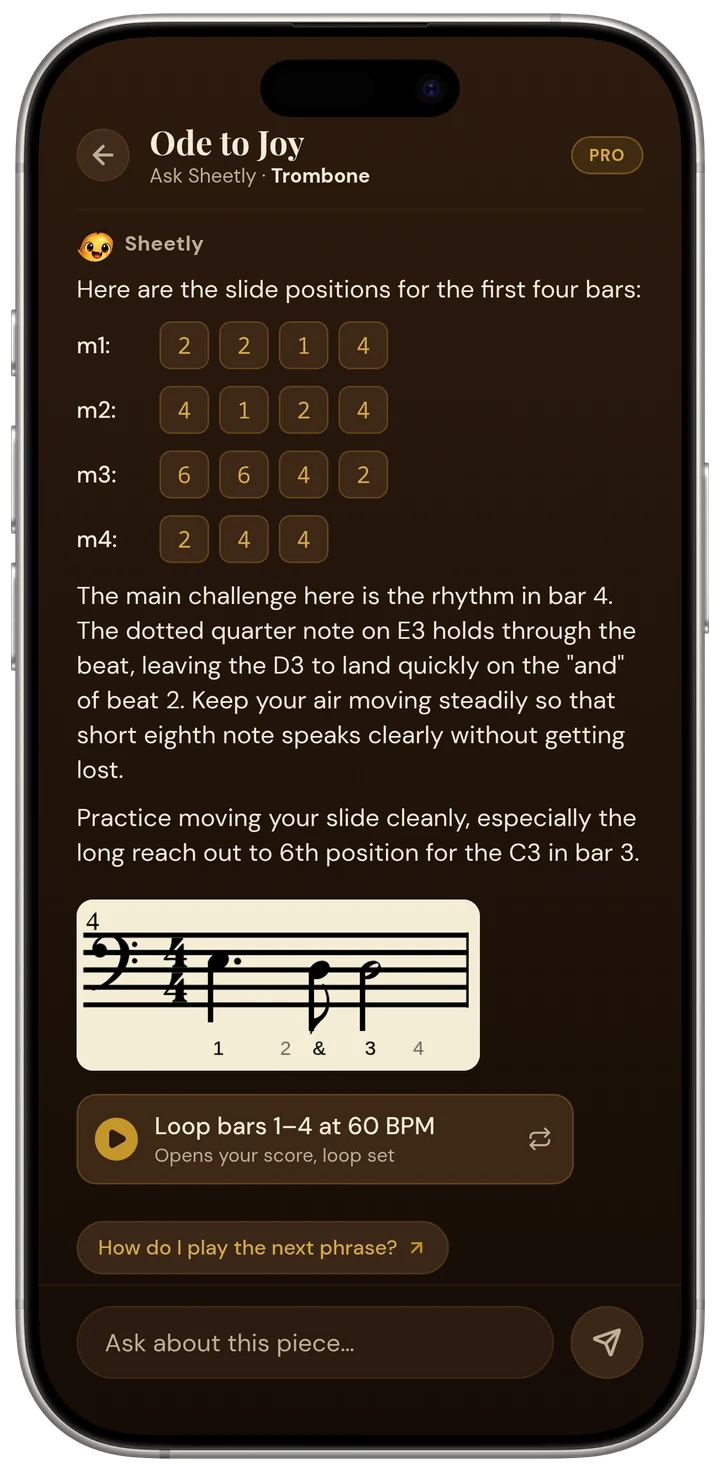
Here is a real exchange. Someone scanned Ode to Joy, a trombone part in bass clef, opened Ask Sheetly and typed: how do I play the first notes in Ode to Joy?
The answer was not a paragraph about Beethoven. It was four rows of numbers, one row per bar, and a line saying that those are the slide positions for the first four bars. A trombone has no keys: you change the note by moving the slide to one of seven slide positions, with 1st position closest to you and 7th furthest away.
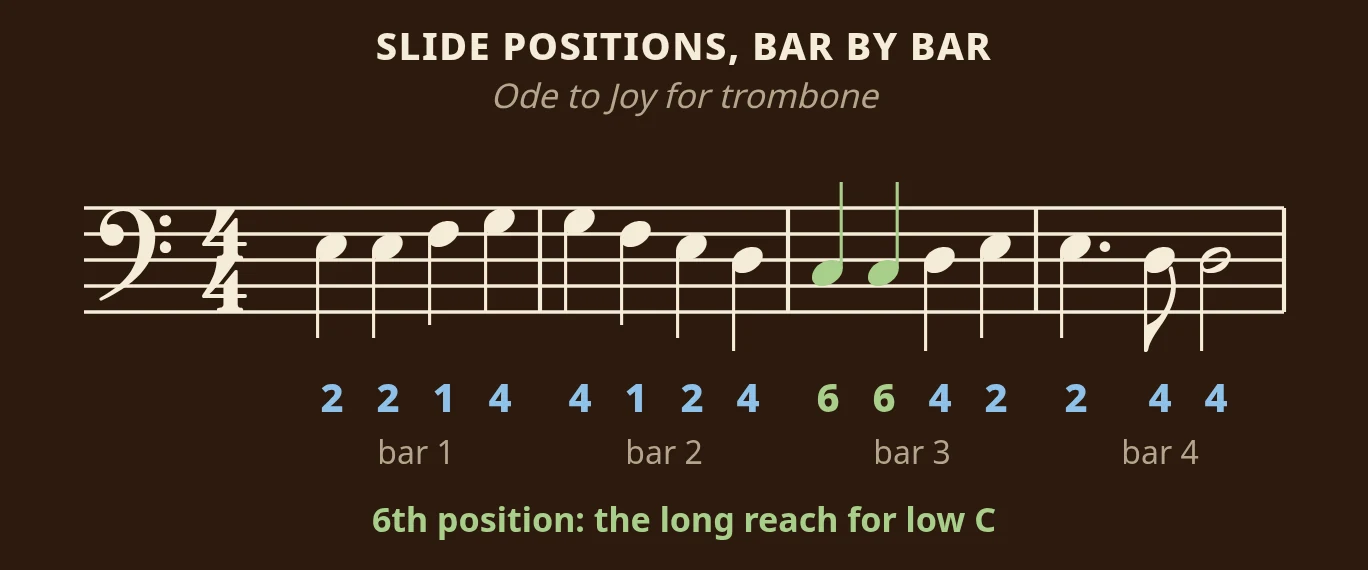
Bar 1 is E, E, F, G, which is positions 2, 2, 1, 4. Bar 3 starts on low C, which is 6th position, a long reach out. And bar 4 has a dotted rhythm: the answer pointed out that the dotted quarter note on E holds through the beat, so the D has to land quickly on the "and" of beat 2. Those details are only right because the coach was reading this particular part. Change the instrument in the player to clarinet and the same notes come back as clarinet advice, because a clarinet does not have a slide.
From the answer to the practice
An answer is only half the job. Under it, Sheetly offered a button to loop bars 1 to 4 at 60 BPM, which opens the score with that loop already set. That is the honest next step: go back to the player, loop the bars, keep the tempo low and play them until they are boring. The coach can tell you where to look. The player is where you do the work. Our guide to looping one bar explains that part.
Ask about your own page
Ask Sheetly answers from the page you scanned. Take a photo of your printed part with your iPhone or iPad, and Sheetly reads the actual notes: the pitches, the rhythms and the bar lines. The coach is given that score, not just its title. So when you ask about bar 12, you get your bar 12, whether the piece is famous or a band arrangement nobody else has heard of. When you open the coach, it even suggests two or three things it noticed in your score, like a big leap in a named bar or a passage that repeats earlier bars.
Questions to the coach need an internet connection. A score you have already scanned plays offline, so you can take the advice into the practice room with you.
Questions
How does the coach know what is in my score?
It is given the notes of the exact page you photographed before it answers. A question about bar 12 is answered from your bar 12, pitches and rhythms included, not from a general description of the piece.
Can I ask about any bar, or only the first ones?
Any bar. Name a bar number or a passage and ask how to play it, how to count it or what to practise. A trombone part gets slide positions; a piano part gets piano answers.
How do I find the bar number if my music has none?
Count from the start. The first full bar is bar 1, so skip a short pickup bar if there is one. Write the number in pencil above the first bar of every line, and you will never have to count from the top again.
What are slide positions?
A trombone changes notes by moving its slide. There are seven positions, from 1st with the slide closed to 7th with it stretched out. Each position, combined with how you buzz, gives a different note.