The short version
forScore is an iPad and iPhone sheet-music reader: a PDF library with annotation tools, built for performers. It displays the page; it does not read the notation into playable notes and has no AI coach. Sheetly photographs your own printed page, turns it into a score that plays, and lets you ask a coach about that score by bar number. A performer with a PDF library should keep forScore. A learner who wants to hear a printed page should try Sheetly.
- Keep forScore if you perform from an iPad and need a fast, reliable PDF library with annotation. Sheetly is not a replacement for that job.
- Try Sheetly if you want a printed page or a PDF to play: at any tempo, looped on the hard bars, with a coach that has read the notes.
- Sheetly is, as far as we know, the only sheet-music app where you photograph your own printed page and then ask an AI coach questions about that score by bar number. It does not listen to you play and it does not replace a teacher.
We make Sheetly. We have not measured forScore and make no claims about it beyond what its own materials describe. Where forScore is the better tool we say so.
Most people who type “forScore alternative” into a search box are not unhappy with forScore. They have discovered that a reader, however polished, answers one question (where is my music?) and not the other (what does this sound like, and how do I play it?). Those are two different products, and this page is about the second.
What forScore is for
forScore is a library and reading tool for performers. Per its own materials it organises PDF scores on an iPad or iPhone and lets you annotate them. It treats the page as an image to be displayed well. It does not read the notation from a photograph into playable notes, and it has no coach that has read your specific page.
That is a sensible scope, and for the people it serves it is close to indispensable. A gigging musician does not want the app to interpret the notes; they want the page on screen instantly, marked up the way they marked it. If that is you, stop reading and keep forScore.
The gap appears when the person holding the iPad is not performing but learning. A learner wants to hear bar 9 before trying it, loop bars 9–12 at half speed, and ask what the fingering should be. A PDF displayed beautifully cannot do any of that, because to a reader the notes are pixels, not pitches.
forScore and Sheetly side by side
The two apps overlap only at the edges. forScore is a PDF library and reader with no notation recognition and no coach; Sheetly reads a photographed or imported page into playable notes, plays it, loops it, records your take and includes a coach that has read the score. Neither app listens to you play. The table shows the split.
| Sheetly | forScore | |
|---|---|---|
| Reads your printed page into playable notes | Yes: photograph or PDF, server-side recognition | No: displays the PDF as an image |
| Plays the score back | Yes, any tempo, loop a bar or passage, piano / organ / flute and more | No |
| Listens to you play | No | No |
| AI coach about your score | Yes, has read the notes; answers by bar number | No |
| Library and PDF reading | A library of your scanned and imported scores | Its core strength: PDF library and annotation for performers |
| Platform | iPhone and iPad; Android on the way | iPad and iPhone, per its own materials |
What Sheetly does with your page
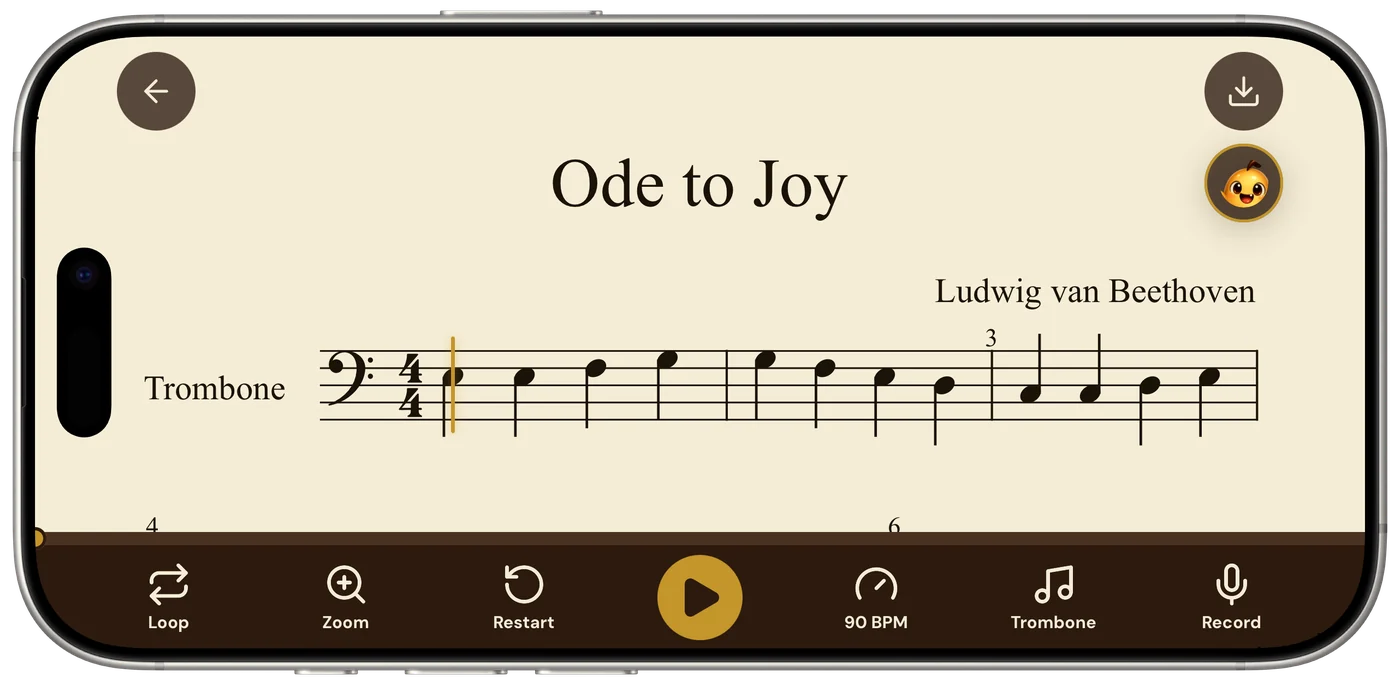
Sheetly photographs a printed page or imports a PDF, reads the notation on a server, and hands back a score that plays. You set any tempo, loop a bar or a passage, choose piano, organ, flute, trumpet or another sound, record your own take against the score, and export PDF, MIDI or MusicXML. The coach has read the actual notes and answers by bar number.
The accuracy behind that is measured. On Sheetly’s own 31-piece benchmark the strict F1 (pitch, onset and duration all correct) was 96% on clean renders and 95% on simulated phone photographs; on the public OLiMPiC suite of 60 systems cut from real scanned pages it was 90% mean, with usable output for all 60. Method on the benchmark page. Closed products were not measured.
Ask Sheetly: a coach that has read your score
Not a chatbot bolted onto a music app. The coach has the actual notes of the page you just photographed, so you can ask about your bar 12 and get an answer about what is written in it.
We know of no other sheet-music app that does this. A reader shows you the page; the coach has read it.
And what it does not do
Sheetly does not listen to you play through the microphone and does not mark your notes right or wrong. It reads printed, engraved notation only: not handwriting, not guitar tab, not shape notes. There is no correction editor; a misread note means a better photograph and a rescan. It needs a connection to scan and to ask the coach; scanned scores play back offline.
Which one should you use?
Keep forScore if you perform from an iPad and your music already lives in it as PDFs; it is the right tool and Sheetly does not replace it. Use Sheetly if you are learning a piece from a printed page and want to hear it, loop the hard bars, record yourself and ask a coach what is written there. Many people will sensibly use both.
- Performer with a PDF library. forScore. Nothing on this page changes that.
- Learner with a printed page, wanting to hear it. Sheetly.
- You want to be told whether you played the right notes. Neither; look at a lesson app that listens through the mic.
- You want to ask a question about this bar. Sheetly.
Photograph the page. Hear it. Ask about it.
Scan the printed page you are working on, play it at your tempo, loop the bars that need work, and ask the coach what to drill. Free to download on iPhone and iPad.

Free to download · iPhone and iPad · Android on the way

Questions
Can Sheetly replace forScore?
For a performer’s PDF library, no. forScore is built to organise, annotate and display PDF scores on stage, and Sheetly does not try to do that job. Sheetly replaces forScore only for the learner who wanted the page to play rather than display.
Does forScore play the music on the page?
Not as far as its own materials describe. forScore displays PDF pages and lets you annotate them; it does not read the notation from the page into playable notes. Sheetly reads a photographed or imported page into a score that plays at any tempo.
Can I use forScore and Sheetly together?
Yes. Keep your performing library in forScore and use Sheetly for the piece you are learning: photograph the printed page, loop the hard bars, record a take and ask the coach by bar number. Sheetly also exports PDF, MIDI and MusicXML.
Is Sheetly free like a basic reader?
Sheetly is free to download on iPhone and iPad, with a Pro subscription for the features a learner uses daily. Sheetly needs a connection to scan a page and to ask the coach; scores already scanned play back offline.